

During army chief’s US visit, Islamabad and Washington agree to improve ties through trade, investment

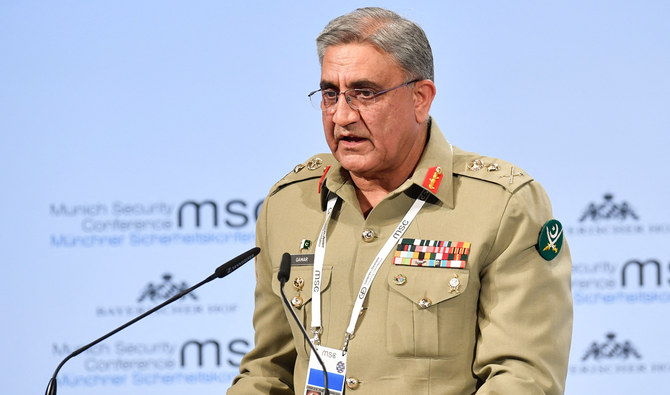
Pakistan's Chief of Army Staff Qamar Javed Bajwa gives his speech on day two of the 54th Munich Security Conference (MSC) in Munich, southern Germany, on February 17, 2018. (AFP/File)
Short Url
Updated 05 October 2022
Follow

During army chief’s US visit, Islamabad and Washington agree to improve ties through trade, investment

  • General Qamar Javed Bajwa is in US on a week-long visit to discuss bilateral ties and regional security
  • Washington has over the years worked closely with Pakistani army chiefs alongside civilian governments

ISLAMABAD: Pakistan army chief General Qamar Javed Bajwa met top US military and security officials during a week-long visit to Washington, with both sides agreeing on the need to boost bilateral ties by improving economic cooperation, trade and investment.

Washington has over the years worked closely with Pakistani army chiefs alongside civilian governments.

On Tuesday, Gen Bajwa called on US defense secretary General Lloyd James Austin III (Retired), national security adviser Jacob Jeremiah Sullivan, and deputy secretary of state Wendy Ruth Sherman.

“Both sides agreed that Pakistan-US have long history of bilateral cooperation and shall continue improving through economic ties, trade and investment,” the Pakistan army’s media wing said in a statement.

“Both sides had convergence on major international issues including Afghanistan and need for cooperation to avoid humanitarian crisis and improving peace and stability in the region.”

The army chief thanked the US for its assistance in the aftermath of recent floods and condoled over death and devastation in a hurricane in Florida.

Last month, Pentagon announced the US State Department had approved the potential sale of F-16 aircraft sustainment and related equipment to Pakistan in a deal valued at up to $450 million. The State Department subsequently said the equipment would sustain Pakistan’s “capability to meet current and future counterterrorism threats.”

The US-built F-16 aircraft are a critical part of the military arsenal of Pakistan, whose arch-rival India worries that the fleet could be used against it by its neighbor.

Officially for years allies in fighting terrorism, Pakistan and the United States have had a complicated relationship, bound by Washington’s dependence on Pakistan to supply its troops in Afghanistan but plagued by accusations Islamabad was playing a double game.

Tensions grew that militants that targetted American troops in Afghanistan were long allowed to shelter on Pakistani soil. Islamabad denies this.


Pakistan eyes enhancing mines, minerals cooperation with Saudi Arabia at Future Minerals Forum 2026

Updated 5 sec ago
Follow

Pakistan eyes enhancing mines, minerals cooperation with Saudi Arabia at Future Minerals Forum 2026

  • Pakistan’s Petroleum Minister Ali Pervaiz Malik meets Saudi Minister of Industry and Mineral Resources Bandar Ibrahim Alkhorayef in Riyadh
  • Saudi minister offers to support Pakistan’s mining industry via Kingdom’s knowledge and expertise, says Pakistan’s petroleum ministry

ISLAMABAD: Pakistan’s Petroleum Minister Ali Pervaiz Malik met Saudi Arabia’s minister of industry and mineral resources at the Future Minerals Forum (FMF) in Riyadh on Monday, the Pakistani petroleum ministry said, during which both sides agreed to strengthen cooperation in the mines and minerals sector. 

Malik is leading the Pakistani delegation at the FMF 2026 summit in Riyadh. The Jan. 13-15 event is expected to attract around 20,000 representatives from governments, businesses, multilateral and non-governmental organizations, academic institutions and trade associations from more than 160 countries, organizers said. At least 13 public and private companies from Pakistan’s mines and mineral sector are participating in the event. 

“The minister held a meeting with Saudi Minister of Industry and Mineral Resources Bandar Ibrahim Alkhorayef, during which both sides agreed to further strengthen bilateral cooperation in the minerals and mining sector,” the Pakistani petroleum ministry said in a statement. 

The ministry said Alkhorayef pointed out “vast opportunities” for cooperation between Pakistan and Saudi Arabia in the mineral sector, adding that the Kingdom would support the development of Pakistan’s mining industry through its knowledge and technical expertise. 

Malik said fertilizer production and medical devices manufacturing sectors also present important opportunities for joint ventures between Pakistan and Saudi Arabia.

In recent years, Saudi Arabia has positioned itself as a leader in the global minerals and energy sectors and accelerated investments in green technologies, sustainable mining practices and international collaborations that are shaping the future of the mines and mineral industry.

Pakistan organized a minerals summit in April 2025 which saw participation from major international companies including the Canada-based Barrick Gold and officials from the US, Saudi Arabia, China, Türkiye, UK, Azerbaijan and other nations. 

Islamabad also plans to organize a Pakistan Mineral Investment Forum this year to attract foreign investment in its mines and minerals sector. Pakistan lies in the middle of the mineral-rich geological zone, called the ‘Tethyan Belt,’ where one of the world’s largest copper-gold mines is currently under development at Reko Diq. 

This mine is expected to start production by 2028.