

In a first, Pakistani literary academy publishes Urdu translations of Saudi short stories

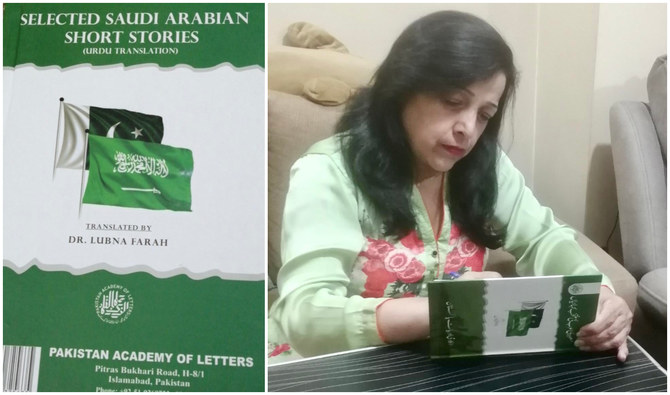
Dr. Lubna Farah is seen reading the book of Saudi short stories, which she translated into Urdu, at her home in Islamabad, Pakistan, on October 3, 2022. (Photo courtesy: Dr. Lubna Farah)
Short Url
Updated 03 October 2022
Follow

In a first, Pakistani literary academy publishes Urdu translations of Saudi short stories

  • ‘Selected Saudi Arabian Short Stories’ aims to acquaint Pakistani readers with Saudi culture, literature, and fiction
  • Book published to commemorate the completion of 75 years of diplomatic ties between Islamabad and Riyadh

ISLAMABAD: To commemorate the completion of 75 years of diplomatic ties between Islamabad and Riyadh, the Pakistan Academy of Letters (PAL) has published a book of Urdu translations of Saudi short stories to “promote literary and cultural ties” between the two countries, the chairman of the body said on Monday.

Islamabad and Riyadh have close diplomatic, military, and economic ties. More than 2.5 million Pakistanis live and work in Saudi Arabia, which is one of the largest sources of remittances to the South Asian nation.

“The book published under the title ‘Selected Saudi Arabian Short Stories’ will help strengthen literary linkages between the two countries and acquaint Pakistani readers with Saudi culture, literature, and fiction,” PAL chairman Dr. Muhammad Yousuf Khushk told Arab News.

He said it was “a matter of great pride” for the academy to put out the work on the occasion of 75 years of the establishment of bilateral relations.

“It is the first time that Saudi literature is translated into Urdu for the Pakistani public," Khushk said. "This book showcases the work of 17 key Saudi writers, most of whom belong to the 20th century and enjoy great respect among Saudi fiction.”


The photos, taken on October 03, 2022 in Islamabad, shows the cover of a book of Urdu translation of Saudi short stories. (Courtesy: Dr. Lubna Farah)

The anthology, which includes an introduction as well as a detailed analysis of each story, will “soon be available for the public in all major libraries across Pakistan,” he added, saying PAL had borne all costs of publishing the book. 

Dr. Lubna Farah, who translated the short stories, said the aim of the book was to improve cultural knowledge among Pakistanis about the daily lives of Saudis.

“Unfortunately, no one in Pakistan has access to Saudi literature due to language and other barriers,” she told Arab News.

“We decided to present it [book] as a gift of 75 years of Pakistan-Saudi Arabia relations and I worked for six months on the project to connect with Saudi writers to get permission to translate their stories as it was a matter of copyrights,” she added.

The effort to connect with Saudi writers succeeded with the help of Dr. Khalid Al-Youssef, an official at the Saudi northern literary club, Farah said.

“The 17 selected stories are related to Saudi culture and depict their daily life," she added, "They are written by both male and female writers.”

Farah said the book was the first of its kind.

“It has never been done before,” she said. 

“Neither Pakistani literature was translated in Arabic for Saudi people, nor their [literary] writings were translated in Urdu for the Pakistani public.”


Pakistan finance chief calls for stronger emerging market voice during Saudi conference

Updated 12 February 2026
Follow

Pakistan finance chief calls for stronger emerging market voice during Saudi conference

  • Aurangzeb tells Saudi state media developing economies must assume larger global role
  • Minister says AlUla conference can strengthen coordination among emerging economies

KARACHI: Pakistan’s Finance Minister Muhammad Aurangzeb on Thursday called for developing economies to play a greater role in shaping global economic governance in an interview on the sidelines of the AlUla Conference for Emerging Market Economies in Saudi Arabia.

The conference, hosted by the Kingdom’s Finance Ministry, brings together top government functionaries, central bank governors and policymakers from emerging markets to discuss debt sustainability, macroeconomic coordination and structural reforms amid global economic uncertainty.

In a conversation with the Saudi Press Agency, Aurangzeb described the conference as a timely platform for dialogue at a moment of heightened geopolitical tensions, trade fragmentation and rapid technological change, including advances in artificial intelligence.

“It is not merely about discussions but about translating deliberations into concrete policy actions and execution over the course of the year,” he said, according to a statement circulated by the Finance Division in Islamabad.

The minister said emerging markets’ growing share of global output and growth should be matched by greater influence in international decision-making.

He noted these economies must strengthen collective dialogue and coordinated policy responses to address shared challenges, adding that the global landscape had evolved significantly since the inaugural edition of the conference.

Aurangzeb expressed confidence that the outcomes of the AlUla Conference would contribute to strengthening coordination among emerging economies and reinforcing their collective voice in shaping a more inclusive and resilient global economic order, the statement added.