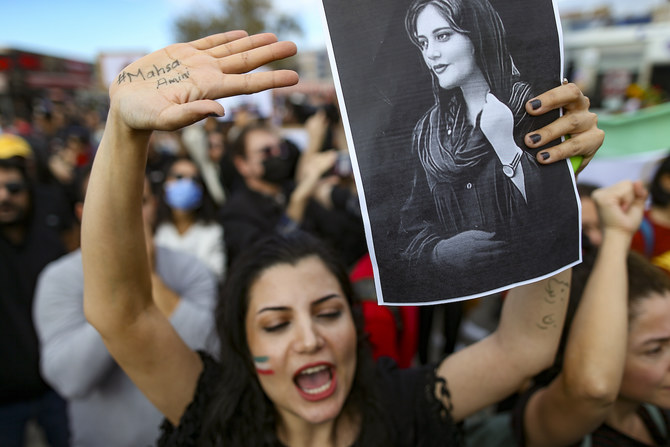
WASHINGTON: Canada imposed fresh sanctions on Iran on Monday for alleged human rights violations, including the death of Mahsa Amini, a 22-year-old from Iranian Kurd who died while in custody of Iran’s “morality police,” the Canadian government said.
“These sanctions are in response to gross human rights violations that have been committed in Iran, including its systematic persecution of women and in particular, the egregious actions committed by Iran’s so-called ‘Morality Police,’ which led to the death of Mahsa Amini while under their custody,” the Canadian government said in a statement.
These new measures built on Canada’s existing sanctions against Iran and listed 25 individuals and 9 entities, including officials in Iran’s Islamic Revolutionary Guard Corps (IRGC) and its ministry of intelligence and security, the Canadian government said.
Iran’s state-run Press TV and its ‘Morality Police,’ which enforce the Islamic Republic’s strict dress code, were also sanctioned by Canada.
Amini was arrested on Sept. 13 in Tehran for “unsuitable attire” by the morality police. She died three days later in hospital after falling into a coma.
Amini’s family says she was beaten to death in custody. Iran’s police authorities deny those allegations and say Amini died of a heart attack.
Her death sparked huge protests in Iran and by Iranians in other parts of the world. The unrest has spiraled into the biggest show of opposition to Iran’s authorities in years.
Prior to Monday’s measures, Canada had imposed sanctions on a total of 41 Iranian individuals and 161 Iranian entities, the Canadian government said.
In 2012, Canada designated Iran as a “supporter of terrorism.”


Canada imposes fresh sanctions on Iran citing death of Mahsa Amini
https://arab.news/8zanh
Canada imposes fresh sanctions on Iran citing death of Mahsa Amini

- These new measures built on Canada’s existing sanctions against Iran and listed 25 individuals and 9 entities
- Iran’s state-run Press TV and its ‘Morality Police,’ which enforce the Islamic Republic’s strict dress code, were also sanctioned by Canada


Turkiye ‘deeply disturbed’ over Israel-US strikes, Iran attacks on Gulf
- “We are deeply disturbed over the US-Israel attacks on our neighbor Iran,” Erdogan said
- “In order to prevent our region from experiencing greater suffering, all actors, especially the Islamic world, must take action“
ISTANBUL: Turkish President Recep Tayyip Erdogan said Saturday he was “deeply disturbed” by the Israeli-US attacks on Iran, but also condemned Tehran’s retaliatory strikes on the Gulf, demanding action to end the conflict.
The confrontation began earlier on Saturday with the Israeli and US strikes and quickly broadened regionally as Tehran retaliated against Gulf states and Israel.
“We are deeply disturbed over the US-Israel attacks on our neighbor Iran,” Erdogan said in a televised address, in which he also denounced Iran’s drone and missile attacks against the Gulf as “unacceptable, regardless of the reason.”
“In order to prevent our region from experiencing greater suffering, all actors, especially the Islamic world, must take action,” he added.
Turkiye had “worked hard for a long time to resolve the conflicts at the negotiating table... but the trust deficit between the parties could not be overcome,” he said, vowing to “accelerate Turkiye’s diplomatic efforts” to bring the parties back to the table.
Earlier Saturday, Foreign Minister Hakan Fidan spoke by phone with his Iranian counterpart Abbas Araghchi and six other top diplomats about ways to “end the attacks,” a foreign ministry source said.
Erdogan also said Turkiye had not seen any problem “in terms of border security” along the 500-kilometer (300-mile) frontier it shares with Iran.
“The police, gendarmerie and intelligence services are taking all necessary measures,” he said.
Earlier, Turkiye’s Interior Minister Mustafa Ciftci also held calls with his Azerbaijani counterpart Vilayet Eyvazov and Iraq’s Interior Minister Abdul?Amir al?Shammari on “strengthening areas of cooperation,” the ministry wrote on X.
All three countries share a border with Iran.
Iran’s neighbors have long feared that a new round of strikes on the country could destabilize the entire region, with concerns focused on a possible influx of refugees.
Turkiye currently hosts more than 74,000 Iranians with residence permits and some 5,000 refugees.


