

5.7 million Pakistani flood victims to face food crisis — UN

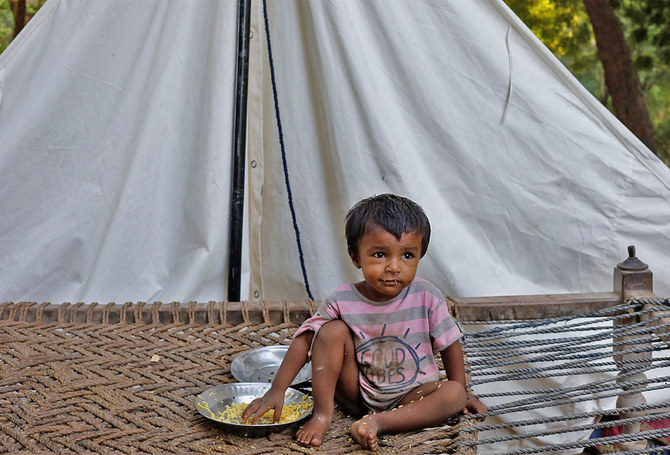
A boy, who's family displaced because of the floods, eats boiled rice while sitting outside his family tent while taking refuge in a camp, in Sehwan, Pakistan, on September 30, 2022. (REUTERS)
Short Url
Updated 03 October 2022
Follow

5.7 million Pakistani flood victims to face food crisis — UN

  • Even before floods, WHO says, 16 percent of Pakistanis were living in moderate or severe food insecurity
  • Islamabad insists that there is no immediate worry about food supplies as wheat stocks are enough

ISLAMABAD: The United Nations humanitarian agency is warning that about 5.7 million Pakistani flood survivors will face a serious food crisis in the next three months, as the death toll from the deluge rose on Monday. 

Pakistan’s National Disaster Management Authority reported that floods fueled by abnormally heavy monsoon rains have killed 1,695 people, affected 33 million, damaged more than 2 million homes and displaced hundreds of thousands now living in tents or makeshift homes. 

The UN Office for the Coordination of Humanitarian Affairs in its latest report Saturday said the current floods are expected to exacerbate food insecurity in Pakistan and said 5.7 million people in flood-affected areas will be facing a food crisis between September and November. 

Even before the floods, according to the World Health Organization, 16 percent of the population was living in moderate or severe food insecurity. 

However, Pakistan’s government insists that there is no immediate worry about food supplies, as wheat stocks are enough to last through the next harvest and that the government is importing more. 

The UN agency said in a tweet on Monday that the agency and other partners have scaled up their flood response and delivered aid to 1.6 million people directly affected by the deluges. 

OCHA said outbreaks of waterborne and other diseases are on the rise in Sindh and southwestern Baluchistan provinces, where floods have caused the most damage since mid-June. 

Several countries and UN agencies have sent more than 131 flights carrying aid for survivors, but many are complaining they have either received too little help or are still waiting for it. 

The UN humanitarian agency also said in its Saturday report that rainfall in Baluchistan and Sindh lightened substantially over the past week, as temperatures start to decrease ahead of winter. 

“Normal conditions are prevailing in most districts of Baluchistan, while in Sindh, the Indus River is flowing normally,” said OCHA. Overall, it added, in 18 out of 22 districts of Sindh, floodwater levels had receded at least 34 percent, and in some districts up to 78 percent. 
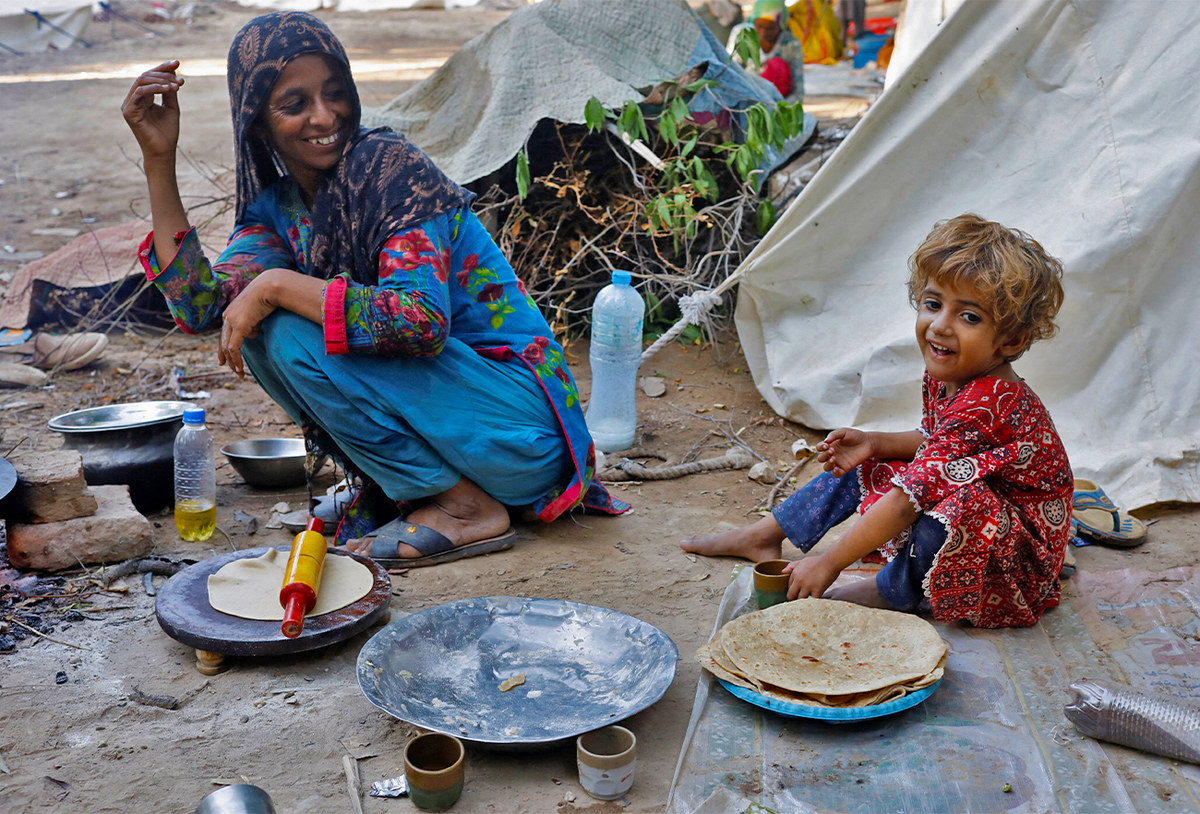


A woman displaced because of the floods reacts to her daughter as she prepares flat breads outside her tent while taking refuge in a camp, in Sehwan, Pakistan, on September 30, 2022. (REUTERS)

The OCHA report also highlighted the ordeal of flood survivors, saying many continue to live in “unsanitary conditions in temporary shelters, often with limited access to basic services, compounding the risk of a major public health crisis.” 

It said pregnant women are being treated in temporary camps when possible, and nearly 130,000 pregnant women need urgent health services. 

“Already before the floods, Pakistan had one of the highest maternal mortality rates in Asia, with the situation likely to deteriorate,” it said. 

The UN is due to issue a revised appeal seeking an additional $800 million from the international community to respond to the soaring life-saving needs of Pakistani flood survivors. The UN said last week that “food is being delivered to vulnerable families; however, it is still not enough to meet the nutrition needs of the people.” 

Pakistan says floods caused about $30 billion of damage to its economy. 

Floods washed away thousands of kilometers of roads, destroyed 440 bridges, and disrupted railroad traffic. 

Pakistan Railways said it has started restoring train service from Sindh to other cities after repairing some of the tracks damaged by floods. 


Pakistan kills 11 militants in separate operations in western provinces

Updated 27 December 2025
Follow

Pakistan kills 11 militants in separate operations in western provinces

  • Military says five Baloch separatist fighters were killed in an intelligence-based operation in Kohlu district
  • Police say six Pakistani Taliban died in Lakki Marwat during a joint operation after drone attacks on homes

ISLAMABAD/PESHAWAR: Pakistani security forces and police killed at least 11 militants in separate counterterrorism operations in the country’s western provinces of Balochistan and Khyber Pakhtunkhwa, authorities said on Friday, highlighting the distinct insurgencies confronting the country along its border with Afghanistan.

In southwestern Balochistan, the military said it killed separatist militants in an intelligence-based operation in Kohlu District on Dec. 25, while police in the northwestern district of Lakki Marwat fought and killed the Pakistani Taliban.

Pakistan’s military said the Balochistan operation targeted fighters it identified as part of “Fitna al Hindustan,” a term authorities use for Baloch separatist outfits, including the Balochistan Liberation Army (BLA), which have waged a decades-long insurgency in the resource-rich province.

“During the conduct of operation, own forces effectively engaged the terrorists’ location, and after an intense fire exchange, five Indian sponsored terrorists were sent to hell,” the military’s media wing, Inter-Services Public Relations (ISPR), said in a statement, adding that weapons and explosives were recovered and follow-up clearance operations were underway.

In Lakki Marwat, police said counterterrorism units and local peace committees launched a coordinated operation against militants they described as “khwarij,” a term the Pakistani state uses for factions aligned with the Tehreek-e-Taliban Pakistan (TTP), an umbrella group of militants that primarily operates in Khyber Pakhtunkhwa.

According to police, six militants were killed and several others wounded during the operation, after authorities said militants had used drone-mounted devices to target residential homes, injuring civilians.

“Protection of life and property of the public is the police’s top priority, and strict, indiscriminate action against khwarij and other anti-peace elements will continue,” Bannu Region Deputy Inspector General Sajjad Khan said in a statement released by the regional police office.

The two operations highlight Pakistan’s parallel security challenges in its western regions.

In Balochistan, separatist groups accuse the federal government and military of marginalizing ethnic Baloch communities and denying them a fair share of the province’s mineral wealth, allegations Islamabad denies.

In Khyber Pakhtunkhwa, the TTP has intensified attacks on security forces and civilians since the Afghan Taliban’s return to power in Kabul in 2021.

Pakistan has repeatedly said these militant groups operating in both provinces receive backing from India and find shelter in Afghanistan, claims denied by New Delhi and Kabul.

Pakistani authorities said counterterrorism operations will continue nationwide under a campaign approved by the federal government to curb militancy and restore security.