

In Pakistan's north, RCC overpasses replace hanging bridges to reduce travel time, locals' woes

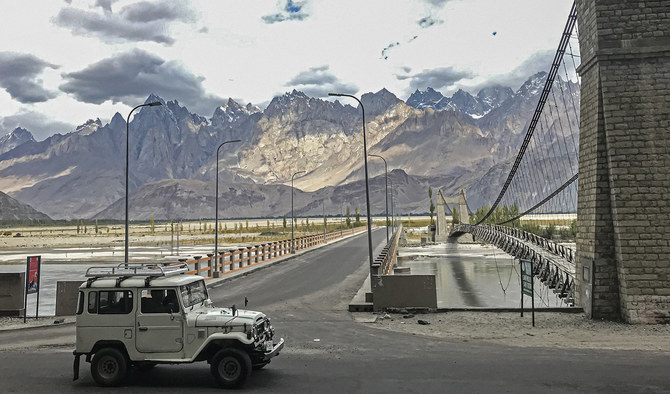
A view of the newly-constructed Saling RCC bridge located in Ghanche district of Gilgit-Baltistan, Pakistan on September 27, 2022. (AN photo)
Short Url
Updated 03 October 2022
Follow

In Pakistan's north, RCC overpasses replace hanging bridges to reduce travel time, locals' woes

  • Locals had to wait for hours to cross cantilever bridges in Gilgit-Baltistan, that too with not enough weight
  • Official says 22 of 63 bridges in Ghanche have been converted into RCC that has increased tourist influx too

KHAPLU: Suspension bridges are disappearing fast and being converted into reinforced cement concrete (RCC) overpasses in Pakistan’s northern Gilgit-Baltistan region, with locals saying the conversion has reduced travel time and resolved a number of issues faced by them over the years.

Pakistan’s mountainous Gilgit-Baltistan, an impoverished part of the larger Kashmir region, is the South Asian country’s gateway to China and home to a key artery of the multibillion-dollar China-Pakistan Economic Corridor (CPEC).

The mountainous region, bordering Afghanistan and China, comprises valleys, glacial lakes and is home to five out of the world’s 14 mountain peaks above 8,000 meters. For years, the only means to cross rivers in the region had been rafts, called ‘Zakh’ in the local language, but then locals built a cantilever bridge in the Frano village of Chorbat valley in the late 1930s.
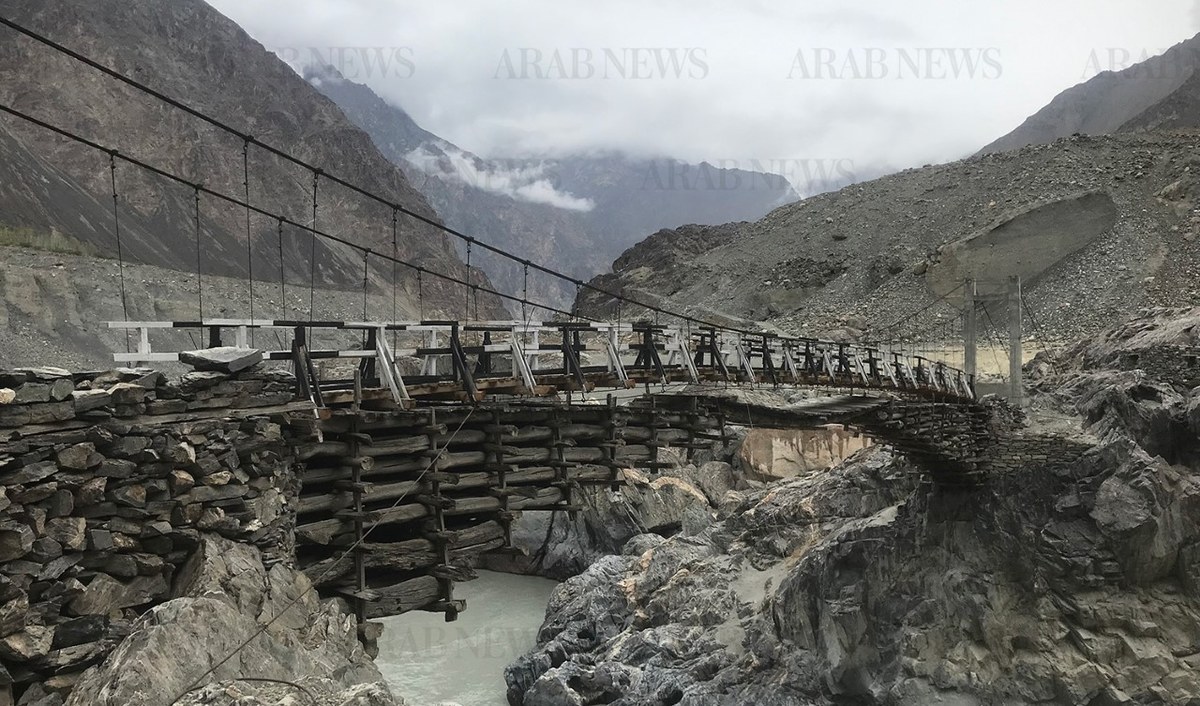


This picture taken on September 25, 2022 shows Apo Ali Shah bridge, built in 1930s, in Frano village of Gilgit-Baltistan, Pakistan. (AN photo)

It is believed to be the first ever cantilever bridge in the Baltistan region which was built using poplar trees, under the supervision of a farmer, Apo Ali Shah, according to Hajji Muhammad Iqbal, a local historian and former provincial lawmaker. The bridge was also named after Shah.

“The construction of Apo Ali Shah bridge started in 1936 and culminated in 1940. The local farmer built this bridge according to his own architecture and without using a single nail. Till 1970, no other bridge had been built in the district and it was used to reach different valleys,” Zakawat Ali, an executive engineer at Public Works Department in Ghanche district, told Arab News last week.

“It was feasible only for light traffic and limited weight. Now RCC bridges are for all kinds of traffic and people belonging to all walks of life benefit from these bridges.”
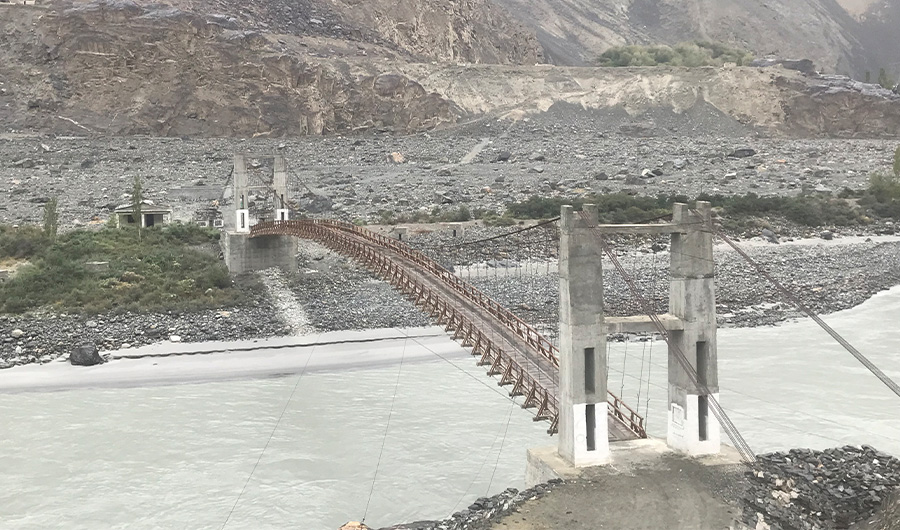


A view of Siari suspension bridge located in Siari village of Gilgit-Baltistan, Pakistan on September 25, 2022. (AN photo). 

Ali said there were 63 suspension bridges in Ghanche, but 22 of them have been converted into RCC overpasses over the years. Conversion of four more suspension bridges is underway in the district, he added.

Fida Hussain, a resident of Saling valley of Ghanche, said the inauguration of Saling RCC overpass in 2020 had gotten them out of misery.

“A loaded truck can now enter our village which was not possible earlier,” Hussain told Arab News. “Tourist influx into Saling valley and the value of lands have increased as well.”
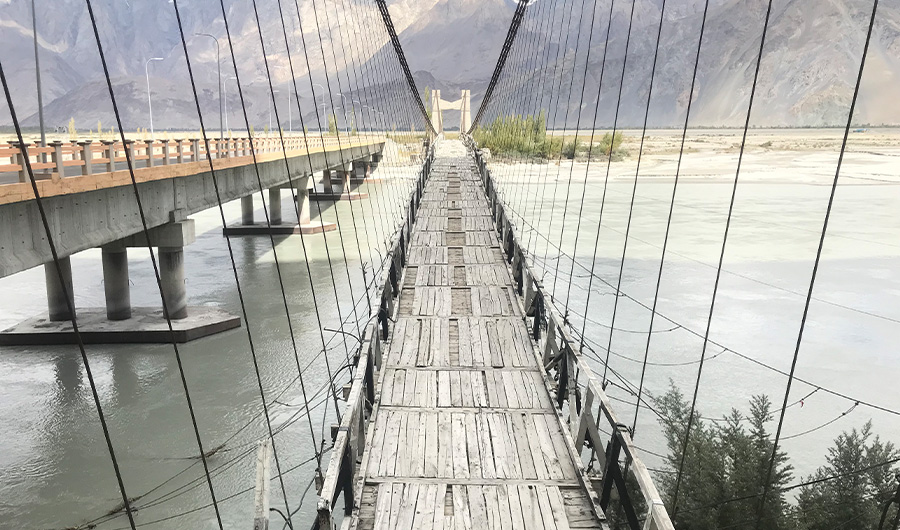


A view of a suspension bridge located in Saling valley that was closed for traffic after the construction of an RCC bridge in Ghanche district of Gilgit-Baltistan, Pakistan on September 27, 2022. (AN photo)

Musa Ali, another resident of Saling valley who runs a small shop for the last 17 years, says previously he had to spend hours visiting Khaplu, the headquarter of Ghanche district, to source goods.

“We had to wait for hours to cross the suspension bridge, especially when the winds blew,” he said. “Now we can easily cross the RCC bridge with unlimited weight. Thank God, we are happy as the RCC bridge has made our life easy.”


‘Fully stand with Bangladesh’: Pakistan PM backs decision to boycott India match

Updated 04 February 2026
Follow

‘Fully stand with Bangladesh’: Pakistan PM backs decision to boycott India match

  • Pakistan’s government have not allowed the national cricket team to play its World Cup match against India on Feb. 15
  • Pakistan has accused India of influencing ICC decisions, criticized global cricket body for replacing Bangladesh in World Cup

ISLAMABAD: Prime Minister Shehbaz Sharif on Wednesday backed his government’s decision to bar the national men’s cricket team from playing against India in the upcoming T20 World Cup tournament, reaffirming support for Bangladesh. 

Pakistan’s government announced on social media platform X last week that it has allowed its national team to travel to Sri Lanka for the World Cup. However, it said the Green Shirts will not take the field against India on their scheduled match on Feb. 15. 

Pakistan’s participation in the tournament was thrown into doubt after Pakistan Cricket Board (PCB) Chairman Mohsin Naqvi criticized the International Cricket Council (ICC) for replacing Bangladesh with Scotland. The decision was taken after Bangladesh said it would not let its team travel to India out of security concerns. 

During a meeting of the federal cabinet, Sharif highlighted that Pakistan has said that politics should be kept away from sports. 

“We have taken this stand after careful consideration and in this regard, we should stand fully with Bangladesh,” Sharif said in televised remarks. 

“And I believe this is a very reasonable decision.”

Pakistan has blamed India for influencing the ICC’s decisions. The global cricket governing body is currently led by Jay Shah, the head of the Board of Control for Cricket in India. Shah is the son of Indian Home Minister Amit Shah. 

Pakistan’s boycott announcement has triggered media frenzy worldwide, with several Indian cricket experts and analysts criticizing Islamabad for the decision. An India-Pakistan cricket contest is by far the most lucrative and eagerly watched match of any ICC tournament. 

The ICC has ensured that the two rivals and Asian cricket giants are always in the same group of any ICC event since 2012 to capitalize on the high-stakes game. 

The two teams have played each other at neutral venues over the past several years, as bilateral cricket remains suspended between them since 2013 due to political tensions. 

Those tensions have persisted since the two nuclear-armed nations engaged in the worst fighting between them since 1999 in May 2025, after India blamed Pakistan for an attack in Indian-administered Kashmir that killed tourists. 

Pakistan denied India’s allegations that it was involved in the attack, calling for a credible probe into the incident.