Iran’s leaders ‘in disarray’ as protests grow

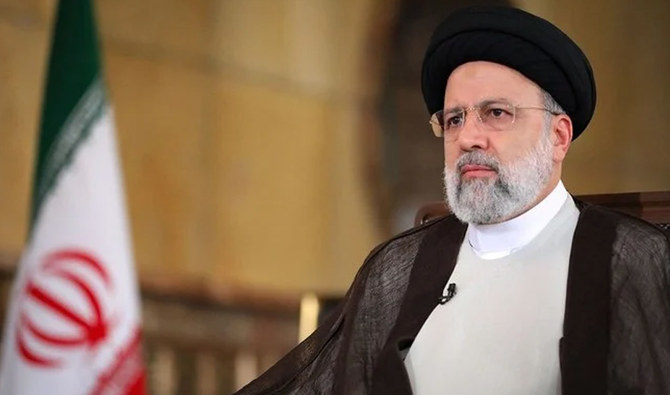
The two candidates viewed as favorites to replace Khamenei are his son Mojtaba and President Ebrahim Raisi, above. (AFP)
Short Url
Updated 01 October 2022
Follow

Iran’s leaders ‘in disarray’ as protests grow

  • Nationwide unrest over Mahsa Amini's death coincide with new rumors about the supreme leader’s ailing health
  • The two candidates viewed as favorites to replace Khamenei are his son Mojtaba and President Ebrahim Raisi

JEDDAH: Iran’s clerical rulers are in disarray over how to crush mass anti-government protests amid rifts over security tactics and high-level maneuvering over who will succeed Ayatollah Ali Khamenei, analysts say.
Nationwide unrest over the death of 22-year-old Mahsa Amini in morality police custody has coincided with new rumors about the 83-year-old supreme leader’s ailing health, posing a threat to Iran’s religious establishment.
Although in theory, the 86-member Assembly of Experts will choose the next leader, jockeying for influence has already begun, making it difficult for the ruling clerics to unite around a set of security tactics.
“This race has caused disarray inside the leadership. The deepening rift is the last thing we need when the country is in turmoil,” one hard-line official said. “The main issue right now is the Islamic Republic’s survival.”

The two candidates viewed as favorites to replace Khamenei are his son Mojtaba and President Ebrahim Raisi. “Neither of them has popular support,” said Karim Sadjadpour, a senior fellow at the Carnegie Endowment for International Peace. “But what keeps the Islamic Republic in power is not popular support, but repression — and both men are deeply experienced in repression.”
As the protests spread to 80 cities nationwide, Iran’s rulers have accused a coalition of “anarchists, terrorists and foreign foes” of orchestrating the troubles — a narrative few Iranians believe.
Alarmed by the depth of popular outrage, some senior clerics and politicians have appealed for restraint to avoid bloodshed that could galvanize and embolden protesters.
But that has not stopped hard-liners calling for tougher measures, despite the death of at least 75 protesters in the security crackdown. “A part of the establishment fears that this time using more lethal force can push the Islamic Republic to a no return point,” said a senior former Iranian official.


Tunisian police arrest member of parliament who mocked president

Updated 5 sec ago
Follow

Tunisian police arrest member of parliament who mocked president

  • Ahmed Saidani mocked the president in a Facebook post, describing him as the “supreme commander of sewage and rainwater drainage”

TUNIS: Tunisian police arrested lawmaker Ahmed Saidani on Wednesday, two of his colleagues ​said, in what appeared to be part of an escalating crackdown on critics of President Kais Saied.
Saidani has recently become known for his fierce criticism of Saied. On Tuesday, he mocked the president in a Facebook post, describing him as the “supreme commander of sewage and rainwater drainage,” blasting what he said ‌was the absence ‌of any achievements by Saied.
Saidani ‌was ⁠elected ​as ‌a lawmaker at the end of 2022 in a parliamentary election with very low voter turnout, following Saied’s dissolution of the previous parliament and dismissal of the government in 2021.
Saied has since ruled by decree, moves the opposition has described as a coup.
Most opposition leaders, ⁠some journalists and critics of Saied, have been imprisoned since he ‌seized control of most powers in 2021.
Activists ‍and human rights groups ‍say Saied has cemented his one-man rule and ‍turned Tunisia into an “open-air prison” in an effort to suppress his opponents. Saied denies being a dictator, saying he is enforcing the law and seeking to “cleanse” the country.
Once a supporter ​of Saied’s policies against political opponents, Saidani has become a vocal critic in recent months, accusing ⁠the president of seeking to monopolize all decision-making while avoiding responsibility, leaving others to bear the blame for problems.
Last week, Saidani also mocked the president for “taking up the hobby of taking photos with the poor and destitute,” sarcastically adding that Saied not only has solutions for Tunisia but claims to have global approaches capable of saving humanity.
Under Tunisian law, lawmakers enjoy parliamentary immunity and cannot be arrested for carrying out their ‌duties, although detention is allowed if they are caught committing a crime.