

At medical camps, a flood of disease after rains deluge in southern Pakistan 

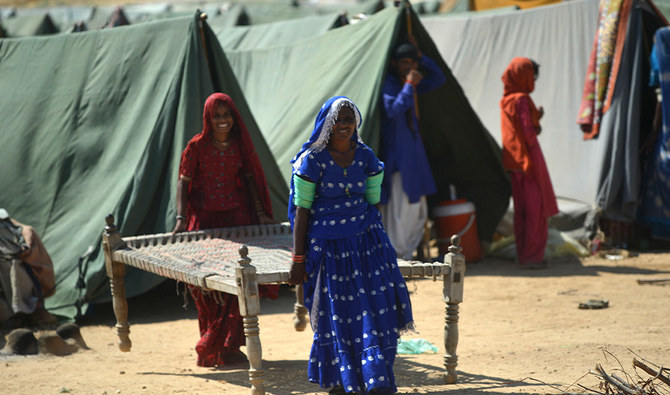
Internally displaced flood-affected people take refuge in a camp at Kotri in Jamshoro district of Sindh province on September 28, 2022. (AFP)
Short Url
Updated 01 October 2022
Follow

At medical camps, a flood of disease after rains deluge in southern Pakistan 

  • Nearly 350 people have died in Sindh province since July 1 of diseases that have spread in the aftermath of floods. 
  • Doctors have treated 3.38 million patients with diarrhea, skin and respiratory infections, malaria, dengue at 21,955 medical camps 

DADU, Sindh: Inside a small tent on a major highway in Pakistan’s southern Sindh province, Shabiraan Ameer held up her arms and moved her face to a side to bare her neck, both covered in rashes and stained with blood from constant scratching. 

Ameer’s family is only one among nearly 15 million people affected by recent floods in Sindh and living in tent-cities and makeshift shelters on roadsides or staying back in flooded villages, surrounded from all sides with water. 

As waters from the floods recede, which officials say may take up to six months, swaths of Pakistan, particularly the Balochistan and Sindh provinces, have become infested with diseases including malaria, dengue fever, diarrhea and skin infections. 

According to a Sindh health department report, nearly 350 people have died since July 1 of diseases that have spread in the aftermath of floods. Doctors have treated 3.38 million patients with diarrhea and skin diseases, acute respiratory infection (ARI), and suspected and confirmed cases of malaria, dengue and other conditions at 21,955 medical camps in Sindh. 

“It [skin] bleeds when I rub it,” Ameer, a young mother of two, told Arab News. “I clean the wound with a cloth, then I sit and cry.” 

In Dadu district where Ameer is from, Pakistan’s largest freshwater lake of Manchar burst its banks, submerging hundreds of villages and displacing nearly 0.8 million people. 

As the water level rose three weeks ago, Ameer and her entire family were forced to tread to safety through toxic waters. 

“We don’t have a home and if we had money, we would have treated this,” Ameer said of her infection. “My entire body is taken over by disease.” 

Pointing to her children, she added: “My small children shout and cry in pain. Their bodies also bleed, they weep.” 

Many patients interviewed by Arab News at government medical camps for flood survivors in Dadu said they were not attended by doctors or given proper medication. 

“I got my check-up, but fever doesn’t go away,” Ibrahim, a child whose mouth had rashes due to high-fever, told Arab News. 

Rukhsana, who only gave her first name, said her three-year-old son had been ill for over a month: 

“I got him treated at a government hospital, we have given him a lot of medicines but his fever doesn’t go away.” 

Doctors and organizers at the tent city admitted they did not have adequate resources to deal with the scale of the problem, especially when there was one doctor available per 500 patients. 

Flight Lt. (R) Musarrat Shah, a social activist who is running a tent-city in Kakkar, said women and children were particularly vulnerable. 

“We are unable to provide good treatment and good medicines to this large scale of people,” she said. “A single doctor for 500 … is not enough when people are facing so many diseases, so many problems.” 

Dr. Muhammad Ali Chandio, a government doctor in Dadu’s main city camp, said fever and skin disease were rampant at the facility and malaria was suspected in a growing number of people. 

“The water available here is not clean, which is causing abdominal diseases in people, there are cases of diarrhea, cholera,” the doctor said. “If the environment is not good, then it’s obvious that diseases will spread.” 

At the IDP camp in Dadu city, Dr. Saima Parveen, the doctor in charge, said medicines needed proper storage and an enabling environment to work. 

“Fever will subside if you give syrup, paracetamol to kids with high fever but this environment, and this weather, the hot weather, will not let the fever go away,” she said. 

“They [doctors] gave anti-malarial to children but due to the atmosphere here, the dirty water standing here, the mosquitoes will come, mosquitoes bite them and they get malaria again.” 

Chandio added: “A temperature of 25 Celsius is required to keep medicines but here it is very hot and the medicines get spoiled and they are no longer effective.” 


Italian officials go on trial over shipwreck that killed Pakistanis among 94 migrants

Updated 6 sec ago
Follow

Italian officials go on trial over shipwreck that killed Pakistanis among 94 migrants

  • Thirty-five children were among those killed when the boat crashed on the rocks off the coast of the tourist town of Cutro in 2023
  • They are accused of involuntary manslaughter and “culpable shipwreck,” a crime in the Italian penal code punishing negligent actions

ROME: Six members of Italy’s police and coast guard go on trial Friday over a 2023 shipwreck that killed at least 94 migrants, accused of failing to intervene on time.

The disaster off the southern Calabrian coast was Italy’s worst in a decade and set off a firestorm of criticism against far-right Prime Minister Giorgia Meloni’s tough stance on the thousands of migrants who arrive by boat each year from North Africa.

Thirty-five children were among those killed when the boat crashed on the rocks off the coast of the tourist town of Cutro on February 26, 2023.

Four officers from Italy’s Guardia di Finanza (GDF) financial crimes police and two members of the coast guard are standing trial in nearby Crotone.

They are accused of involuntary manslaughter and “culpable shipwreck,” a crime in the Italian penal code punishing negligent actions or omissions leading to a shipwreck.

The overcrowded boat had set sail from Turkiye carrying people from Afghanistan, Iran, Pakistan and Syria. Around 80 survived.

Dozens of bodies washed up along the beach, their coffins later filling much of a nearby sports hall — brown wood for the adults, white for the children.

Authorities say more people may have perished in the shipwreck, their bodies never found.

’Negligent’
The charges against the officers relate to a search-and-rescue operation that never came, despite the boat having been tracked for hours.

A plane from European Union border agency Frontex had spotted the vessel in difficulty some 38 kilometers off the coast and flagged it to Italian authorities.

But a boat subsequently sent by the GDF police turned back due to the bad weather, and the migrant boat eventually capsized on rocks near the beach.

Prosecutors accuse the police of having failed to communicate key information to the coast guard, while the coast guard members allegedly failed to collect details from police that would have alerted them to the situation’s urgency.

Liborio Cataliotti, a lawyer for defendant Alberto Lippolis from the GDF — who ran the air and naval command center from Calabria’s other coast — told AFP his client was “very calm” heading into trial.

He said his client is being held responsible for subordinates not having provided more information.

All those on trial worked from various control centers far from the site of the shipwreck.

More migrants feared dead

Charity groups that operate search-and-rescue boats in the Mediterranean, including SOS Humanity and Mediterranea Saving Humans, are civil parties to the case.

They say the tragedy points to the policy of Meloni’s hard-right government of treating migrant boats as a law enforcement issue rather than a humanitarian one.

Human Rights Watch’s acting deputy director for Europe and Central Asia, Judith Sunderland, said it was not only the individual officers on trial, but also “Italian state policies that prioritize deterring and criminalizing asylum seekers and migrants over saving lives.”

Visiting Cutro after the tragedy, Meloni put the onus for the disaster squarely on the shoulders of human traffickers, announcing toughened penalties for those who cause migrant deaths.

Two men accused of trafficking the migrants on the boat, one Turkish and the other Syrian, were sentenced to two decades in prison in 2024.

In December that year, two Pakistanis and a Turk were convicted by a court in Crotone for their lesser roles in managing the migrants on board, with sentences from 14 to 16 years.

Around 66,000 migrants landed on Italy’s shores last year, a similar number to 2024, down from more than 157,000 in 2023, according to Italian government officials.

But many lost their lives trying to make the journey.

At least 1,340 people died while crossing the central Mediterranean last year, according to the UN’s International Organization for Migration (IOM).

On Monday, the agency said it feared for the lives of over 50 people missing after a shipwreck off the coast of Libya during the recent Storm Harry.

Days earlier, one-year-old twin girls were reported missing after their boat hit bad weather crossing from Tunisia to Italy.