DUBAI: Iran’s intelligence ministry says it has arrested nine foreigners over recent anti-hijab protests sweeping the country.
In a statement carried by the state-run news agency IRNA, the ministry said Friday that those arrested included citizens of Germany, Poland, Italy, France, the Netherlands and Sweden.
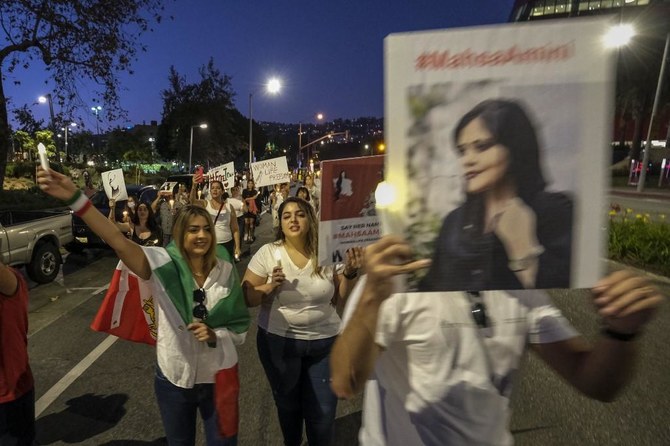
The death in custody of Mahsa Amini, who was detained for allegedly wearing the mandatory Islamic headscarf too loosely, has triggered an outpouring of anger at Iran’s ruling clerics.
Her family says they were told she was beaten to death in custody. Police say the 22-year-old Amini died of a heart attack and deny mistreating her, and Iranian officials say her death is under investigation.
Iran has claimed that the daily protests that have swept the country for the past two weeks were instigated by foreigners. Protesters have denied such claims, portraying their actions as a spontaneous uprising against the country’s strict dress code, including the compulsory hijab for women in public.
Iran has detained individual foreigners in the past, often on claims that they were spies while not providing evidence. Critics have denounced the practice as an attempt by Iran to use detained foreigners as bargaining chips for concessions from the international community.
Earlier in June, Iran arrested two French citizens, Cecile Kohler, 37, and Chuck Paris, 69 over meeting with protesting teachers and taking part in an anti-government rally.
A number of Europeans were detained in Iran in recent months, including a Swedish tourist, two French citizens, a Polish scientist and others.
The arrests come as leaked government documents show that Iran ordered its security forces to “severely confront” antigovernment demonstrations that broke out earlier this month, Amnesty International said Friday.
The London-based rights group said security forces have killed at least 52 people since protests over the Amini’s death began nearly two weeks ago, including by firing live ammunition into crowds and beating protesters with batons.
It says security forces have also beaten and groped female protesters who remove their headscarves to protest the treatment of women by Iran’s theocracy.
The state-run IRNA news agency meanwhile reported renewed violence in the city of Zahedan, near the borders with Pakistan and Afghanistan. It said gunmen opened fire and hurled firebombs at a police station, setting off a battle with police.
It said police and passersby were wounded, without elaborating, and did not say whether the violence was related to the antigovernment protests. The region has seen previous attacks on security forces claimed by militant and separatist groups.
Videos circulating on social media showed gunfire and a police vehicle on fire. Others showed crowds chanting against the government. Video from elsewhere in Iran showed protests in Ahvaz, in the southwest, and Ardabil in the northwest.
Amnesty said it obtained a leaked copy of an official document saying that the General Headquarters of the Armed Forces ordered commanders on Sept. 21 to “severely confront troublemakers and anti-revolutionaries.” The rights group says the use of lethal force escalated later that evening, with at least 34 people killed that night alone.
It said another leaked document shows that, two days later, the commander in Mazandran province ordered security forces to “confront mercilessly, going as far as causing deaths, any unrest by rioters and anti-Revolutionaries,” referring to those opposed to Iran’s 1979 Islamic Revolution, which brought the clerics to power.
“The Iranian authorities knowingly decided to harm or kill people who took to the streets to express their anger at decades of repression and injustice,” said Agnes Callamard, Amnesty International’s Secretary General.
“Amid an epidemic of systemic impunity that has long prevailed in Iran, dozens of men, women and children have been unlawfully killed in the latest round of bloodshed.”
Amnesty did not say how it acquired the documents. There was no immediate comment from Iranian authorities.
Iranian state TV has reported that at least 41 protesters and police have been killed since the demonstrations began Sept. 17. An Associated Press count of official statements by authorities tallied at least 14 dead, with more than 1,500 demonstrators arrested.
The New York-based Committee to Protect Journalists said Thursday that at least 28 reporters have been arrested.
Iranian authorities have severely restricted Internet access and blocked access to Instagram and WhatsApp, popular social media applications that are also used by the protesters to organize and share information.
That makes it difficult to gauge the extent of the protests, particularly outside the capital, Tehran. Iranian media have only sporadically covered the demonstrations.
Iranians have long used virtual private networks and proxies to get around the government’s Internet restrictions. Shervin Hajjipour, an amateur singer in Iran, recently posted a song on Instagram based on tweets about Amini that received more than 40 million views in less than 48 hours before it was taken down.
Non-governmental Iran Human rights Organization said that Hajjipour has reportedly been arrested.


![]()

Iran says it has arrested 9 foreigners over protests
Short Url
https://arab.news/wkg44
Iran says it has arrested 9 foreigners over protests
- Iran has claimed that the daily protests that have swept the country for the past two weeks were instigated by foreigners
- Earlier in June, Iran arrested two French citizens for meeting protesting teachers


Latest updates


© 2026 SAUDI RESEARCH & PUBLISHING COMPANY, All Rights Reserved And subject to Terms of Use Agreement.