Beijing says man killed in Karachi shooting in dental clinic not Chinese national

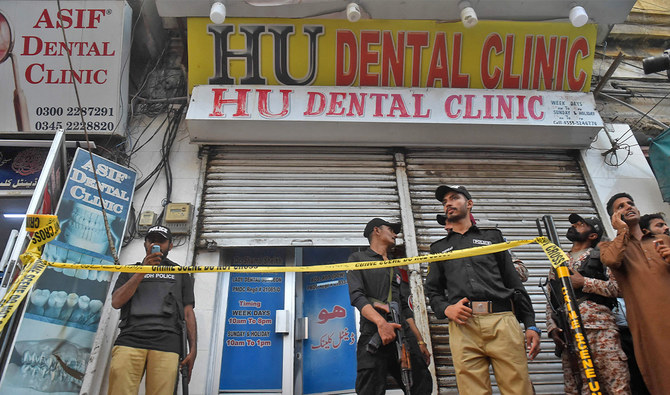
Policemen gather outside a dental clinic after a Chinese origin man was shot dead in an attack in Karachi, Pakistan, on September 28, 2022. (AFP)
Short Url
Updated 29 September 2022
Follow

Beijing says man killed in Karachi shooting in dental clinic not Chinese national

  • Pakistani police earlier said Chinese-Pakistani dual national was killed in attack
  • Counterterrorism official says Sindhi separatist group claimed attack

KARACHI: China’s foreign minister on Thursday rejected reports that a man gunned down in a dental clinic in Pakistan’s southern port city of Karachi was a Chinese national.  

An armed man, posing as a patient at a dental clinic in Karachi on Wednesday shot dead Ronald Raimond Chao and injured Dr. Richad Hu, 50, and his wife Margaret Hu, 45. Pakistani police said the couple ran the clinic where the incident took place.  

A First Information Report (FIR) lodged at Karachi’s Preedy police station said the victims were Pakistanis of Chinese descent. However, the media reported the deceased and the wounded couple were Chinese-Pakistani dual nationals.  

Deputy Inspector General of Police Counter Terrorism Department (CTD) Asif Aijaz Shaikh also told media Dr. Richard and his wife were dual nationals who were living in Karachi since the last four to five decades.   

“We express condolences for the victim and sympathies to the injured. To my knowledge, the victim you mentioned was not a Chinese citizen,” Wang Wenbin, China’s foreign ministry spokesperson, told media during a press briefing.  

Raja Umar Khattab, head of the Transnational Terrorists Intelligence Group (TTIG) of Karachi CTD, said the attack had been claimed by the Sindhudesh People’s Army militant group. Khattab said he believed the group had been formed recently.  

“Sindhudesh People’s Army is believed to be an alliance of Sindhudesh Revolutionary Army and Baloch National Army. The organization, according to my information, has been formed days before the attack,” he said.  

Chinese nationals have frequently been attacked by separatist groups from Pakistan’s impoverished, southern Balochistan province. Beijing is involved in huge infrastructure projects in Balochistan which are part of its Belt and Road Initiative.  

Pakistani officials have expressed fears in the past of growing links between Sindhi separatists and militant groups from insurgency-racked Balochistan. Sindhi separatists, who want the southern Sindh province to break away from Pakistan's federation, have launched low-intensity attacks against the state over the years.

In April, a female suicide bomber of the Baloch Liberation Army (BLA) group attacked the Confucius Institute at Karachi University. Three Chinese language teachers and their Pakistani driver were killed in the blast.  

Last year, a suicide bomber blew up a passenger bus, killing 13 people. Of these, nine were Chinese nationals working on the Dasu Hydropower project in Pakistan’s northwestern Khyber Pakhtunkhwa province.


Pakistan says it is targeting militant infrastructure in Afghanistan as Kabul threatens to hit Islamabad

Updated 9 sec ago
Follow

Pakistan says it is targeting militant infrastructure in Afghanistan as Kabul threatens to hit Islamabad

  • Ata Tarar says Pakistan is carrying out ‘precise intelligence-based operations’ to avoid civilian casualties
  • Afghan defense minister says the underlying dispute between the two sides is over the ‘Durand Line’ border

ISLAMABAD: Pakistan said on Saturday it was conducting intelligence-based operations against militant infrastructure inside Afghanistan while attempting to avoid civilian casualties, as a senior Afghan Taliban official warned Kabul could retaliate by targeting Islamabad if Pakistani forces struck the Afghan capital.

The escalating rhetoric comes as cross-border fighting between the two neighbors intensifies following clashes that began last month when Afghan forces launched attacks on Pakistani military installations along the frontier. Kabul said the assault was retaliation for Pakistani airstrikes targeting what Islamabad called militant camps inside Afghanistan.

Pakistan’s defense minister Khawaja Muhammad Asif said last week the situation had effectively become “open war” between the two countries.

“Pakistan is only targeting terrorist infrastructures and support system with precise intelligence based operations ensuring no collateral damage takes place,” Pakistan’s Information Minister Ataullah Tarar said in a statement.

He challenged the recent claims made by an Afghan defense ministry spokesperson earlier this week who said his country was making significant battlefield gains against Pakistan including the killing of 109 soldiers and the capture or destruction of 14 military posts in large scale attacks.

“These so called attacks by Afghan Taliban in coordination with FAK [Fitna Al Khawarij] Terrorists once again confirm the nexus of Afghan Taliban regime and multiple terrorist organizations operating from within their territory,” Tarar continued. “All such attempts are responded to, immediately and effectively with severe retributive punishment that is swift, precise and effective.”

“The imaginary numbers being floated by Afghan Taliban regime are however not worth any serious comment,” he added.

Tarar said Pakistan’s military campaign — described as Operation Ghazb Lil Haq — had inflicted heavy losses on Afghan Taliban forces.

According to figures shared by the minister, 527 Taliban fighters had been killed and more than 755 injured since the clashes began, while 237 check posts were destroyed and 38 captured and destroyed. He said 205 tanks, armored vehicles and artillery guns were destroyed and 62 locations across Afghanistan had been targeted by air strikes.

Arab News could not independently verify the claims made by either side.

CIVILIAN CASUALTIES

Earlier this week, the United Nations raised concern over the toll of the escalating conflict on civilians.

UN human rights chief Volker Turk said on Friday that 56 Afghan civilians — nearly half of them children — had been killed since hostilities between Pakistan and Afghanistan intensified.

However, Tarar questioned the UN findings, saying its assertions appeared to rely heavily on information provided by Taliban authorities and did not adequately reflect independently verified intelligence.

“Pakistan categorically reiterates that all counter-terrorism operations conducted by its security forces are carried out with the highest degree of precision, professionalism, and responsibility,” he said.

Islamabad has long accused the Taliban government of allowing militant groups, including the Tehreek-e-Taliban Pakistan (TTP), to operate from Afghan soil, a charge Kabul denies.

“Operations are meticulously planned so that civilian areas remain completely safe,” the minister said. “The locations targeted are remote terrorist hideouts and facilities far removed from populated zones, including sensitive areas such as Kabul’s Green Zone.”

AFGHAN WARNING

Meanwhile, Afghanistan’s Defense Minister Mullah Yaqoob issued a warning to Pakistan in remarks circulated by Afghan broadcaster TOLOnews.

“If Kabul lacks peace, there will be no peace in Islamabad. If Kabul is attacked, Islamabad will be attacked,” Yaqoob said in a promotional clip of an interview shared on social media.

Yaqoob rejected Pakistan’s justification that the presence of the TTP in Afghanistan warranted military action and suggested the underlying dispute was over the contested “Durand Line” border between the two countries.

So far, there has been no official response from Pakistan to Yaqoob’s remarks.