UN says disease outbreaks remain ‘growing concern’ in flood-hit Pakistan

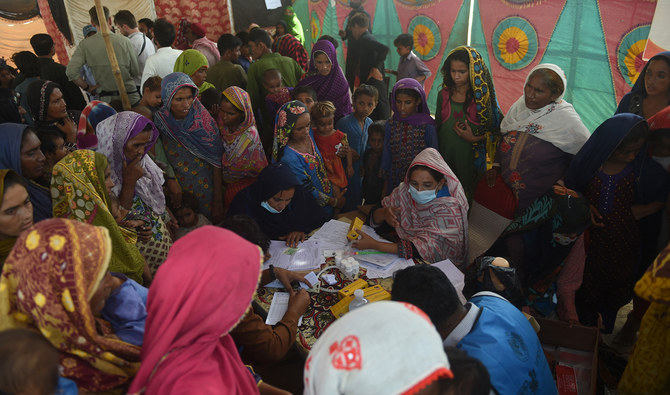
Local residents displaced by floods gather at a makeshift medical camp set in Dadu district, Sindh province on September 27, 2022. (AFP)
Short Url
Updated 28 September 2022
Follow

UN says disease outbreaks remain ‘growing concern’ in flood-hit Pakistan

  • Deaths from infections, malaria, dengue have caused more than 300 deaths since July in worst-hit province of Sindh
  • Flood-ravaged regions have become infested with diseases including malaria, dengue fever, diarrhea and skin problems

ISLAMABAD: The United Nations has said outbreaks of mosquito-borne and water-borne diseases in flooded Pakistan were a “growing concern,” as deaths from infections, malaria and dengue fever have caused more than 300 deaths since July in the worst-hit province of Sindh, according to health officials.

The death toll from the deluge itself has reached 1,663, including 614 children and 333 women, a figure that does not include deaths from fast-spreading diseases, according to data from the National Disaster Management Authority.

“Outbreaks of vector-borne and water-borne diseases are a growing concern in Sindh and Balochistan provinces, where many districts remain inundated by floodwaters,” Stephane Dujarric, a spokesperson for UN Secretary-General Antonio Guterres, said on Tuesday.

He said floods had damaged nearly 1,500 health facilities across the country, including more than 300 refrigerators and solar power systems, which was disrupting vaccine cold chains.

“Assessments are continuing, but an estimated 7.9 million people remain displaced by the catastrophic floods.  Nearly 600,000 people are living in relief camps, and more than 7,000 schools across Pakistan are being used as temporary relief camps,” the spokesperson said, adding that the UN and its humanitarian partners were continuing to scale up response and had reached more than 1.6 million people impacted by the floods.

“Nearly 600,000 people are living in relief camps, and more than 7,000 schools across Pakistan are being used as temporary relief camps … More than two million houses have been damaged by the heavy rains and floods. More than 25,000 schools and 13,000 km of roads have also reportedly been damaged.”

Record monsoon rains in south and southwest Pakistan and glacial melt in northern areas triggered the flooding that has affected nearly 33 million people in the South Asian nation of 220 million, sweeping away homes, crops, bridges, roads and livestock and causing an estimated $30 billion of damage.

Hundreds of thousands of displaced people are in dire need of food, shelter, clean drinking water, toilets and medicines. Many have been sleeping in the open by the side of elevated highways.

The economic losses from the flooding will slash the country’s GDP growth to around 3 percent from the estimated target of 5 percent set out in the budget when it had narrowly escaped defaulting on its debt in a balance of payment crisis.

Pakistan was already reeling from economic blows when the floods hit, with its foreign reserves falling as low as one month’s worth of imports and its current account deficit widening.


Bangladesh leader pushes for SAARC revival after meeting Indian, Pakistani dignitaries

Updated 02 January 2026
Follow

Bangladesh leader pushes for SAARC revival after meeting Indian, Pakistani dignitaries

  • Muhammad Yunus met Pakistan’s parliamentary speaker, Indian FM at Khaleda Zia’s funeral on Wednesday
  • SAARC has been dysfunctional since 2016, after India withdrew following a militant attack it blamed on Islamabad

ISLAMABAD: Bangladesh Chief Adviser Muhammad Younus this week pushed for reviving the South Asian Association for Regional Cooperation (SAARC) platform after meeting dignitaries from India, Pakistan and other parts of the region. 

SAARC has been effectively dysfunctional since 2016, when its planned Islamabad summit collapsed after India withdrew following a militant attack it blamed on Pakistan. Islamabad denied involvement, but New Delhi’s decision prompted Afghanistan, Bangladesh and Bhutan to pull out, leading to the indefinite postponement of the summit.

Younus met Pakistan’s National Assembly Speaker Ayaz Sadiq and Indian External Affairs Minister Subrahmanyam Jaishankar at former Bangladesh premier Khaleda Zia’s state funeral in Dhaka on Wednesday. The funeral also saw a handshake between the Indian and Pakistani representatives, the first high-level contact between officials of the two countries since their conflict in May. 

“During the meetings, Professor Yunus repeatedly emphasized the need to revive the South Asian Association for Regional Cooperation (SAARC),” Yunus’ account on social media platform X said.

“We witnessed a true SAARC spirit at the funeral yesterday,” the account quoted Yunus as saying. “SAARC is still alive. The SAARC spirit is still alive.”

The Bangladesh leader said apart from Jaishankar and Sadiq, representatives from South Asia who attended the funeral included Nepal’s Foreign Minister Bala Nanda Sharma, Sri Lanka’s Minister of Foreign Affairs, Employment and Tourism Vijitha Herath, and Maldives Minister of Higher Education and Labor Ali Haider Ahmed. 

Yunus said he tried to convene an informal gathering of SAARC leaders on the sidelines of the UN General Assembly in New York last year.

His statement to revive SAARC follows that of Pakistan’s Prime Minister Shehbaz Sharif, who earlier this month also called for reviving the South Asian platform. 

Sharif’s message last month came as the bloc marked the 40th anniversary of its founding charter. The Pakistani premier stressed the importance of deeper economic collaboration and collective responses to shared regional challenges such as poverty, climate-induced natural disasters, food and energy insecurity, and public-health vulnerabilities.