

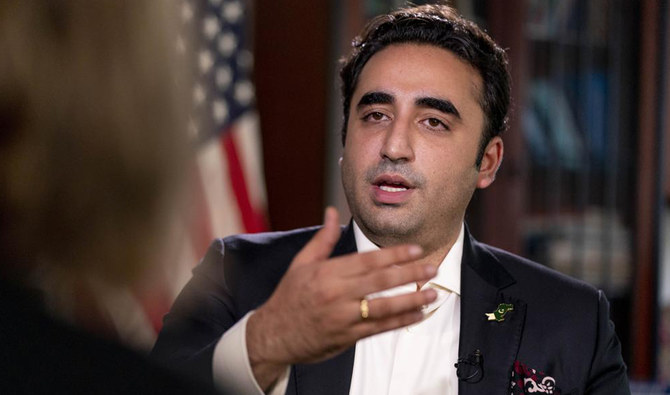

WASHINGTON: Pakistan’s foreign minister says the international community should work with Afghanistan’s ruling Taliban, not against it, when it comes to combatting foreign extremist groups and the economic and humanitarian crises in that country — even as many US officials say the Taliban have proved themselves unworthy of such cooperation.
Bilawal Bhutto Zardari, Pakistan’s top diplomat, spoke to The Associated Press in the final days of a trip to the United Nations General Assembly in New York and to Washington that has focused on trying to draw more world attention to unprecedented flooding that has one-third of his country underwater.
Unrelenting monsoon rains that scientists say are worsened by climate change have killed more than 1,000 people in Pakistan, caused tens of billions of dollars in damage and destroyed much of the country’s staple food and commercial crops.
Pakistan is among many countries hardest-hit by climate change that have become increasingly outspoken in seeking more financial assistance from richer nations. Past and current economic and industrial booms of China, the United States and other leading economies are the biggest contributors to climate change, which is primarily caused by burning fossil fuels.
The roughly 30 million people in Pakistan reported to be displaced by the floods are “truly paying in the forms of their lives and their livelihoods for the industrialization of other countries,” said Zardari.
“And justice would be that we work together” globally, “that we’re not left alone, to deal with the consequences of this tragedy,” he said.
Zardari is the son of a past Pakistani prime minister and a past president. He became foreign minister in April.
He met with Secretary of State Antony Blinken on Monday. The Biden administration on the same day announced another $10 million in food aid for Pakistan, on top of more than $56 million in flood relief and humanitarian assistance this year.
More broadly, however, the Biden administration and other governments of leading economic nations have delivered only a small part of the $100 billion in annual aid they have pledged to help less-wealthy nations survive the droughts, rising seas and other disasters of climate change and switch to cleaner energy themselves.
“We expect the United States to be one of the leading players” in that, said Zardari, who also spoke approvingly of a nascent proposal out of the UN in which developed nations could cancel out existing debt as a form of climate aid.
“We’ve not yet seen — and that doesn’t mean we won’t see — the translation of this vision to practicalities on the ground” in terms of the overall climate aid, he said.
Zardari, who spoke to the AP on Tuesday at Pakistan’s embassy, also gave contentious recommendations that the US work more directly with Afghanistan’s Taliban. Pakistan and the United States have shared widely varying amounts of cooperation against violent armed groups sheltering in Afghanistan over the decades. The US long has been at odds with many Pakistani officials over sympathetic handling and support for the Taliban.
No country recognizes the Taliban, a group sanctioned as a terrorist organization that retook power by military force in August 2021, as Afghanistan’s legitimate government. The United States and the international community at large have sought to deal with billions of dollars in frozen Afghan Central Bank funds, to institute financial reforms, and to deliver badly needed aid to ordinary Afghans with minimal involvement by the Taliban.
“At the risk of hurting anyone’s feelings, I think it’s important to mention that these funds, it’s not the Taliban’s funds, it’s not the Americans’ funds. These are funds that belong to the people of Afghanistan,” Zardari said.
Economic isolation and privation such as Afghanistan has experienced since the Taliban takeover only feed authoritarianism and extremism, he said. The best financial outcomes would work through existing institutions, now in Taliban hands, not through “some sort of parallel government.”
Asked if he meant the US needed to hold its nose and deal with Afghanistan’s ruling power, Zardari said, “Pretty much.”
Meanwhile, the US discovery that the global leader of Al-Qaeda, Ayman Al-Zawahiri, had taken up refuge in the heart of Afghanistan’s capital since the Taliban had returned to power has left US leaders condemning Taliban officials for alleged complicity. The US killed Zawahiri in a drone strike in July.
The Taliban had yet to have the time and ability to grapple with extremist groups as a government should, Zardari said. “For them to demonstrate their will to take on terrorist organizations, we need to help them build their capacity to also do so” before judging them, he said.


