

Out of spot market, Pakistan braces for harsh winters as gas shortfall fears loom

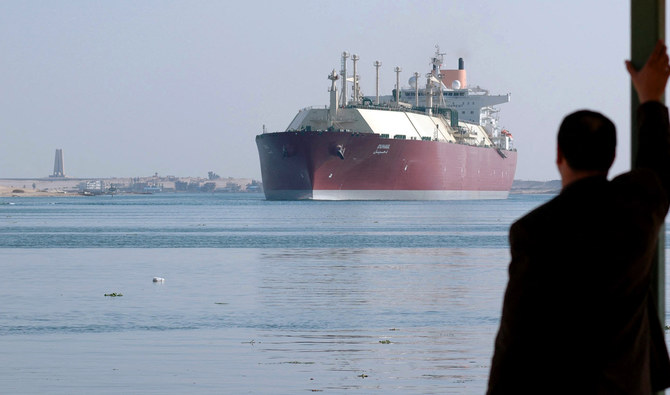
An Egyptian man looks at the Qatari Liquefied Natural Gas (LNG) carrier "Duhail" as its passes through the Suez Canal near the Egyptian port city of Ismailia on April 1, 2008. (AFP/File)
Short Url
Updated 28 September 2022
Follow

Out of spot market, Pakistan braces for harsh winters as gas shortfall fears loom

  • Pakistan imported its last LNG cargo from Qatar at $17 per mmBtu under a long-term supply agreement
  • At present Pakistan only relies on imported LNG cargoes through long term contracts with Qatar and ENI

KARACHI: Pakistan is bracing for one of the harshest winters this year following skyrocketing prices of Liquefied Natural Gas (LNG) spot cargoes in the global market and record currency depreciation at home, analysts said, as fears of increasing gas outages during peak winter hours loom large.

The south Asian country requires 4.1 billion cubic feet per day (bcfd) of gas, with winter demand peaking to around 4.5 bcfd against local production of 3.22 bcfd. The shortfall is bridged through LNG imports.

Seen as the viable option to meet domestic gas demand, Pakistan started importing LNG seven years ago. However, the price of the commodity in the international market surged from lows of $2 per million British thermal units (mmBtu) in 2020 to highs of $57 in August this year after demand in Europe surged, pushing Islamabad out of the spot market for the time being.

At present the country only relies on imported LNG cargoes through long term contracts made with Qatar and Italian multinational ENI. The term agreements allow the country to import around 8 cargoes per month against the requirement of around 12 to meet the shortfall.

An official from Pakistan LNG Limited (PLL), a state-owned entity mandated to import and procure LNG, confirmed to Arab News on Tuesday that the country was currently importing all term cargoes from Qatar and ENI.

As the spot LNG market remains out of the reach of Pakistan, many Pakistani analysts expect the current winter season to be tough for domestic gas consumers amid shortages of gas.

Pakistan imported its last LNG cargo from Qatar at $17 per mmBtu under a long-term supply agreement.

“Normally the demand in winter increases by around 1 bcfd,” Farhan Mahmood, Head of Research at Sherman Securities, told Arab News. “As this year Pakistan is unlikely to secure cargoes from spot market, it is expected that shortfall and load shedding of gas will be more than last year.”

“With LNG prices currently hovering around $38 per mmBtu and the Pakistani rupee trading at historic lows amid depleting forex reserves, the government may not venture to import costly gas, rather it would prefer to save dollars.”

PLL did not receive any bid in response to a tender floated in July 2022 to import 10 cargoes of LNG

Pakistan’s woes were also compounded after Russia invaded Ukraine early this year and European countries rushed to secure gas supplies from LNG producing countries as Moscow slowed gas flows westwards.

The Kremlin says the West triggered the energy crisis by imposing the most severe sanctions in modern history, a step President Vladimir Putin says is akin to a declaration of economic war

“The Russia-Ukraine war has also disrupted the international market and European countries have rushed to secure cargoes for winter as demand has increased substantially there,” Mahmood added.

Some experts, however, say gas outages would be comparatively on the lower side this winter as high demand for gas will be compensated with additional electricity generation.

“By December this year some 1320MW electricity would be added to the national grid with commissioning of three coal-fired power plants in Thar, Sindh, that would compensate the gas demand,” Tahir Abbas, Head of Research at Arif Habib Limited, a Karachi-based brokerage firm, told Arab News.

“There would definitely be a shortfall of gas but it would not be as severe as it was last year keeping in view the additional electricity generation.”

Pakistan’s policy in winters is to divert gas supplies to domestic consumers from the power sector, which in turn impacts industrial activities.

This year, the government is also expected to encourage consumers to switch over to electricity by offering incentives to save gas for industrial and heating purposes.

In another bid to secure long-term supplies of gas, PLL has invited bids for 72 LNG cargoes from international suppliers across a period of six years. The fate of the tender would be decided on October 03, 2022, when the bids are opened.

The south Asian nation’s import of LNG declined by 3.37 percent to $629.4 million during the first two months, July-August 2022, of the current fiscal year, compared with the same period last year.

Pakistan energy imports increased by 105.3 percent to $23.3 billion during the last fiscal year, FY22, including the imports of LNG which increased by 90.6 percent to $4.98 billion, according to official data.


Pakistan, 21 other countries condemn Israeli West Bank measures, warn of ‘de facto annexation’

Updated 5 sec ago
Follow

Pakistan, 21 other countries condemn Israeli West Bank measures, warn of ‘de facto annexation’

  • Joint statement says settlement expansion violates international law, cites UN resolutions, ICJ advisory opinion
  • Signatories include European and Latin American nations such as France and Brazil , alongside Muslim countries

ISLAMABAD: Pakistan and 21 other countries, including France, Brazil, Spain and Denmark, on Tuesday condemned sweeping Israeli measures to expand control over the occupied West Bank, warning the steps risk advancing “unacceptable de facto annexation” and undermining prospects for a two-state solution.

In a joint statement issued by the foreign ministers of countries from the Middle East, Europe and Latin America, as well as the secretaries general of the League of Arab States and the Organization of Islamic Cooperation, the signatories urged Israel to immediately reverse recent decisions reclassifying Palestinian land and accelerating settlement activity.

The statement marks a broadening of international criticism beyond Muslim-majority states that have long denounced Israeli settlement expansion, bringing together countries like Norway, Sweden, Portugal, Finland, Iceland, Ireland and Luxembourg alongside Arab and other Muslim-majority nations.

“Israel’s illegal settlements, and decisions designed to further them, are a flagrant violation of international law, including previous United Nations Security Council Resolutions and the 2024 Advisory Opinion of the International Court of Justice,” the ministers said.

They added the measures were “part of a clear trajectory that aims to change the reality on the ground and to advance unacceptable de facto annexation,” warning that they undermine ongoing efforts for regional peace and stability, including a proposed 20-Point Plan for Gaza, and threaten prospects for broader regional integration.

The ministers called on Israel “to reverse them immediately, to respect its international obligations, and to refrain from actions that would result in permanent changes to the legal and administrative status of the occupied Palestinian Territory.”

The latest statement follows mounting concern over Israel’s land and settlement policies in the West Bank.

Last week, Pakistan and seven other Muslim nations condemned Israel’s decision to approve land registration procedures in parts of the West Bank for the first time since 1967, a move widely seen as easing the path for settlement expansion and potential annexation.

Members of the Israeli cabinet have backed measures to tighten administrative control over areas of the West Bank, including Area C, which makes up around 60 percent of the territory and remains under full Israeli security and administrative control under the Oslo accords.

More than 500,000 Israeli settlers live in settlements and outposts in the West Bank, excluding Israeli-annexed East Jerusalem, alongside around three million Palestinians.

Settlements are considered illegal under international law, a position Israel disputes.

In the latest statement, the foreign ministers reiterated their rejection of “all measures aimed at altering the demographic composition, character and status of the Palestinian Territory occupied since 1967, including East Jerusalem,” and said they oppose “any form of annexation.”

“In view of the alarming escalation in the West Bank, we also call on Israel to put an end to settler violence against Palestinians, including by holding those responsible accountable,” they added.

The ministers pledged to take “concrete steps, in accordance with international law,” to counter the expansion of illegal settlements and policies or threats of forcible displacement and annexation.

Highlighting sensitivities around Jerusalem during Ramadan, they stressed the importance of preserving the historic and legal status quo at the city’s holy sites, recognizing the special role of the Hashemite custodianship of Jordan.

Reaffirming support for a negotiated settlement, the signatories said they remain committed to achieving “a just, comprehensive and lasting peace” on the basis of a two-state solution, in line with the Arab Peace Initiative and relevant UN resolutions, based on the June 4, 1967 lines.

“As reflected in the New York Declaration, the end of the Israeli-Palestinian conflict is imperative for regional peace, stability and integration,” the statement said, adding that only the realization of an independent, sovereign and democratic Palestinian state would allow coexistence among the region’s peoples and states.