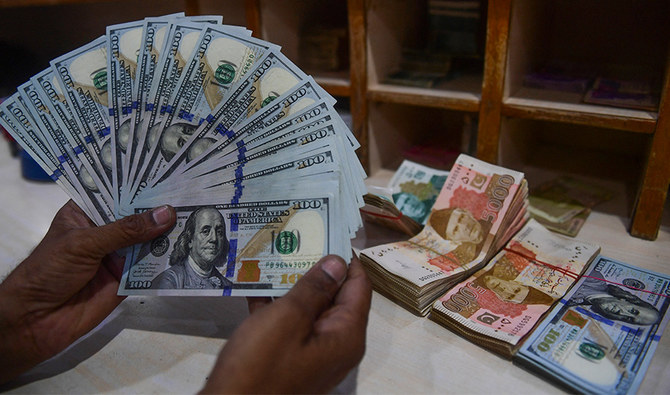

KARACHI: Pakistan’s national currency on Tuesday gained 1.33 percent against the United States dollar after Prime Minister Shehbaz Sharif’s aide, Ishaq Dar, returned to the country from London to take over as finance chief, with analysts and traders expecting he would help stabilize the currency and tame record-high inflation.
The rupee gained by Rs3.11 or 1.33 percent to close at Rs233.91 against the greenback in the interbank market on Tuesday. The rupee has recouped Rs5.74 or 2.3 percent during the last two consecutive trading sessions following the nomination of Dar, known to favor a strong currency, as finance minister.
Dar on Tuesday took oath as a senator, a day after he landed in Pakistan from London where he has lived in self-imposed exile for five years.
Dar is a member of PM Sharif’s ruling PMLN party and has already been finance minister four times. Dubbed Daronomics, his approach kept the rupee stable between Rs98 and Rs105 against the greenback during his last stint in office from 2013-2017 but he was also widely criticized for deliberately undervaluing the rupee by pumping dollars in the market.
“The arrival of Dar has changed the sentiments in the currency market and many people think that he would take punitive actions against the speculators,” Zafar Paracha, General Secretary of the Exchange Companies Association of Pakistan (ECAP), told Arab News.
“Dar has a track record of keeping the rupee stable and a history of improving the economy of the country as well. Many believe that the currency would further strengthen in the coming days.”
Pakistan’s currency has lost its value by 6.48 percent during the current month and has depreciated by 24.54 percent since January this year as demand for imports exerted pressure on the rupee.
A Pakistani anti-corruption court declared Dar an absconder after the veteran politician, who is a close aide to three-time Prime Minister Nawaz Sharif, failed to turn up for several court hearings in 2017. Dar, who has pleaded not guilty to charges he amassed wealth beyond known sources of income, said he was receiving medical treatment in London and unable to return.
The charges against Dar followed an investigation into the finances of former PM Nawaz Sharif, who was ousted in July 2017 after the Supreme Court disqualified him for not declaring a small salary from his son’s off-shore company.
Both Dar and Nawaz deny any wrongdoing.
During his stint as finance minister from 2013-2017, Dar was initially lauded for steering Pakistan out of a balance of payments crisis in 2013 and returning the nuclear-armed country toward a higher growth trajectory.
But in the year before he stepped down as finance minister after Pakistan’s Supreme Court disqualified him from office, Dar faced widespread criticism for his refusal to allow the rupee to weaken to ease macroeconomic pressures. He was also accused of eroding the central bank’s independence.
Dealers said assurances from the World Bank, the International Monetary Fund and Asian Development Bank that they will not abandon Pakistan in the aftermath of recent floods has played a positive role in the rupee’s appreciation.
Pakistan’s stocks also continued the previous day’s positive momentum on the arrival of Dar as well as a declining trend in global commodity prices, anticipation of financial assistance from global institutions for flood relief, and strengthening of the Pakistani rupee against the US dollar.
“Bullish activity continued led by scrips across the board ahead of a new finance minister likely to take oath tomorrow [Wednesday],” Ahsan Mehanti, CEO of Arif Habib Corporation, said.
The benchmark KSE100 index gained 367 points to settle at 41,518, after profit taking kicked-in during the mid session.
“Rupee recovery, surge in global crude oil prices , speculations over likely support receipts from WB and ADB for flood loss relief and expectations over FATF [financial watchdog] for exit from gray list next month played a catalyst role in bullish close,” Mehanti added.