

Pakistan court frees senior journalist Ayaz Amir in daughter-in-law’s murder case

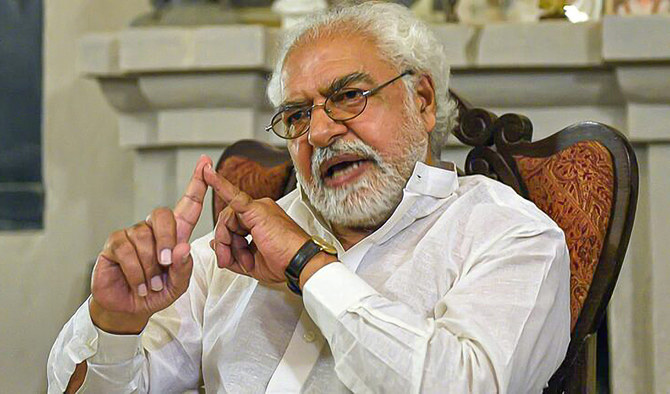
An undated file photo of Pakistani journalist Ayaz Amir. (Photo courtesy: social media)
Short Url
Updated 27 September 2022
Follow

Pakistan court frees senior journalist Ayaz Amir in daughter-in-law’s murder case

  • Amir was taken into custody on charges of aiding his son Shahnawaz who is suspected of murdering his wife
  • Sarah Inam, an economist and Canadian national, worked in Abu Dhabi, she wed Shahnawaz three months ago

ISLAMABAD: A Pakistani court on Tuesday freed Ayaz Amir, a well-known columnist and politician, in a case related to the murder of his daughter-in-law in which the chief suspect is his son, Amir’s lawyer said.

Pakistani police arrested the veteran journalist on Sunday for allegedly aiding his son, Shanawaz, in last week’s murder of Sarah Inam at a farmhouse in Islamabad.

Inam, a 37-year-old economist and a Canadian national of Pakistani origin, had wed Shahnawaz around three months ago. The murder took place a day after Inam returned from Abu Dhabi where she worked.

Shahnawaz, the prime accused in the case, is still in police custody after being arrested from the crime scene early Saturday. Media reported that Inam’s immediate family, based in Canada, had arrived in Pakistan on Monday night to pursue the case.

“In today’s hearing, I inquired from the prosecution what evidence it had against my client,” Amir’s lawyer, Basharatullah Khan, told Arab News. 

Khan said the police were keeping his client in custody without any evidence and the court had “discharged” him after reviewing the record.

At Monday’s hearing, Amir had told the judge that he was “traumatized” by the murder. 

“I had informed the police about the incident and even guided them to the farmhouse where the murder took place,” the journalist said.

According to the first information report, Shahnawaz’s mother had called the police on September 23 and informed them that her son had murdered his wife “with a dumbbell.”

Inam’s murder is reminiscent of last year’s headline-grabbing murder of Noor Mukadam, 27, which drew an outpouring of anger over femicides in the South Asian nation. 

In March this year, a Pakistani court sentenced to death Pakistani-American Zahir Jaffer, a childhood friend of Mukadam, for beheading her. Mukadam and Jaffer were widely believed to have been in a romantic relationship, which they had broken off a few months before her murder. 

Hundreds of women are killed in Pakistan every year, while thousands more suffer brutal violence. But few cases receive sustained media attention, and only a small fraction of perpetrators are ever punished or convicted by courts. 

But Mukadam’s shocking murder, involving members of the privileged elite of Pakistani society, triggered an explosive reaction from women’s rights activists reckoning with pervasive violence. 

It also increased pressure for a swift conclusion of the trial in a country known to have a sluggish justice system and where cases typically drag on for years.


Pakistan, global crypto exchange discuss modernizing digital payments, creating job prospects 

Updated 05 December 2025
Follow

Pakistan, global crypto exchange discuss modernizing digital payments, creating job prospects 

  • Pakistani officials, Binance team discuss coordination between Islamabad, local banks and global exchanges
  • Pakistan has attempted to tap into growing crypto market to curb illicit transactions, improve oversight

ISLAMABAD: Pakistan’s finance officials and the team of a global cryptocurrency exchange on Friday held discussions aimed at modernizing the country’s digital payments system and building local talent pipelines to meet rising demand for blockchain and Web3 skills, the finance ministry said.

The development took place during a high-level meeting between Finance Minister Muhammad Aurangzeb, Pakistan Virtual Assets Regulatory Authority (PVARA) Chairman Bilal bin Saqib, domestic bank presidents and a Binance team led by Global CEO Richard Teng. The meeting was held to advance work on Pakistan’s National Digital Asset Framework, a regulatory setup to govern Pakistan’s digital assets.

Pakistan has been moving to regulate its fast-growing crypto and digital assets market by bringing virtual asset service providers (VASPs) under a formal licensing regime. Officials say the push is aimed at curbing illicit transactions, improving oversight, and encouraging innovation in blockchain-based financial services.

“Participants reviewed opportunities to modernize Pakistan’s digital payments landscape, noting that blockchain-based systems could significantly reduce costs from the country’s $38 billion annual remittance flows,” the finance ministry said in a statement. 

“Discussions also emphasized building local talent pipelines to meet rising global demand for blockchain and Web3 skills, creating high-value employment prospects for Pakistani youth.”

Blockchain is a type of digital database that is shared, transparent and tamper-resistant. Instead of being stored on one computer, the data is kept on a distributed network of computers, making it very hard to alter or hack.

Web3 refers to the next generation of the Internet built using blockchain, focusing on giving users more control over their data, identity and digital assets rather than big tech companies controlling it.

Participants of the meeting also discussed sovereign debt tokenization, which is the process of converting a country’s debt such as government bonds, into digital tokens on a blockchain, the ministry said. 

Aurangzeb called for close coordination between the government, domestic banks and global exchanges to modernize Pakistan’s payment landscape.

Participants of the meeting also discussed considering a “time-bound amnesty” to encourage users to move assets onto regulated platforms, stressing the need for stronger verifications and a risk-mitigation system.

Pakistan has attempted in recent months to tap into the country’s growing crypto market, crack down on money laundering and terror financing, and promote responsible innovation — a move analysts say could bring an estimated $25 billion in virtual assets into the tax net.

In September, Islamabad invited international crypto exchanges and other VASPs to apply for licenses to operate in the country, a step aimed at formalizing and regulating its fast-growing digital market.