

Pakistan not seeking debt relief from commercial creditors — finance minister 

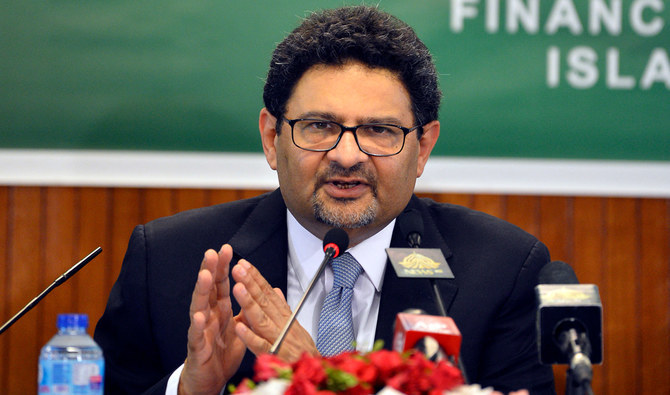
Pakistan's Finance Minister Miftah Ismail speaks during the launch ceremony of 'Economy Survey 2021-22' in Islamabad on June 9, 2022. (AFP/File)
Short Url
Updated 24 September 2022
Follow

Pakistan not seeking debt relief from commercial creditors — finance minister 

  • Pakistan’s bonds slumped to just half their face value after a UN policy memo urged the cash-strapped country to restructure debt 
  • Miftah Ismail says given the climate-induced disaster in Pakistan, Islamabad is seeking debt relief from bilateral Paris Club creditors 

ISLAMABAD: Pakistan’s finance minister Miftah Ismail on Friday tried to calm creditor fears and said the South Asian country would not seek any relief from commercial banks or Eurobond creditor, after Prime Minister Shehbaz Sharif requested wealthy countries for a “substantial debt relief.” 

Pakistan’s bonds had slumped to just half their face value throughout the day after the Financial Times said a United Nations development agency was urging the cash-strapped country to restructure its debt. 

Devastating floods have inundated large swathes of Pakistan since mid-June, killing more than 1,500 people and causing damages estimated at $30 billion, fanning fears that Pakistan would not meet its debts. 

“Given the climate-induced disaster in Pakistan, we are seeking debt relief from bilateral Paris Club creditors,” Finance Minister Miftah Ismail said on Twitter on Friday. 

“We are neither seeking, nor do we need, any relief from commercial banks or Eurobond creditors.” 


The bond market reaction on Friday strengthened fears of another default by Pakistan, hammering its international market government debt. 

One of the main sovereign bonds due for repayment in 2024 slumped more than 10 cents to about 50 cents on the dollar, while another due in 2027 fell to about 45 cents. 

Ismail said the country had $1 billion bond due in December which it would “pay on time and in full.” 

A memorandum the United Nations Development Programme (UNDP) is set to hand Pakistan’s government this week says its creditors should consider debt relief in the wake of the floods, according to the Financial Times. 

The memorandum further proposed debt restructuring or swaps, in which creditors would forego some repayments in exchange for Pakistan’s agreement to invest in climate change-resilient infrastructure, the paper said. 

PM Sharif appealed on Friday to rich nations for immediate debt relief, saying what had been done was commendable, but it was far from meeting the country’s needs. 

The prime minister, who along with Ismail was in New York to attend the United Nations General Assembly (UNGA) session, told Bloomberg TV that Pakistan had taken up the debt relief issue with UN Secretary-General Antonio Guterres and world leaders. 

“We have spoken to European leaders and other leaders to help us in Paris club, to get us a moratorium,” he said, referring to rich nation creditors. 

Sharif and finance minister Ismail said they had also taken up the relief issue with the International Monetary Fund (IMF) and the World Bank. 

Ismail said the IMF had “almost agreed” to the request for easing the conditions of Pakistan’s $7 billion program that was resumed in July after being delayed for months. 

Of late, there have been concerns about Pakistan’s debt obligations and its declining foreign exchange reserves due to political uncertainty. 

The floods have come at a time when the Pakistani rupee is on the verge of a record low. The economy is forecast to slow amid floods, policy tightening and efforts to tackle fiscal and external imbalances, according to the Asian Development Bank, which cut growth forecasts to 3.5 percent from 4.5 percent for the 2023 fiscal year this week. 


Pakistan welcomes Afghan scholars’ reported resolution against use of soil for cross-border attacks

Updated 11 December 2025
Follow

Pakistan welcomes Afghan scholars’ reported resolution against use of soil for cross-border attacks

  • Around 1,000 Afghan scholars passed a resolution this week prohibiting use of Afghan soil for cross-border attacks against another country, Afghan media reported
  • Development takes place as tensions persist between Pakistan and Afghanistan amid Islamabad’s allegations of Taliban supporting cross-border attacks against it 

ISLAMABAD: Pakistan’s foreign office spokesperson on Thursday welcomed a resolution reportedly passed by Afghan scholars against allowing the use of Afghan soil for attacks against any other country, but still demanded written assurances of the same from the Afghan leadership. 

According to a report published by Afghan news channel Tolo News, around 1,000 Afghan scholars gathered in Kabul on Wednesday to pass a resolution that, among other things, said no one will be allowed to use Afghanistan’s soil against other countries for attacks. The resolution also said that if anyone fails to comply with this decision, the Afghan government has the right to take action against them.

The development takes place as tensions persist between Afghanistan and Pakistan. Both countries have engaged in border clashes since October, with Islamabad accusing Kabul of harboring militants that launch attacks on Pakistan.

Afghanistan denies the allegation and says it cannot be held responsible for Pakistan’s security. 

Speaking to reporters during a weekly press briefing, Foreign Office spokesperson Tahir Andrabi said he had not seen the full text of the resolution. 

“Any developments with regards to the fact that Afghan leadership, the segment of Afghan society, realized the gravity of the situation that their soil is being used by not just TTP, but also by their own nationals to perpetrate terrorism in Pakistan — any realization to this effect is positive and one would certainly welcome it,” Andrabi said.

However, he said similar commitments by Kabul on preventing cross-border attacks have been made in the past but were not honored. 

Pakistan and Kabul engaged in a series of peace talks in Istanbul and Doha recently after their deadly border clashes in October. Andrabi pointed out that Islamabad had insisted on getting written assurances from the Afghan leadership that they would prevent Afghan soil from being used by the Pakistani Taliban and other militant groups. However, he said Islamabad had not received any. 

He said the resolution by Afghan scholars does not qualify as a proper written assurance from Kabul as it does not explicitly mention Pakistan or the Pakistani Taliban.

’NO FORMAL EXTRADITION TREATY’

Commenting on media reports of Islamabad seeking extradition of certain individuals from the UK, Andrabi confirmed that there exists no formal extradition treaty between Pakistan and the UK. However, he said cases can still be processed individually.

“In the absence of a formal treaty, the extradition cases can be processed on a case-to-case basis,” the FO spokesperson said. “And certain cases were submitted to the British High Commission in Islamabad for their consideration.”

Pakistan last week asked the UK to extradite two prominent pro-Imran Khan figures, former accountability aide Shehzad Akbar and YouTuber-commentator Adil Raja, saying they were wanted on charges of anti-state propaganda.

The issue had been brought up during Pakistan Interior Minister Mohsin Naqvi’s meeting with British High Commissioner Jane Marriott in Islamabad. The Interior Ministry said Naqvi had formally handed over Pakistan’s extradition documents, requesting that Raja and Akbar be returned to Pakistan without delay.