

Pakistan battles disease surge as flood deaths surpass 1,600 

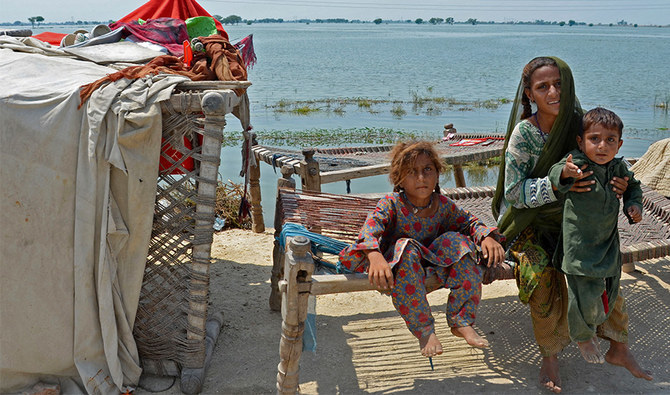
An internally displaced flood-affected family sits outside their makeshift shelter in a flood-hit area following heavy rains in Dera Allah Yar town of Jaffarabad district in Balochistan province on September 8, 2022. (AFP)
Short Url
Updated 24 September 2022
Follow

Pakistan battles disease surge as flood deaths surpass 1,600 

  • Rains and floods have affected 33 million people and destroyed or damaged 2 million homes 
  • Some of the doctors who refused to work in Sindh province have been fired by the government 

ISLAMABAD: Pakistan deployed thousands more doctors and medics to battle the outbreak of disease as the death toll from the unprecedented floods that have gripped the country this summer surpassed 1,600 on Friday, officials said. 

The disaster management agency said 10 more people had died from the floods in the past 24 hours — four in Sindh, the worst-hit province in the deluge, and six in Baluchistan province — bringing the overall number of fatalities to 1,606 across Pakistan. 

In Sindh, where thousands of makeshift medical camps for flood survivors have been set up, the National Disaster Management Authority said outbreaks of a spate of illnesses such as typhoid, malaria and dengue fever have killed at least 300 of the flood victims. 

Some of the doctors who refused to work in Sindh province have been fired by the government, according to the provincial health department. Floods have killed 728 people, including 313 children and 134 women in the province since July. 

The monsoon rains and flooding, which many experts say are fueled by climate change, have also affected 33 million people and destroyed or damaged 2 million homes across Pakistan. About half a million flood survivors are homeless, living in tents and makeshift structures. 

Over the past two months, Pakistan sent nearly 10,000 doctors, nurses and other medical staff to tend to survivors in across Sindh. About 18,000 doctors and nearly 38,000 paramedics are treating survivors in the province, according to the latest data from the health department. 

Floods have also damaged more than 1,000 health facilities in Sindh, forcing some survivors to travel to other areas to seek medical help. 

Waterborne and other diseases in the past two months have killed 334 flood victims, authorities said. The death toll prompted the World Health Organization last week to raise the alarm about a “second disaster,” with doctors on the ground racing to battle outbreaks. 

Some floodwaters in Pakistan have receded, but many districts in Sindh are still submerged, and displaced people living in tents and makeshift camps face the threat of gastrointestinal infections, dengue fever and malaria, which are on the rise amid stagnant waters. 

Also Friday in Sindh, teams of fumigators fanned out across flood-hit areas, spraying in an effort to keep mosquitos at bay and prevent further outbreaks of dengue fever and malaria. Over 134,000 cases of diarrhea and 44,000 cases of malaria were reported in the hardest-hit areas of Sindh this past week. 

Dengue fever is also on the rise, especially in Karachi, the provincial capital, where health teams were spraying insecticide onto puddles of water in the streets. 

The devastation has led the United Nations to consider sending more money than it committed during its flash appeal for $160 million to support Pakistan’s flood response. 

Pakistani Prime Minister Shahbaz Sharif, who is in New York, spoke Friday at the UN General Assembly, detailing the level of the devastation in his country and seeking more help from the international community. Sharif’s office said he met earlier with President Joe Biden at a reception for the world leaders gathering in New York. 

On Thursday, Sharif tweeted his thanks to Biden for highlighting the plight of flood victims and urging the world community to help Pakistan as it was still underwater and needed help. Washington is a key supporter for Pakistan’s response to floods. 

Pakistan’s Foreign Ministry says 123 flights carrying aid from various countries and UN agencies have ferried in desperately needed help. Local authorities are distributing these supplies, which include tents, food items, kitchen sets and bottles of drinking water, among flood survivors across the country. 

On Wednesday, Julien Harneis, the UN resident coordinator in Pakistan, said the humanitarian situation remains dire, with widespread damage to physical infrastructure and ongoing harm to people and livestock. Outbreaks of diarrhea, typhoid and malaria are increasing rapidly as millions of people sleep in temporary shelters or in the open, he said. 


Islamabad tree felling sparks debate over Pakistani capital’s green future

Updated 10 sec ago
Follow

Islamabad tree felling sparks debate over Pakistani capital’s green future

  • Authorities say removals target allergy-causing trees under court orders
  • Critics warn development-linked felling is eroding capital’s planned green character

ISLAMABAD: Pakistan’s government is facing growing criticism over a large-scale tree-cutting drive in Islamabad, with residents, environmental experts and lawmakers warning that the removals risk undermining the capital’s carefully planned green character, even as authorities insist the operation is legal and narrowly targeted.

Islamabad, designed in the 1960s by Greek architect Constantinos Doxiadis, was purpose-built to replace Karachi as the federal capital and conceived as a low-density city where green belts and protected natural zones were central to urban planning. The master plan divided the city into sectors separated by open spaces, with surrounding hills and forests intended to act as natural buffers against unchecked expansion.

That vision has come under renewed scrutiny in recent months as thousands of trees have been felled across the capital, including in and around environmentally sensitive areas near the Margalla Hills and Shakarparian, prompting public protests and calls for greater transparency.

Officials from the Capital Development Authority (CDA) acknowledge around 29,000 trees have been cut, but deny that any removals took place in designated green belts. They say replacement plantations exceed the number of trees felled.

Pakistan’s Climate Change Minister Musadik Malik said the bulk of the tree cutting stems from a court order targeting paper mulberry trees, which are blamed for triggering seasonal pollen allergies.

“About three years ago, I guess in 2022 or 2023, the Islamabad High Court made a decision, passed a judgment that all of these paper mulberry trees should be cut, should be culled,” Malik said.

“They are very harmful to people who have asthma,” he added. “So, because of that, according to the plan, the culling of these paper mulberry trees is being carried out.”

CDA officials also reject accusations of illegal felling.

Irfan Niazi, director general environment at the authority, said no development project violates green zoning.

“No development project of CDA is being carried out in the green belt or the green area wherever it was planned in the master plan,” he said. “You will not find a small brown patch on these projects. All of them are purely green and trees in a one-to-10 ratio have been added over there.”

Niazi said Islamabad’s forest cover has more than doubled since it became the capital.

“When Islamabad was announced as the capital at that time it inherited only 18,000 acres of forest … Now, it is 39,130 acres which is a huge area,” he said, adding that more than three million trees were planted in the Margalla Hills National Park last year.

The CDA also pointed to satellite data.

“According to the Normalized Difference Vegetation Index (NDVI) analysis of Islamabad, a comparative assessment between January 2023 and December 2025 shows a net increase of more than 9,000 acres in green cover,” it said in a post on X.

“ERODING GREEN CHARACTER”

Critics say the recent felling has gone far beyond paper mulberry and question whether authorities are respecting the city’s master plan and legal protections for forested areas.

Former CDA planning chief Dr. Ghulam Sarwar Sandhu said development is strictly restricted in forested and protected zones.

“In the master plan of Islamabad three major areas were reserved for forestry,” he said. “One is the Margalla Hills National Park area. It includes Margalla Hills, Shakarparian and two kilometers around Rawal Lake. It has been declared an environmentally sensitive area.”

Sandhu questioned the legality of tree cutting inside protected areas.

“Does the CDA have the power to cut trees from the Margalla Hills National Park area? No. There is no approval from the Islamabad Wildlife Board,” he said. “To me the CDA has no consideration for maintaining the green character of the city as provided in the master plan of Islamabad.”

Environmental groups also dispute the government’s framing, arguing that replacement planting does not compensate for the loss of mature trees or habitat fragmentation.

Muhammad Ibrahim Khan, director forest at WWF, said tree cutting must follow ecological best practices.

“There are ecological rules and regulations, or there is an ecological approach. Do it [cutting] according to the best practice. It is not that the whole of Islamabad should be turned into a plane field first and then tree plantation should be started,” he said.

Khan cited the Margalla Enclave link road, a joint housing project by the CDA and the Defense Housing Authority (DHA), as an example of unchecked development.

“So, for example, on the Margalla Enclave link road that’s being constructed, our team went and assessed it. So far, about 10 to 15 hectares of area has been cleared for the road, and it’s still expanding. It’s a 4-kilometer-long, 12-lane road, so quite a bit of area is being cleared. And it’s not just paper mulberry; there are also some of our native species like shisham and simal that are being cleared as well.”

The controversy has also drawn criticism from within the ruling coalition.

“There has to be a proper plan, even if there is some kind of construction work to be done, it cannot happen at the cost of environment, it cannot happen at the cost of the urban biodiversity, it cannot happen at the cost of clean air, which is most needed,” said Shazia Marri, a member of the National Assembly from the Pakistan Peoples Party, an ally of Prime Minister Shahbaz Sharif’s party.

“Pakistan People’s Party is concerned about this very act of the government where they have cut so many trees. Almost 30,000 trees have been cut in Islamabad. There is no proper justification given. Some say that it is due to pollen allergy but not all trees contribute to pollen allergy. There are all sorts of trees cut. There are very old trees that are being cut, native trees being cut,” she said.

Questions have also been raised about regulatory oversight.

Ali Sakhawat, director of the Islamabad Wildlife Board, said key stakeholders were not informed during recent phases of tree cutting.

“Previously, in the committee that was formed in 2025, our board members were part of it, when there was tree cutting in F9 Park,” he said. “The second phase [of cutting] that they have done, the intimation was not done to the relevant stakeholders. If it was to be done, then no doubt there would have been a public hearing before that.”