

Neither did India offer flood aid, nor did Islamabad ask — Pakistani foreign minister

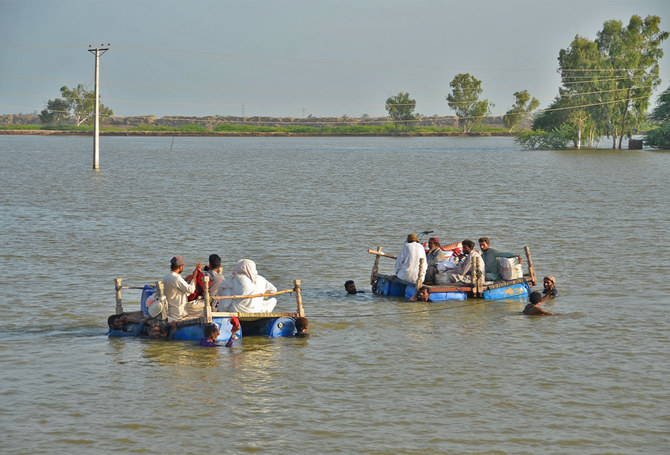
Internally displaced people wade through floodwaters after heavy monsoon rains at Usta Mohammad city in Jaffarabad district of Balochistan province on September 18, 2022. (AFP)
Short Url
Updated 23 September 2022
Follow

Neither did India offer flood aid, nor did Islamabad ask — Pakistani foreign minister

  • Muslim-majority Himalayan region has been at the heart of more than 70 years of animosity between Pakistan and India
  • Bhutto Zardari draws world’s attention to conflict in Indian-administered Kashmir, calls for “lasting” solution at OIC meeting

ISLAMABAD: Pakistani foreign minister Bilawal Bhutto Zardari said on Thursday engagement with neighbor and archrival India was “untenable” over what he called its anti-Muslim policies, especially in Indian-administered Kashmir, adding that India had not offered flood aid to Islamabad.

The Muslim-majority Himalayan region of Kashmir has been at the heart of more than 70 years of animosity since the partition of the British colony of India into the separate countries of Muslim Pakistan and majority Hindu India. Both rule parts of the region but claim it in full.

Ties between the nuclear-armed rivals have been particularly strained since a suicide bombing of an Indian military convoy in Kashmir in 2019 that New Delhi says was carried out by Pakistan-based militants. The bombing led to India sending warplanes to Pakistan. Islamabad denies state complicity in any attacks in Indian-administered Kashmir.

In August 2019, Indian Prime Minister Narendra Modi withdrew Indian-administered Kashmir’s autonomy in order to tighten his grip over the territory, provoking outrage in Pakistan and the downgrading of diplomatic ties and suspension of bilateral trade.

“Unfortunately, the India today is a changed India … it is no longer the secular India promised by its founding fathers for all its citizens,” Bhutto Zardari said in an interview with a French TV channel when the host asked if India had sent aid to help victims of cataclysmic floods. “It is increasingly becoming a Hindu-supremacist India at the expense of its Christian and Muslim minorities.”

“We have seen certain steps and actions that had made engagement with India untenable for us, particularly the unilateral illegal actions of August 2019,” the foreign minister added. “All of this creates very little space for us to engage.”

When asked if India had sent aid after the recent catastrophic floods that have killed almost 1,600, the Pakistani leader said: “No.”

When asked if Pakistan had requested assistance from India, he added: “No.”

On Wednesday, Bhutto Zardari drew the world’s attention to the ongoing conflict in Indian-administered Kashmir, calling for a “just and lasting” solution while speaking at a meeting of the OIC Contact Group on Jammu and Kashmir on the margins of the 77th United Nations General Assembly Session in New York on Wednesday.

The group reviewed the political and security environment in Kashmir Valley and what it called “the deteriorating humanitarian and human rights situation” there.

The Contact Group comprises Azerbaijan, Niger, Pakistan, Saudi Arabia and Turkey.

OIC Secretary General Hissein Brahim Taha chaired the meeting and in his opening remarks reaffirmed the OIC’s commitment to a “peaceful settlement of the Jammu and Kashmir dispute in accordance with the relevant resolutions of the United Nations and the OIC Summits and Council of Foreign Ministers.”

He also presented a report on the implementation of an action plan agreed upon during the last meeting of the Contact Group in March 2022 in Islamabad.

Speaking at the Contact Group meeting, Bhutto Zardari drew attention to “the worsening situation” in Kashmir since August 2019.

Indian security forces, he said, “continued to conduct cordon-and-search operations, put down protests violently, indiscriminately use pellet guns, imprison Kashmiri political leaders, abduct and torture children and women, and stage fake encounters.”

“The Foreign Minister stressed that durable peace and stability in South Asia would remain tense and fragile without a just and lasting solution to the Jammu and Kashmir dispute in accordance with United Nations Security Council resolutions and the wishes of the Kashmiri people,” the foreign office said in a statement.

The meeting of the Contact Group concluded with the adoption of a joint communiqué that “unequivocally reaffirmed the OIC’s position and resolutions on the Jammu and Kashmir dispute.”



Pakistan opposition to continue protest over ex-PM Khan’s health amid conflicting reports

Updated 16 February 2026
Follow

Pakistan opposition to continue protest over ex-PM Khan’s health amid conflicting reports

  • Pakistan’s government insists that the ex-premier’s eye condition has improved
  • Khan’s personal doctor says briefed on his condition but cannot confirm veracity

ISLAMABAD: Pakistan’s opposition alliance on Monday vowed to continue their protest sit-in at parliament and demanded “clarity” over the health of jailed former prime minister Imran Khan, following conflicting medical reports about his eye condition.

The 73-year-old former cricket star-turned-politician has been held at the high-security Adiala prison in Rawalpindi since 2023. Concerns arose about his health last week when a court-appointed lawyer, Barrister Salman Safdar, was asked to visit Khan at the jail to assess his living conditions. Safdar reported that Khan had suffered “severe vision loss” in his right eye due to central retinal vein occlusion (CRVO), leaving him with just 15 percent sight in the affected eye.

On Sunday, a team of doctors from various hospitals visited the prison to examine Khan’s eye condition, according to the Adiala jail superintendent, who later submitted his report in the court. On Monday, a Supreme Court bench led by Chief Justice Yahya Afridi observed that based on reports from the prison authorities and the amicus curiae, Khan’s “living conditions in jail do not presently exhibit any perverse aspects.” It noted that Khan had “generally expressed satisfaction with the prevailing conditions of his confinement” and had not sought facilities beyond the existing level of care.

Having carefully perused both reports in detail, the bench observed that their general contents and the overall picture emerging therefrom are largely consistent. The opposition alliance, which continued to stage its sit-in for a fourth consecutive day on Monday, held a meeting at the parliament building on Monday evening to deliberate on the emerging situation and discuss their future course of action.

“The sit-in will continue till there is clarity on the matter of [Khan's] health,”  Sher Ali Arbab, a lawmaker from Khan's Pakistan Tehreek-e-Insaf (PTI) party who has been participating in the sit-in, told Arab News, adding that PTI Chairman Gohar Ali Khan and Opposition Leader in Senate Raja Nasir Abbas had briefed them about their meeting with doctors who had visited Khan on Sunday.

Speaking to reporters outside parliament, Gohar said the doctors had informed them that Khan’s condition had improved.

“They said, 'There has been a significant and satisfactory improvement.' With that satisfactory improvement, we also felt satisfied,” he said, noting that the macular thickness in Khan’s eye had reportedly dropped from 550 to 300 microns, a sign of subsiding swelling.

Gohar said the party did not want to politicize Khan’s health.

“We are not doctors, nor is this our field,” he said, noting that Khan’s personal physician in Lahore, Dr. Aasim Yusuf, and his eye specialist Dr. Khurram Mirza had also sought input from the Islamabad-based medical team.

“Our doctors also expressed satisfaction over the report.”

CONFLICTING ACCOUNTS

Despite Gohar’s cautious optimism, Khan’s personal physician, Dr. Yusuf, issued a video message on Monday, saying he could neither “confirm nor deny the veracity” of the government’s claims.

“Because I have not seen him myself and have not been able to participate in his care... I’m unable to confirm what we have been told,” Yusuf said.

He appealed to authorities to grant him or fellow physician, Dr. Faisal Sultan, immediate access to Khan, arguing that the ex-premier should be moved to Shifa International Hospital in Islamabad for specialist care.

Speaking to Arab News, PTI’s central information secretary Sheikh Waqas Akram said Khan’s sister and their cousin, Dr. Nausherwan Burki, will speak to media on Tuesday to express their views about the situation.

The government insists that Khan’s condition has improved.

“His eye [condition] has improved and is better than before,” State Minister Talal Chaudhry told the media in a brief interaction on Monday.

“The Supreme Court of Pakistan is involved, and doctors are involved. What medicine he receives, whether he needs to be hospitalized or sent home, these decisions are made by doctors. Neither lawyers nor any political party will decide this.”