

Engagement with India ‘untenable,’ Pakistan FM says when asked if neighbor sent flood aid

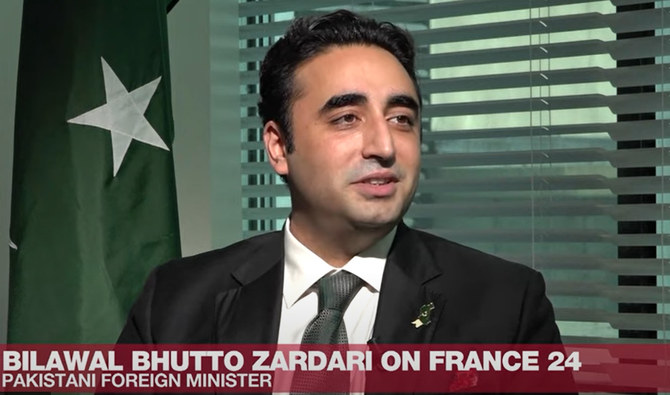
Pakistani Foreign Minister Bilawal Bhutto Zardari speaks during an interview with France 24 in New York on September 22, 2022. (Screengrab)
Short Url
Updated 23 September 2022
Follow

Engagement with India ‘untenable,’ Pakistan FM says when asked if neighbor sent flood aid

  • Muslim-majority Himalayan region has been at the heart of more than 70 years of animosity between Pakistan and India
  • Bhutto Zardari draws world’s attention to conflict in Indian-administered Kashmir, calls for “lasting” solution at OIC meeting

ISLAMABAD: Pakistani foreign minister Bilawal Bhutto Zardari said on Thursday engagement with neighbour and archrival India was “untenable” over what he called its anti-Muslim policies, especially in Indian-administered Kashmir.

The Muslim-majority Himalayan region of Kashmir has been at the heart of more than 70 years of animosity since the partition of the British colony of India into the separate countries of Muslim Pakistan and majority Hindu India. Both rule parts of the region but claim it in full.

Ties between the nuclear-armed rivals have been particularly strained since a suicide bombing of an Indian military convoy in Kashmir in 2019 that New Delhi says was carried out by Pakistan-based militants. The bombing led to India sending warplanes to Pakistan. Islamabad denies state complicity in any attacks in Indian-administered Kashmir.

In August 2019, Indian Prime Minister Narendra Modi withdrew Indian-administered Kashmir’s autonomy in order to tighten his grip over the territory, provoking outrage in Pakistan and the downgrading of diplomatic ties and suspension of bilateral trade.

“Unfortunately, the India today is a changed India … it is no longer the secular India promised by its founding fathers for all its citizens,” Bhutto Zardari said in an interview with a French TV channel when the host asked if India had sent aid to help victims of cataclysmic floods. “It is increasingly becoming a Hindu-supremacist India at the expense of its Christian and Muslim minorities.”

“We have seen certain steps and actions that had made engagement with India untenable for us, particularly the unilateral illegal actions of August 2019,” the foreign minister added. “All of this creates very little space for us to engage.”

On Wednesday, Bhutto Zardari drew the world’s attention to the ongoing conflict in Indian-administered Kashmir, calling for a “just and lasting” solution while speaking at a meeting of the OIC Contact Group on Jammu and Kashmir on the margins of the 77th United Nations General Assembly Session in New York on Wednesday.

The group reviewed the political and security environment in Kashmir Valley and what it called “the deteriorating humanitarian and human rights situation” there.

The Contact Group comprises Azerbaijan, Niger, Pakistan, Saudi Arabia and Turkey.

OIC Secretary General Hissein Brahim Taha chaired the meeting and in his opening remarks reaffirmed the OIC’s commitment to a “peaceful settlement of the Jammu and Kashmir dispute in accordance with the relevant resolutions of the United Nations and the OIC Summits and Council of Foreign Ministers.”

He also presented a report on the implementation of an action plan agreed upon during the last meeting of the Contact Group in March 2022 in Islamabad.

Speaking at the Contact Group meeting, Bhutto Zardari drew attention to “the worsening situation” in Kashmir since August 2019.

Indian security forces, he said, “continued to conduct cordon-and-search operations, put down protests violently, indiscriminately use pellet guns, imprison Kashmiri political leaders, abduct and torture children and women, and stage fake encounters.”

“The Foreign Minister stressed that durable peace and stability in South Asia would remain tense and fragile without a just and lasting solution to the Jammu and Kashmir dispute in accordance with United Nations Security Council resolutions and the wishes of the Kashmiri people,” the foreign office said in a statement.

The meeting of the Contact Group concluded with the adoption of a joint communiqué that “unequivocally reaffirmed the OIC’s position and resolutions on the Jammu and Kashmir dispute.”


Separated twice: An Afghan man’s life in Pakistan and the fear of losing home again

Updated 27 January 2026
Follow

Separated twice: An Afghan man’s life in Pakistan and the fear of losing home again

  • Lost as a child in Peshawar, Mohammad Rahim Khan built a life in Pakistan but remains undocumented
  • Deportation drive of ‘illegal’ foreigners exposes legal gaps around adoption, marriage, refugee status

ISLAMABAD: Mohammad Rahim Khan was five years old when he last saw his mother.

It was at the Hajji Camp bus stop in Pakistan’s northwestern city of Peshawar, more than four decades ago. His mother, an Afghan refugee fleeing war, had brought him across the Tari Mangal border in Kurram district and into Pakistan. While waiting at the crowded terminal, Khan wandered to a nearby toy shop. When he returned, she was gone.

He searched for her for two days. She never came back.

A local shopkeeper, Ali Muhammad, took pity on the child and brought him home, promising to help find his family. The temporary shelter became permanent. Khan grew up in Pakistan, adopted informally into the household, and never returned to Afghanistan.

Now 45, he lives on the outskirts of Islamabad in a modest two-room house, working as a daily wage laborer. But a nationwide deportation drive launched by Pakistan in 2023 has placed his entire life under threat.

Since November 2023, authorities have deported nearly 2 million Afghan nationals, targeting those without legal documentation. Khan, who has remained undocumented throughout his adult life, fears he may soon be among them.

“I spoke to my lawyer that I am very worried,” Khan told Arab News. “I love Pakistan.”

A FAMILY WITHOUT PAPERS

Ali Muhammad later married Khan to his daughter, Gul Mina. Together, they have six children, four daughters and two sons. Yet despite decades in Pakistan, Khan’s Afghan nationality continues to shadow the family.

Khan never held an Afghan refugee card, Afghan Citizen Card (ACC), Proof of Registration (POR), or any other formal documentation. His family assumed for decades that his informal adoption, marriage to a Pakistani citizen, and long residence would provide sufficient legal standing. They only sought legal advice when the deportation drive began threatening separation.

Without a Pakistani national identity card, his children cannot obtain Form-B, the birth registration document required for school enrolment.

“They [children] are told to get a Form-B,” Gul Mina told Arab News. “Otherwise, they will not go to school.”

Three of their daughters were forced to leave school after eighth grade.

Healthcare has also been affected. When Khan’s 13-year-old son, Ehsanullah, fractured his arm, a public hospital refused to issue a registration card without identity documents.

“Then I went to a [private clinic] in Chak Shahzad and got my treatment there,” Khan said.

The family has petitioned the Islamabad High Court to block his deportation. Lawyers say the case highlights how thousands of long-term residents fall through legal cracks created by Pakistan’s citizenship, refugee and documentation framework.

LEGAL GREY ZONE

Pakistan does not legally recognize Western-style adoption. Instead, it uses a guardianship system under the 1890 Guardians and Wards Act, aligning with Islamic principles that preserve lineage, so adopted children don’t inherit or change their family name but receive care, education and welfare through court-appointed guardianship.

“Because we don’t have a legal pathway for adoption per se, the adopted child does not get citizenship of the adopting parents automatically,” said Advocate Umer Ijaz Gillani, a legal expert on citizenship.

Years earlier, Khan’s father-in-law had offered to register him as his biological son to obtain identity documents, but Khan refused, calling the move fraudulent. Because Khan later married his father-in-law’s daughter, both he and his wife cannot legally list the same person as their father on official records, leaving them without a lawful workaround.

Marriage offers no certainty either. Pakistan’s Citizenship Act of 1951 grants citizenship to foreign women married to Pakistani men, but is silent on foreign husbands married to Pakistani women.

While higher courts have, at times, ruled in favor of such men, implementation has been inconsistent. In October 2025, the Supreme Court struck down a high court order that had directed authorities to grant citizenship to an Afghan man married to a Pakistani woman.

Even the Pakistan Origin Card (POC), a long-term residency document, remains difficult to secure.

“We have experienced that in the case of especially Afghan men who marry Pakistani women, the government authorities are often reluctant to recognize this right,” Gillani said.

According to submissions made by government officials in court, authorities have received at least 117 applications for nationality from Afghan men married to Pakistani women following directives issued by the Peshawar High Court, reflecting a broader pattern rather than isolated cases.

‘NO RELAXATION’

Officials say the deportation policy allows no exceptions.

“No relaxation has been granted by the government, including for those who’ve married to Pakistani citizens,” said Asmatullah Shah, the chief commissionerate for Afghan refugees.

“If they want to live here, they should go back and apply for a visa and then they can come here with valid documentation.”

Legal experts note that deportation would send Khan to Afghanistan despite having no known relatives there, and that returning legally would require obtaining an Afghan passport and a Pakistani visa, costs far beyond the means of a daily wage laborer.

For Khan’s mother-in-law, Husn Pari, who raised him for decades as her own son, the prospect is devastating.

“When I am not able to meet [Khan] for one day, my day does not pass,” she said. “His own mother, how much pain must she be in?”

For Khan, the fear of deportation echoes the trauma of his childhood.

“Before I was separated from my first mother,” he said. “The second time I will be separated from my second mother. This is very difficult for me.”