

RIYADH: Mental health is still often considered a taboo subject in the region and across the world, with explanations ranging from the superstitious to the criminal, but it is now being highlighted and normalized by Saudi filmmakers with their movies and television shows.
In her most recent work, Saudi writer, director, and actress Sarah Taibah packs a collection of laughs, empathy, and thought-provoking elements into the TV series “Jameel Jeddan.” The show is a coming-of-age story that takes viewers on a journey of love, trauma, and loss, to ultimately accepting reality, alongside quirky anime references and challenging of stigmas.
Taibah plays the main character, Jameel, who wakes up from a five-year coma and is forced to finish her last year at high school, rejoining a society with which she no longer identifies. As a coping mechanism, she begins to form an animated alternative reality.
“I think mental health is a very private experience that one battles with on a daily basis, secretly, without necessarily sharing it,” Taibah told Arab News.
She believes it’s important for films and shows to feature protagonists struggling with mental health issues — “something very relatable yet misunderstood in society.”
What Taibah and fellow filmmaker and director of the show, Anas BaTahaf, do is present the story — and mental health issues — in a palatable way for mass audiences. Saudi viewers often respond well to comedy or action, perhaps explaining why Saudi cinema often lacks sensitive stories.
In Saudi, about one in three adults have experienced a diagnosable mental disorder during their lifetime, according to the Saudi National Health & Stress Survey. Awareness is often the first step in both helping people understand they need help, and in offering help to those who need it.
According to a recent study by the British Board of Film Classification of young people between the ages of 13 and 18, 78 percent believe that film and TV play an integral role in spreading awareness about mental health issues. In addition, 68 percent said that positive portrayals in entertainment media can help destigmatize these issues.
Another example is that of the upcoming Saudi feature film “Lithium,” which centers around individuals living with bipolar disorder, suffering silently in society. The film aims to present the condition in a positive and honest manner.
The film won support at the Red Sea Fund last month, which aims to provide a more diverse set of movies to global audiences and better serve both Saudi and Arab filmmakers.
“Mental health is still considered a taboo (subject) around the world. These misconceptions should be fixed as some movies tend to show mentally ill people as violent or dangerous to society. More awareness should be maximized around mass media channels and especially among social media influencers,” Talha B., the film’s co-director, told Arab News.
Whether mental health disorders are the main plot driver or incorporated into minor plotlines, they can aid in understanding the psychology and nature of these conditions, creating a community driven by compassion and empathy, he said.
“Everyone suffering from mental illness deserves a chance to be an active member of our society. We believe stories can help break down difficult subject matters like the importance of mental health. Telling stories like ours can help the medicine go down, so to speak,” he added.
Globally, several movies and shows depict mental health issues with recent work including “The Queen’s Gambit,” “BoJack Horseman,” and “Atypical.” However, such work is a rarity in the region.
Still, many Saudi creators acknowledge the need to spotlight mental health on-screen in order to create a greater impact through cultural scenarios that resonate with the Saudi public.
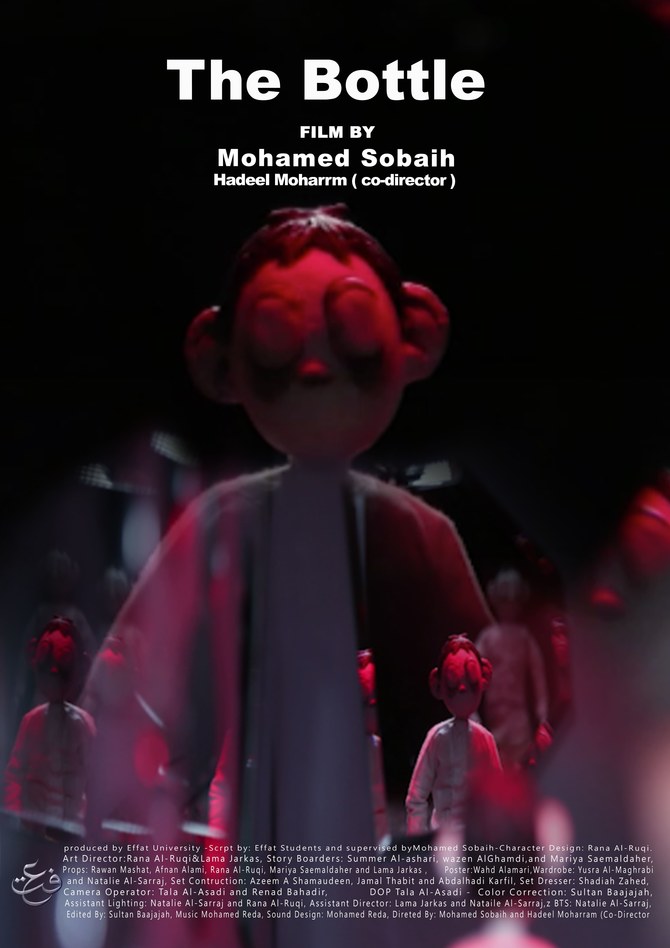
“Nowadays, there is a great need for screening short movies that discuss mental health issues. People need to watch these kinds of movies to understand that all mental issues start within. If the target audience were educated enough about the subject, then they can deal with the problem,” Dr. Mohamed Sobaih, co-director of the stop-motion animation “The Bottle,” told Arab News.
The short animation, initially produced by cinematic arts students at Effat University, examines the life of a man living in a constant loop of his deepest fears, haunted by his worst anxieties.
“The film started out as a final project for a course taught for Cinematic Arts students in Effat University. Us, the batch who made this film, wanted to make something really unique when we decided that the story should focus on what it’s like to suffer from mental health diseases,” said co-director Hadeel Moharram.
The short film was later remade based on feedback from viewers and was screened at the Saudi Film Festival in 2021, where it received rave reviews from audiences who acknowledged the need for seeing such narratives on-screen.
“People came to us after the screening expressing their emotions after watching the film — how they saw pieces of themselves in it and their loved ones. It’s a film after all, and films are for people, and what better way to express ourselves and tell stories other than this form of art,” Moharram said.
Haya Al-Hejailan, a Saudi well-being practitioner and psychedelic integration specialist, recently worked on the documentary “The Psychedelic Renaissance,” which follows the global developments in the field of psychedelic science, medicine, and culture since 2018.
The film, now seeking its final stage of funding, platforms top researchers and figures in the field and highlights two of the most popular psychedelic therapy treatments for depression, post-traumatic stress disorder, and substance dependence. It aims to destigmatize mental health conversations and educate the masses on alternative treatments.
“It raises awareness through psychoeducation, which empowers people to help themselves and help others. The media is a powerful tool for reaching a wide audience and talking about difficult topics in a manner that is digestible and resonant,” Al-Hejailan told Arab News.
She added: “Media representation reminds people suffering that they are not alone and that their suffering is valid — as valid as physical ailments — and it instills hope in people by showing them that this is a part of the human condition and can be effectively addressed and treated through a number of different avenues.”