

AmCham Saudi Arabia launches green business initiative

1 / 4
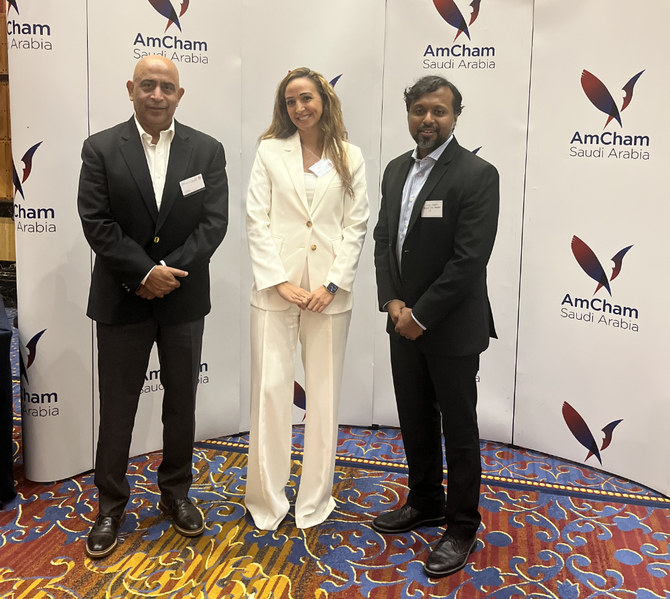
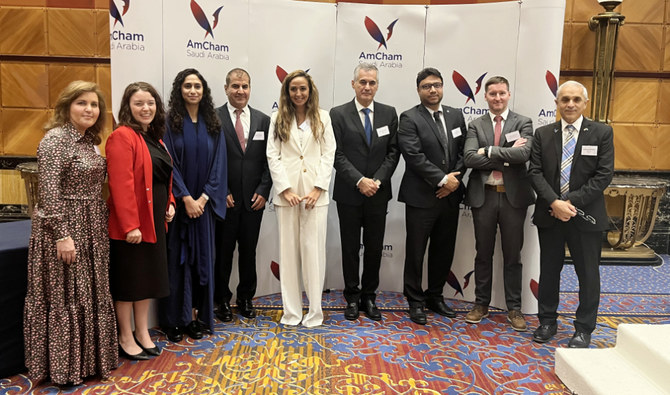
Several leading diplomats, academics and business officials took part in a panel discussion to discuss ESG strategies, plans and reporting at the Jeddah Hilton Hotel where the ESG committee was launched. (Supplied)
2 / 4
Several leading diplomats, academics and business officials took part in a panel discussion to discuss ESG strategies, plans and reporting at the Jeddah Hilton Hotel where the ESG committee was launched. (Supplied)
3 / 4
Several leading diplomats, academics and business officials took part in a panel discussion to discuss ESG strategies, plans and reporting at the Jeddah Hilton Hotel where the ESG committee was launched. (Supplied)
4 / 4
Several leading diplomats, academics and business officials took part in a panel discussion to discuss ESG strategies, plans and reporting at the Jeddah Hilton Hotel where the ESG committee was launched. (Supplied)
Short Url
Updated 21 September 2022
Follow

AmCham Saudi Arabia launches green business initiative

  • AmCham’s new committee to help firms meet environmental obligations
  • Top local, international executives discuss protections for consumers

JEDDAH: The American Chamber of Commerce in Saudi Arabia, or AmCham Saudi Arabia, launched a new committee on Monday to help companies meet their environmental and social responsibility goals.

The ESG, or Environmental, Social and Corporate Governance, committee was launched at the Jeddah Hilton Hotel.

Several leading diplomats, academics and business officials took part in a panel discussion to discuss ESG strategies, plans and reporting.

Julie LeBlanc, US commercial consul for the western region, said American businesses were committed to support the Kingdom’s plans on this front.

“Major US companies, which are leaders in ESG participated in the panel event including PepsiCo, UL, and AspenTech to discuss innovations and best practices in ESG. The United States is committed to supporting the Kingdom’s Vision 2030 goal to diversify its economy,” she said.

The panel was moderated by Nizar Kammourie, CEO of SAWACO Water Desalination, who said the ESG committee would help raise awareness in the business sector on the need for firms to operate in a socially responsible manner.

“By doing so, the AmCham ESG Committee aims to pave the way for US businesses to explore new venues for opportunities in the Saudi market,” he said.

The panelists shared various sustainability measures adopted by their companies which they described as innovative and pioneering.

Tala Alem, sustainability lead at PepsiCo spoke about the responsibility of her company toward ESG based on its business model, operating systems and products.

“At PepsiCo, we look at everything we are engaged in including our entire value chain and creating a sustainability framework to be applied in each country. As every country has its own objectives, in Saudi Arabia, we take into consideration several areas which include agriculture and climate impact, plastics usage and its packaging as well as social and community responsibilities.”

“While every company on its own has a bigger responsibility to the community and the environment, it is valuable for companies to come together with or without the government and share best practices and present case studies as there is a lot of value in it. Such events should be organized more frequently in order to build awareness and encourage everyone to adopt ESG strategies in their company,” Alem added.

Dareen Ayyad, country manager at Underwriters Laboratories, discussed the benefits and the specifics of ESG reporting.

“We look forward to assisting the companies looking for solutions with ESG reporting. UL is providing solutions when it comes to ESG reporting with the help of a software called UL 360 that will help customers in the Kingdom to gather all the ESG data that compile all the information and manage the data.

“We are also offering reporting software for identifying the ESG risks and opportunities. UL offers third party certification and third party advisory services to address the ESG means. We are hoping to create more awareness amongst corporations on the importance of ESG reporting and look forward to engaging with more stakeholders in the Kingdom.”

Echoing these sentiments, David McKenna, sustainability performance director of The Red Sea Development Co., said: “It is important to raise the topic of ESG reporting as more the companies adopt it, the more transparency can be acquired.

“Some companies will take a step forward whereas some backward as it’s not easy to accept ESG strategies, but it is important to disclose the performance across metrics, which could, for various factors, macro and micro, may go up and down but at least the ESG will set a baseline and that will showcase it to the consumers.”

Saif Sheikh, MENA director of solution consulting at Aspen Technology, and Johnny Obeid, vice president of the Middle East at Veolia, opined that ESG is no longer an option and has to be built into business strategy.

Rola Osta, the engagement manager of the chamber’s Jeddah chapter, said that governments and companies have started to take an increased interest in ESG, gaining it an elevated status of relevance.

“A lot of companies are striving to deliver sustainable solutions and outcomes from their operations while aligning the committee’s goals with the Saudi Green Initiative. The AmCham ESG launched this event to present the effort and strategy of companies and government agencies in adopting ESG principles to provide sustainable solutions for their operations.”

Mohammad Tafesh, vice president of the Jeddah chapter, said: “The ESG committee aims to create bridges between US businesses and their counterparts in the Kingdom to provide environmental and sustainability solutions. This will be the first of many upcoming events related to ESG.”

The event was attended by representatives from the US and Italian consulates, Saudi and international companies, and educators from top Saudi universities.

The event concluded with a round of questions and answers.


How Saudi Arabia’s five Founding Day symbols tell a 299-year story

Updated 22 February 2026
Follow

How Saudi Arabia’s five Founding Day symbols tell a 299-year story

  • The flag, the palm, the Arabian horse, the souq and the falcon are symbols that connect Saudi Arabia to its roots
  • Researcher Ismail Abdullah Hejles explains how the Kingdom’s symbols anchor identity, heritage and continuity

RIYADH: As Saudi Arabia prepares to mark its 299th anniversary this Founding Day — commemorating the establishment of the First Saudi State by Imam Muhammed bin Saud in 1727 CE — the moment invites reflection not only on history, but on the symbols that distill that history into enduring meaning.

Beyond ceremony and celebration, the Kingdom’s official Founding Day emblems tell a deeper story: of survival in a harsh landscape, of state-building against the odds, and of values carried forward across nearly three centuries. Together, they form a visual language that binds past to present and projects confidence into the future.

The five Founding Day symbols — the green flag, the palm tree, the Arabian horse, the souq, and the falcon — do not serve a purely celebratory function, Ismail Abdullah Hejles, a Saudi researcher in traditional architecture, told Arab News. Rather, they carry an intellectual and cultural role that connects society to its roots.

“Nations that understand their symbols and identity understand themselves and are better equipped to continue their journey with confidence and balance,” he said.

The Saudi flag. (SPA)

The Saudi flag, a representation of unity and sovereignty, embodies the values upon which the state was founded and reflects the continuity of the nation, linking its past to its present. The current design was adopted in 1937, refining historical banners from the first and second Saudi states.

The Shahada, the Islamic declaration of faith, symbolizes the Kingdom’s foundation on Islamic values, while justice and safety are echoed through the sword, which represents the unification of the Kingdom during the reign of the late King Abdulaziz Al-Saud.

The flag’s green color is traditionally associated with Islam, reflecting continuity and faith as central pillars of the Saudi state.

Additionally, the palm tree and the crossed swords — now synonymous with Saudi Arabia — officially appeared in the Kingdom’s emblem around 1950 following unification. Together, they express strength, justice, and the protection of unity.

The Saudi emblem

“The choice was not arbitrary,” Hejles said. “It brought together strength (the sword) and life and sustainability (the palm). It reflects a careful balance of firmness and generosity.”

The palm tree’s symbolic presence, however, predates the modern state, stretching back to the ancient civilizations of the Arabian Peninsula.

“In the simple oases, the palm tree was life, and the swords were dignity. The palm offered shade and sustenance, the swords protected the land and the name. Between the shade of the palm and the edge of the sword, the story of a nation takes place.”

The palm tree served numerous functions essential to the sustainability of civilizations. Its dates were a nutritious food; its fronds were used for roofing; its trunk built walls; its fiber made ropes; and it provided fuel and shade for communities.

In places such as Qatif and Al-Ahsa, the palm tree formed a complete life system with almost no waste. (SPA)

In places such as Qatif and Al-Ahsa, the palm formed a complete life system with almost no waste. It was not merely an agricultural symbol, but a genuine model of sustainability long before the term itself was coined, Hejles said.

Mentioned in the Qur’an more than 20 times, always associated with generosity and abundance, the palm formed the backbone of the agricultural economy in eastern Arabia.

“The souq (traditional market) was not merely a place of trade but a space for social interaction, knowledge exchange, and solidarity,” Hejles said. Through it, economic activity flourished and relationships between communities were strengthened.

A civilizational concept that emerged centuries before Islam, the souq arose from a simple human need: exchange. (Supplied)

“Nomads and desert dwellers possessed surplus goods and sought what they lacked through barter.”

A civilizational concept that emerged centuries before Islam, the souq arose from a simple human need: exchange. That exchange generated social mobility and fostered a culture of openness, which later contributed to the rise of cities.

A civilizational concept that emerged centuries before Islam, the souq arose from a simple human need: exchange. (Supplied)

In the pre-Islamic era, seasonal markets such as Souq ‘Ukaz, Souq Majanna, and Souq Dhu Al-Majaz were not only commercial hubs, but also literary forums, political arenas, and spaces for reconciliation and arbitration.

Once Islam was adopted, Souq Al-Madinah was established on principles prohibiting monopoly, forbidding fraud, and ensuring justice.

In the Saudi state, the souq evolved from traditional mud-and-wood covered bazaars into modern shopping centers and large commercial complexes. “Yet, the concept remained the same: a place of encounter before it is a place of sale,” Hejles said.

A civilizational concept that emerged centuries before Islam, the souq arose from a simple human need: exchange. (Supplied)

The Arabian horse, another Founding Day symbol, is associated with authenticity and courage. It accompanied the early stages of state-building, travel, and defense, becoming a symbol of strength and pride in Arab heritage.

The Arabs’ oldest companion, the Arabian horse is one of the oldest and purest breeds in the world. It was bred on the Arabian Peninsula for extreme endurance, speed, and agility.

Thanks to their lung capacity, endurance, and strong feet and bones, these horses could cover long distances in harsh desert conditions and survive on minimal resources, sometimes fed only dates and camel’s milk.

To protect them against theft and harsh weather, they were sometimes brought inside family tents, which led to the development of intense bonds with their owners. Arabian horses are known to be fearless and loyal, capable of protecting their masters in battle.

The Arabs’ companion, the Arabian horse is one of the oldest and purest breeds in the world. It was bred on the Arabian Peninsula for extreme endurance, speed, and agility. (SPA photo)

They also possessed a “war-sense,” allowing them to act intelligently in combat, known as well to have a high spirit in battle.

In Saudi Arabia, Arabian horses were vital in travel, trade, and warfare. Today, they symbolize nobility, pride, courage, and honor — reflecting and continuing the Kingdom’s equestrian legacy.

And finally, vigilance, insight, and high ambition are represented by the falcon. “It is tied to the practice of falconry, which requires patience and skill, and today symbolizes the continuity of heritage and elevated aspirations,” Hejles said.

The falcon was not merely a hobby but a hunting tool in a harsh desert environment, a companion to the Bedouin, and a symbol of strength, precision, and patience. (AN photo/AN Huda Bashatah)

Falconry was not merely a hobby, but a hunting tool in a harsh desert environment — a companion to the Bedouin and a symbol of strength, precision, and patience. The long training required to master falconry fostered discipline and strong leadership in its practitioners.

Over time, the falcon became associated with prestige and courage, linked to Bedouin identity and nobility, and embedded in poetry and storytelling.

A heritage passed through generations, falconry is now inscribed on UNESCO’s Representative List of the Intangible Cultural Heritage of Humanity, with Saudi Arabia and other participating countries, reinforcing its global cultural significance.

The falcon was not merely a hobby but a hunting tool in a harsh desert environment, a companion to the Bedouin, and a symbol of strength, precision, and patience. (SPA)

“These symbols were not chosen for their visual appeal,” Hejles said. “They were chosen because they were tested across centuries of lived experience.”

Representing more than their individual images, they are collectively an expression of the Saudi citizen’s relationship with land, environment, dignity, and continuity.