

Saudi Heritage Authority seeks to preserve pottery in Madinah

1 / 2
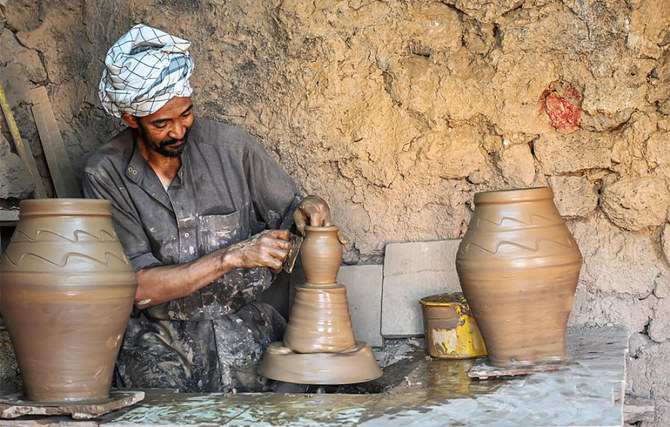
The clay dough is prepared by hand before adding other natural materials to ensure it holds together before using molds of various sizes to obtain the required design. (SPA)
2 / 2
The clay dough is prepared by hand before adding other natural materials to ensure it holds together before using molds of various sizes to obtain the required design. (SPA)
Short Url
Updated 19 September 2022
Follow

Saudi Heritage Authority seeks to preserve pottery in Madinah

  • “Demand for pottery is declining due to the diversity of modern household utensils that have become widely accessible, as well as their different prices

MADINAH: Madinah is known for traditional handicrafts and pottery, as well as the Prophet’s Mosque and other religious sites.

Pottery was initially used by people in everyday life as household items, from storage and cooking to transportation of goods.

But today, due to factory-produced household goods made of plastic, ceramic and aluminum, the ancient craft of pottery is slowly dying as people merely use it as souvenirs or decorative items.

The Saudi Heritage Authority is conducting courses and workshops to preserve pottery, and supporting family potters by displaying their products at events, the Saudi Press Agency reported.

Tammam Mahmoud, one of the potters in the region, is striving hard to keep the art alive. “I’m proud to have inherited this profession from my father and grandfather more than 40 years ago. Despite the challenges and difficulties faced by potters, patience is helping them move forward,” said Mahmoud.

FASTFACT

Potter Tammam Mahmoud said the clay used for pottery production is sourced from the valleys of Madinah following rains.

“Demand for pottery is declining due to the diversity of modern household utensils that have become widely accessible, as well as their different prices.
“Today, the pottery industry is limited to the technical and aesthetic aspects … such as souvenir gifts bought by tourists.”

Mahmoud said the clay used for pottery production is sourced from the valleys of Madinah following rains.

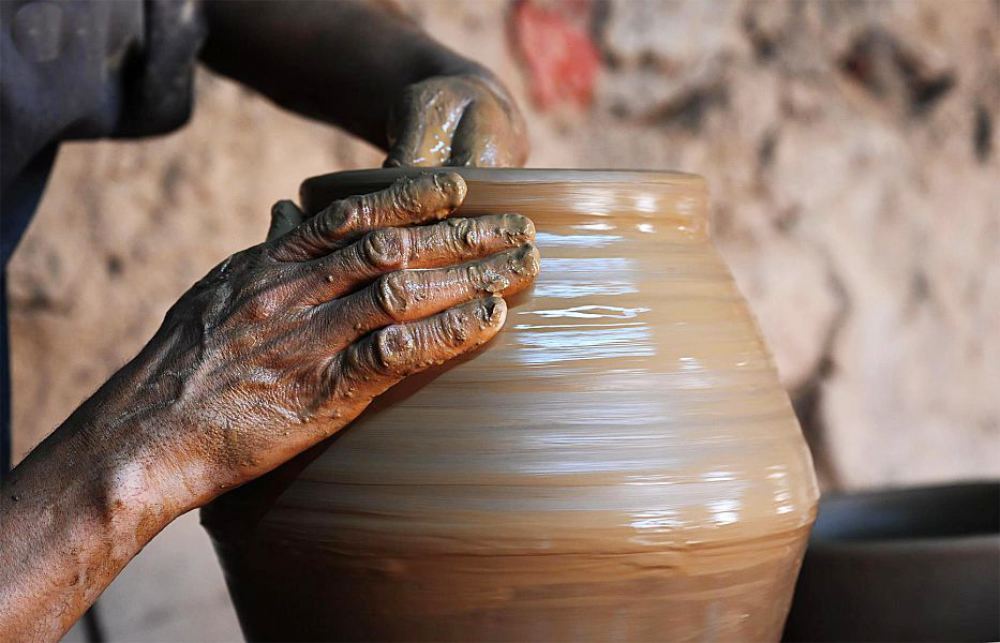
Sharing how a product takes shape, the artisan said the clay dough is prepared by hand before adding other natural materials to ensure it holds together.

The clay is then shaped using molds of various sizes to obtain the required design. The product is dried under the sun, before being baked in a traditional oven at a specific temperature to ensure its durability. It is then sent to the market for sale.  


Children’s Theater Festival opens in Qassim region

Updated 27 January 2026
Follow

Children’s Theater Festival opens in Qassim region

  • To develop future ‘cultural architects,’ says CEO Khaled Al-Baz
  • ‘Nurture creativity, aesthetic awareness and sense of belonging’

BURAIDAH: The Qassim Children’s Theater Festival opened on Tuesday bringing together professionals from across Saudi Arabia and the Gulf.

The event is being held under the patronage of Prince Dr. Faisal bin Mishaal bin Saud bin Abdulaziz, governor of Qassim, at the Science Center in Unaizah governorate.

It has been Organized by the Theater and Performing Arts Association and executed by the Unaizah Theater Association, the Saudi Press Agency reported.

Running until Jan. 31, it features shows, panel discussions, as well as training workshops to develop children’s theater and strengthen professional skills in the field.

Khaled Al-Baz, CEO of the Theater and Performing Arts Association, told the SPA the festival forms part of a broader strategy to position children’s theater as a distinct cultural sector.

“Children today constitute genuine audiences — tomorrow’s cultural architects,” Al-Baz said.

Ahmed Al-Humaimidi, president of the Unaizah Theater Association, said it was an investment in young people, noting that it extends beyond performances to include cultural and educational programming.

He said the initiative aims to nurture creativity, aesthetic awareness and a sense of belonging, while also identifying emerging talent and encouraging knowledge exchange among theater practitioners.

“Our association recognizes children’s theater as foundational to cultivating aware, creative character,” he said.

The festival serves as both an artistic showcase and a platform for professional dialogue, reflecting the Kingdom’s expanding cultural landscape and growing focus on children’s theater as an educational and cultural tool, the SPA noted.

This occurs alongside support for signature initiatives and performing arts promotion as quality-of-life enhancement.