

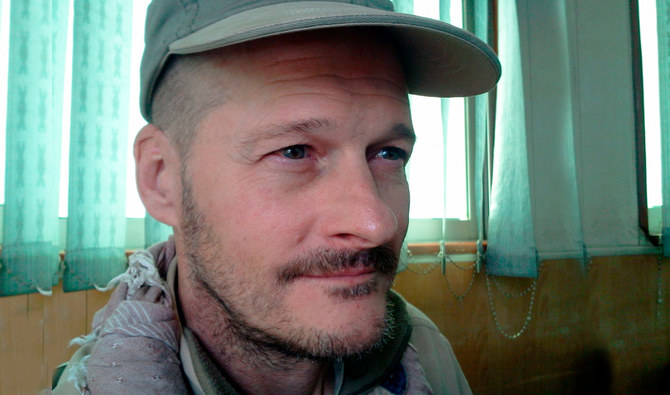
Taliban free American engineer Mark Frerichs in exchange for Afghan tribal leader

This undated photo provided to the AP shows Mark Frerichs, a U.S. veteran and civilian contractor held more than 2 years in Afghanistan by the Taliban. (AP)
Short Url
Updated 19 September 2022
Follow

Taliban free American engineer Mark Frerichs in exchange for Afghan tribal leader

  • Afghan tribal leader traded for American engineer in an exchange Kabul says will improve bilateral relations with Washington
  • Hajji Bashar Noorzai was released after more than 17 years in US custody, was arrested in New York City in 2005 on drugs charges

KABUL: The Taliban and the US have completed a prisoner swap, Afghanistan’s acting foreign minister said on Monday, with an Afghan tribal leader traded for an American engineer in an exchange Kabul says will improve bilateral relations with Washington.

Hajji Bashar Noorzai was released after more than 17 years in US custody. He was arrested in New York City in 2005 on drugs charges and sentenced to life in prison by a US court four years later. The case drew widespread attention because of Noorzai’s prominent role in the illicit drug trade and ties to Taliban founder Mullah Mohammad Omar.

Noorzai was exchanged with US citizen Mark Frerichs at the airport in Kabul, acting foreign minister Amir Khan Muttaqi said at a news conference. Frerichs had worked in Afghanistan on development projects and was abducted in February 2020.

“The American delegation came to Kabul for the exchange of Hajji Bashir and the American prisoner Mark Frerichs, and today at 10 a.m. in the morning, talks were held with them at the Kabul Airport and the exchange was carried out,” Muttaqi told reporters.

“This exchange is a new chapter in the relations between the Islamic Emirate of Afghanistan and the United States of America. We believe that this development will lead to further advancement in bilateral relations,” he added, referring to the Taliban government.

The US had been pushing for the release of Frerichs, including after the Taliban took over Afghanistan in August last year and US-led foreign forces withdrew from the country.

The US Department of State said in January “the legitimacy the Taliban seek is impossible to consider while they hold a US citizen hostage,” adding that the release of Frerichs, who is believed to be the last American held by the group, was among their “core, non-negotiable priorities.”

The prisoner swap meant that the US government “achieved its last goal,” Dr. Faiz Zaland, an Afghan analyst and public policy lecturer at Kabul University, told Arab News.

“I fear that the US will not have any further interest in Afghanistan and things may get slow, blurry and complicated in the country,” Zaland said.

A year since the Taliban took over, the new government is struggling, with its aid-dependent economy in freefall and billions of dollars in foreign aid suspended. Foreign governments have refused to recognize Afghanistan’s new rules, keeping the country further isolated.

But Noorzai’s release is likely to help the Taliban sustain their legitimacy and rule within Afghanistan.

Noorzai, who commended the Taliban’s efforts when speaking to the media following his arrival in Kabul, was a “very close ally” of Omar, the Taliban founder, in the 1990s and “a backbone of the Taliban’s system in terms of financing and military equipment,” Afghan journalist Bilal Sarwary told Arab News.

“If the Taliban were not able to release him, they wouldn’t have been able to convince their members and commanders that they are trying for the release of their friends,” Sarwary said.

He added: “In the past 20 years, the Taliban proved that they will never leave their friends alone.”


Indonesia reaffirms Yemen’s territorial integrity, backs stability efforts amid tensions

Updated 01 January 2026
Follow

Indonesia reaffirms Yemen’s territorial integrity, backs stability efforts amid tensions

  • Statement comes after Saudi Arabia bombed a UAE weapons shipment at Yemeni port city
  • Jakarta last week said it ‘appreciates’ Riyadh ‘working together’ with Yemen to restore stability

JAKARTA: Indonesia has called for respect for Yemen’s territorial integrity and commended efforts to maintain stability in the region, a day after Saudi Arabia bombed a weapons shipment from the UAE at a Yemeni port city that Riyadh said was intended for separatist forces. 

Saudi Arabia carried out a “limited airstrike” at Yemen’s port city of Al-Mukalla in the southern province of Hadramout on Tuesday, following the arrival of an Emirati shipment that came amid heightened tensions linked to advances by the UAE-backed Southern Transitional Council in the war-torn country. 

In a statement issued late on Wednesday, the Indonesian Ministry of Foreign Affairs said it “appreciates further efforts by concerned parties to maintain stability and security,” particularly in the provinces of Hadramout and Al-Mahara. 

“Indonesia reaffirms the importance of peaceful settlement through an inclusive and comprehensive political dialogue under the coordination of the United Nations and respecting Yemen’s legitimate government and territorial integrity,” Indonesia’s foreign affairs ministry said. 

The latest statement comes after Jakarta said last week that it “appreciates the efforts of the Kingdom of Saudi Arabia, as well as other relevant countries, working together with Yemeni stakeholders to de-escalate tensions and restore stability.” 

Saudi Arabia leads the Coalition to Restore Legitimacy in Yemen, which includes the UAE and was established in 2015 to combat the Houthi rebels, who control most of northern Yemen. 

Riyadh has been calling on the STC, which initially supported Yemen’s internationally recognized government against the Houthi rebels, to withdraw after it launched an offensive against the Saudi-backed government troops last month, seeking an independent state in the south.  

Indonesia has also urged for “all parties to exercise restraint and avoid unilateral action that could impact security conditions,” and has previously said that the rising tensions in Yemen could “further deteriorate the security situation and exacerbate the suffering” of the Yemeni people. 

Indonesia, the world’s biggest Muslim-majority country, maintains close ties with both Saudi Arabia and the UAE, which are its main trade and investment partners in the Middle East.