

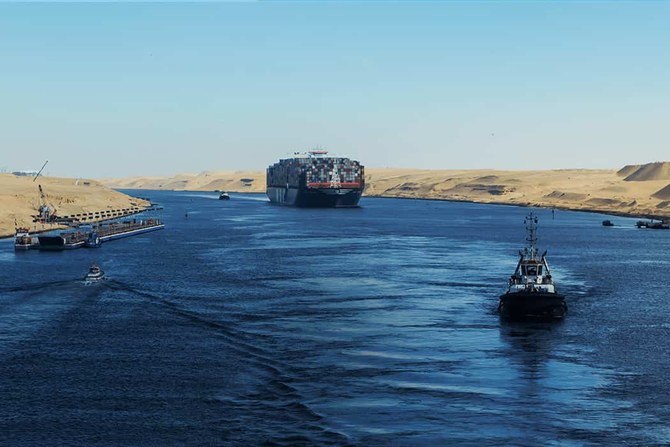
Egypt’s Suez Canal raises transit fees for ships by 15% in 2023 as inflation bites

The increase in fees is attributed to the rise in energy prices, freight rates and in the daily time rental values, according to the Cabinet statement. 
Short Url
Updated 19 September 2022
Follow

Egypt’s Suez Canal raises transit fees for ships by 15% in 2023 as inflation bites

RIYADH: Egypt’s Suez Canal Authority has increased transit fees for all types of ships by 15 percent starting January 2023 in order to deal with the impact of global inflation, the chairman said in a statement.

Osama Rabie added that transit fees for both dry bulk vessels and cruise ships will increase by 10 percent. 

The increase in fees is attributed to the rise in energy prices, freight rates and in the daily time rental values, according to the Cabinet statement. 

Rabie reasoned that the rise in fees for passing the canal “is inevitable and a necessity,” in order to deal with the impact of the current global inflation rates that have exceeded eight percent.

It comes in light of “unprecedented” daily increases in  charter rates for most types of vessels.

Daily charter rates for crude oil tankers increased on average in 2022 by 88 percent compared to 2021, while daily charter rates for LNG carriers rose on average by 11 percent during this year, compared to the year earlier. 

Rabie explained that the most important factor in determining Suez Canal transit fees is the average freight rates for various types of ships.

In recent months, freight rates, especially for containerships, have increased considerably, he explained, adding that it reached higher levels compared to the period before the COVID-19 pandemic.

He added that the current increased energy prices also impacted the authority’s fees calculations.

The continued rise in crude oil prices above the level of $90 per barrel, and the rise in the average prices of LNG above the level of $30 per million thermal units have led to a surge in the average prices of ship bunkers.

Consequently, the rise in energy prices increases the savings that ships achieve by transiting through the Suez Canal, compared to other alternative routes, he explained. 

This happens as the world’s largest wheat importer is intensifying its efforts to confront the challenges posed by the coronavirus pandemic, as well as the Russia-Ukraine crisis. 

Egypt has been hit hard by soaring oil and commodity prices, with the Egyptian pound further devaluing against the dollar and soaring inflation.


Saudi tourism employment surpasses 1m as hospitality sector expands 

Updated 5 sec ago
Follow

Saudi tourism employment surpasses 1m as hospitality sector expands 

RIYADH: Saudi Arabia’s tourism workforce surpassed 1 million in the third quarter of 2025, underscoring the sector’s rapid expansion as the Kingdom continues to develop its hospitality infrastructure and visitor economy. 

According to the latest Tourism Establishments Statistics report released by the General Authority for Statistics, the total number of employees in tourism activities reached approximately 1,009,691 in the third quarter of 2025, marking a 6.4 percent increase compared to the same period in 2024, when employment stood at 948,629. 

The growth in employment comes alongside a significant rise in the number of licensed tourism hospitality facilities, which increased by 40.6 percent year on year to reach 5,622 in the third quarter. Of these, serviced apartments and other hospitality facilities accounted for 52.6 percent, while hotels represented 47.4 percent. 

The robust growth reflected in the latest tourism statistics aligns directly with the goals of Vision 2030, as the Kingdom aims to double tourism’s gross domestic product contribution to 10 percent. The sector is also seeking to create 1.6 million jobs, and attract 150 million visitors annually by 2030.

The report showed that non-Saudi employees made up the majority of the tourism workforce, numbering 764,520 and accounting for 75.7 percent of the total. Saudi nationals employed in the sector reached 245,171, representing 24.3 percent of all tourism workers. 

In terms of gender distribution, male employees dominated the sector with 875,658 workers, while female employees totaled 134,033, making up just 13.3 percent of the workforce. 

Hotel performance showed positive momentum, with the average room occupancy rate rising to 49.1 percent during the quarter, an increase of 2.9 percentage points from 46.1 percent in the same period a year earlier. 

In contrast, serviced apartments and other hospitality facilities experienced a slight dip in occupancy, recording 57.4 percent compared to 58 percent in the same quarter of 2024. 

The average daily room rate in hotels decreased by 3.6 percent to SR341 ($90.9), down from SR354 in the third quarter of 2024. Meanwhile, serviced apartments and similar facilities saw their average daily rate rise by 4.1 percent to SR208, up from SR200 a year earlier. 

The average length of stay in hotels was 4.1 nights, down 1 percent from 4.2 nights in the third quarter of 2024. For serviced apartments and other hospitality facilities, the average stay was 2.1 nights, reflecting a marginal decrease of 0.2 percent year-on-year. 

The statistics draw on administrative records, surveys and secondary data to capture activity across the Kingdom’s tourism sector, GASTAT said.
