Pakistan condemns Indian authorities for arresting Muslim clerics in Kashmir

The photograph shows the Ministry of Foreign Affairs building in Islamabad on Jan. 22, 2020. (AN photo)
Short Url
Updated 18 September 2022
Follow

Pakistan condemns Indian authorities for arresting Muslim clerics in Kashmir

  • Abdul Rashid Dawoodi and Mushtaq Ahmed Veeri have significant social media following and are revered by people
  • Pakistan calls the arrests an attempt to wipe out the religious and cultural identity of the residents of the disputed region

ISLAMABAD: The foreign office of Pakistan on Sunday condemned the arrest of two Islamic scholars along with five members of the Jamaat-e-Islami party in Indian-administered Kashmir while accusing the administration in New Delhi of trying to wipe out the religious and cultural identity of the residents of the region.

According to the Indian media, Abdul Rashid Dawoodi and Mushtaq Ahmed Veeri were arrested in Jammu and Kashmir under the Public Safety Act (PSA) which allows the security forces in Kashmir to detain people for up to two years.

Both clerics have a significant social media following and are revered by people in Kashmir.

The Jamaat-e-Islami party was also banned in the region by the Indian authorities only a few months before they revoked the special constitutional status of Kashmir in 2019 since they suspected that the political faction could “escalate the secessionist movement” in the region.

“These arrests have marked a new low in the Indian occupation forces’ blatant and continued onslaught on the human rights of the innocent Kashmiris,” said the foreign office. “The illegal detention of the Kashmiri Islamic scholars while the true representatives of the Kashmiri people are already under Indian custody under fictitious cases and on fallacious grounds, is yet another Indian attempt to rob the Kashmiri people of their distinct religious and cultural identity.”
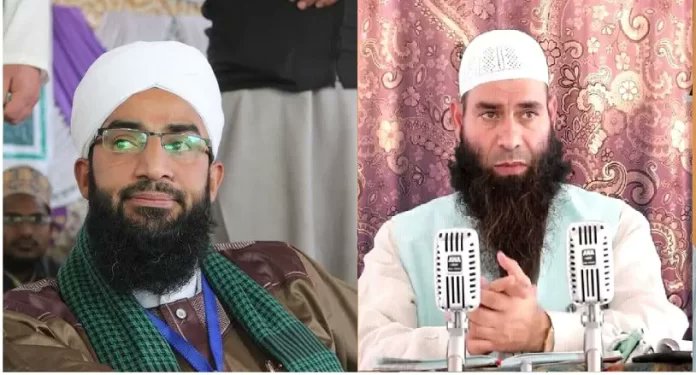


This combination of photos shows Kashmiri Muslim clerics Abdul Rashid Dawoodi and Mushtaq Ahmed Veeri. (Photo courtesy: @CellJammu/Twitter)

The statement noted that Indian authorities were “apprehensive of widespread protests and unrest” in Kashmir while adding the two scholars and their companions had not only been “unjustifiably arrested” but also shifted from Kashmir to a prison in the Hindu-majority Jammu region.

“These politically motivated arrests are clearly meant to stifle the voice of the Muslims of IIOJK [Indian Illegally Occupied Jammu Kashmir] and further marginalize them,” it added.

The foreign office sought immediate release of the religious scholars and other Kashmiri prisoners while urging the international community “to take note of the dangerously growing trajectory of Islamophobia in India.”

It added that Muslims of India were denied space to freely practice their faith as Hindu nationalists attacked their worship places.


Pakistan, Saudi Arabia discuss regional situation, upcoming engagements

Updated 14 February 2026
Follow

Pakistan, Saudi Arabia discuss regional situation, upcoming engagements

  • Ishaq Dar and Prince Faisal bin Farhan agree to stay in contact amid Middle East tensions
  • The two officials speak ahead of Trump’s Feb. 19 Board of Peace meeting in Washington, DC

ISLAMABAD: Pakistan’s Deputy Prime Minister and Foreign Minister Ishaq Dar discussed regional developments and upcoming international engagements with Saudi Foreign Minister Prince Faisal bin Farhan in a phone call on Saturday, according to the foreign office in Islamabad.

The conversation took place against the backdrop of deepening strategic ties between Islamabad and Riyadh. In September last year, the two countries signed a bilateral defense agreement that formalized decades of military cooperation and included a commitment to view aggression against one as an attack on both countries.

“Deputy Prime Minister/Foreign Minister Mohammad Ishaq Dar held a telephonic conversation today with the Foreign Minister of Saudi Arabia, Faisal bin Farhan Al Saud,” Pakistan’s foreign ministry said in a statement.

“The two leaders discussed the evolving regional situation, forthcoming international engagements, and agreed to remain in close contact,” it added.

The two officials spoke at a time of heightened tensions in the Middle East, with the conflict in Gaza far from resolution amid ongoing ceasefire violations by Israel.

The region has also been on edge as the United States pursues nuclear negotiations with Iran, prompting regional states to call for diplomacy rather than new military flare-ups.

Both Pakistan and Saudi Arabia are participants in US President Donald Trump’s Board of Peace, which is scheduled to meet on Feb. 19 in Washington.

Islamabad and Riyadh have consistently coordinated positions over regional and global issues.

The foreign ministry did not provide further details of the discussion.