UN votes to allow Ukraine’s Zelensky to give virtual speech

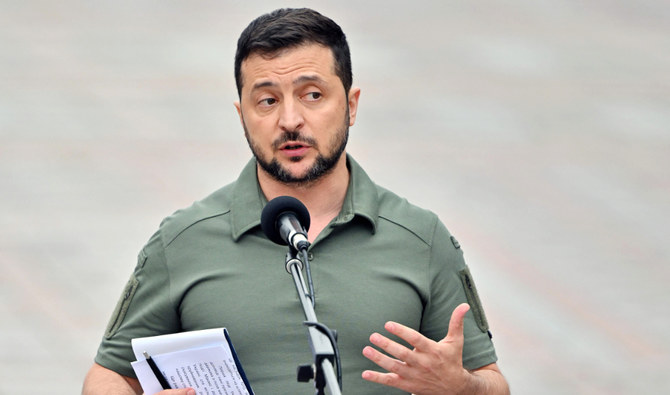
Ukrainian President Volodymyr Zelensky speaks next to President of the European Commission (unseen) during a press conference following their talks in Kyiv on September 15, 2022. (AFP)
Short Url
Updated 17 September 2022
Follow

UN votes to allow Ukraine’s Zelensky to give virtual speech

  • The document, which was proposed by Ukraine and had more than 50 co-sponsors, permits Zelensky to submit a pre-recorded statement to be played in the General Assembly hall

UNITED NATIONS: The UN General Assembly voted Friday to allow Ukraine’s president to deliver a pre-recorded address to next week’s gathering of world leaders because of his need to deal with Russia’s invasion, making an exception to its requirement that all leaders speak in person.
The 193-member world body approved Volodymyr Zelenskky’s virtual address by a vote of 101-7 with 19 abstentions including China. The seven countries voting “no” were Belarus, Cuba, Eritrea, Nicaragua, North Korea, Russia and Syria.
The assembly first voted on an amendment put forward by Belarus, a close ally of Russia, that would have allowed any leader facing exceptional difficulties and unable to attend to deliver a pre-recorded address. It was defeated by a vote of 23-67 with 27 abstentions.
The document that was approved expresses concern that leaders of “peace-loving” UN sovereign nations can’t participate in person “for reasons beyond their control owing to ongoing foreign invasion, aggression, military hostilities that do not allow safe departure from and return to their countries, or the need to discharge their national defense and security duties and functions.”
The document, which was proposed by Ukraine and had more than 50 co-sponsors, permits Zelensky to submit a pre-recorded statement to be played in the General Assembly hall. It stresses that this will not set a precedent for future high-level assembly meetings.
Ukrainian Ambassador Sergiy Kyslytsya expressed satisfaction that the assembly will have a chance to hear directly from Zelensky “about how he sees the end of this war and how he evaluates the impact of this war on global affairs and on the United Nations in particular.”
He expressed gratitude in an interview with The Associated Press that 101 UN member nations gave such strong support to hearing from Zelensky, saying it was “pathetic” that Russia mustered only six other countries to oppose his speech.
Kyslytsya said Zelensky was scheduled to address the assembly Wednesday afternoon and there is no reason that would be changed.
The document refers to the General Assembly resolution adopted at an emergency special session on March 2 — six days after Russia’s Feb. 24 invasion of Ukraine — demanding an immediate halt to Moscow’s offensive and withdrawal of all Russian troops. The vote on the resolution, titled “Aggression against Ukraine,” was 141-5 with 35 abstentions.
British Counsellor Philip Reed told the assembly before the votes that the reason it is necessary “is because Russia has invaded its neighbor and for that reason Ukraine’s president cannot travel to New York for the General Debate,” the official name of the high-level meeting.
Nicaragua’s representative, whom its mission refused to identify, said the proposed decision “reflects a clear trend toward exceptionalisms” and violates the UN Charter’s principle “of sovereign equality of all members.” He urged members to oppose the proposal and avoid “double standards” and “selfish interests.”
As a result of the COVID-19 pandemic, the annual meeting of world leaders at the General Assembly was all virtual in 2020 and hybrid in 2021. But this year the assembly decided that all speeches must be in person.


Trump administration labels 3 Muslim Brotherhood branches as terrorist organizations

Updated 13 January 2026
Follow

Trump administration labels 3 Muslim Brotherhood branches as terrorist organizations

  • The State Department designated the Lebanese branch a foreign terrorist organization
  • “These designations reflect the opening actions of an ongoing, sustained effort to thwart Muslim Brotherhood chapters’ violence,” Rubio said

WASHINGTON: President Donald Trump’s administration has made good on its pledge to label three Middle Eastern branches of the Muslim Brotherhood as terrorist organizations, imposing sanctions on them and their members in a decision that could have implications for US relationships with allies Qatar and Turkiye.
The Treasury and State departments announced the actions Tuesday against the Lebanese, Jordanian and Egyptian chapters of the Muslim Brotherhood, which they said pose a risk to the United States and American interests.
The State Department designated the Lebanese branch a foreign terrorist organization, the most severe of the labels, which makes it a criminal offense to provide material support to the group. The Jordanian and Egyptian branches were listed by Treasury as specially designated global terrorists for providing support to Hamas.
“These designations reflect the opening actions of an ongoing, sustained effort to thwart Muslim Brotherhood chapters’ violence and destabilization wherever it occurs,” Secretary of State Marco Rubio said in a statement. “The United States will use all available tools to deprive these Muslim Brotherhood chapters of the resources to engage in or support terrorism.”
Rubio and Treasury Secretary Scott Bessent were mandated last year under an executive order signed by Trump to determine the most appropriate way to impose sanctions on the groups, which US officials say engage in or support violence and destabilization campaigns that harm the United States and other regions.
Muslim Brotherhood leaders have said they renounce violence.
Trump’s executive order had singled out the chapters in Lebanon, Jordan and Egypt, noting that a wing of the Lebanese chapter had launched rockets on Israel after Hamas’ Oct. 7, 2023, attack in Israel that set off the war in Gaza. Leaders of the group in Jordan have provided support to Hamas, the order said.
The Muslim Brotherhood was founded in Egypt in 1928 but was banned in that country in 2013. Jordan announced a sweeping ban on the Muslim Brotherhood in April.
Nathan Brown, a professor of political science and international affairs at George Washington University, said some allies of the US, including the United Arab Emirates and Egypt, would likely be pleased with the designation.
“For other governments where the brotherhood is tolerated, it would be a thorn in bilateral relations,” including in Qatar and Turkiye, he said.
Brown also said a designation on the chapters may have effects on visa and asylum claims for people entering not just the US but also Western European countries and Canada.
“I think this would give immigration officials a stronger basis for suspicion, and it might make courts less likely to question any kind of official action against Brotherhood members who are seeking to stay in this country, seeking political asylum,” he said.
Trump, a Republican, weighed whether to designate the Muslim Brotherhood a terrorist organization in 2019 during his first term in office. Some prominent Trump supporters, including right-wing influencer Laura Loomer, have pushed his administration to take aggressive action against the group.
Two Republican-led state governments — Florida and Texas — designated the group as a terrorist organization this year.