

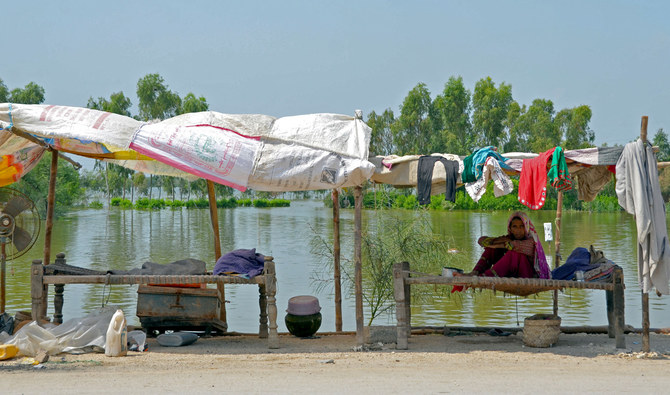

ISLAMABAD: Floodwaters are receding in Pakistan’s worst-hit southern Sindh province, officials said Friday, a potentially bright sign in an ongoing crisis that has left hundreds of thousands of people homeless in the impoverished South Asian country.
The Indus River, which remained swollen until earlier this month, was now rushing at “normal” levels toward the Arabian Sea, according to Mohammad Irfan, an irrigation official in hard-hit Sindh. The water level in the past 48 hours receded as much as three feet in some of the inundated areas nearby, including the Khairpur and Johi towns, where waist-high water damaged crops and homes earlier this month.
A day earlier, engineers had opened a key highway in the southwestern Baluchistan province, allowing rescue workers to speed aid to those suffering in a race against the spread of waterborne diseases and dengue fever.
Still, hundreds of thousands of people in Sindh are living in makeshift homes and tents. Authorities say it will take months to completely drain the water in Sindh.
Nationwide, floods have damaged 1.8 million homes, washed away roads and destroyed nearly 400 bridges, according to the National Disaster Management Authority. The deluge has killed 1,508 people since mid-June, inundated millions of acres of land and affected 33 million people. More than half a million people have been left homeless. At one point, nearly a third of the impoverished country was underwater. Several economists say the cost of the disaster may reach $30 billion.
Pakistani Prime Minister Shahbaz Sharif has urged developed countries, especially those behind climate change, to scale up aid to his country.
The previous day, scientists and experts in the latest study about ongoing floods in Pakistan said that the country’s overall vulnerability, including people living in harm’s way, was the chief factor in the disaster. But “climate change” also played a role in causing heavy rains, which triggered flooding in the country.
August rainfall in the Sindh and Baluchistan provinces — together nearly the size of Spain — was at least seven times normal amounts, while the country as a whole had more than triple its normal rainfall. That’s according to the report by World Weather Attribution, a collection of mostly volunteer scientists from around the world who do real-time studies of extreme weather to look for evidence of climate change.
In Pakistan, the country’s minister for climate change, Sherry Rehman, was the first to publicly blame the developed world for causing climate-induced unusually heavy monsoon rains, which started in June and are expected to continue this month.
“Pakistan, at least in the south, is totally inundated. Outside of Karachi, go a little further up in Sindh and you will see an ocean of water, with no break,” she tweeted recently. “Where to place the tents, where to find dry ground? How to feed 33 million people plus? How to get them health care? Help us.”


