

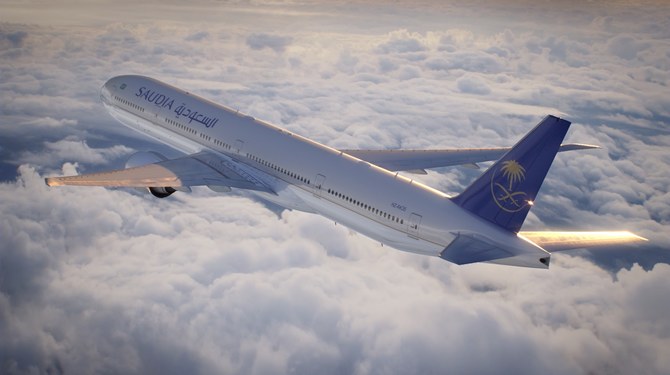
Saudi Arabian Airlines named partner & official carrier of Global AI Summit

Short Url
Updated 14 September 2022
Follow

Saudi Arabian Airlines named partner & official carrier of Global AI Summit

Saudi Arabian Airlines, the Kingdom’s national flag carrier, announced its strategic partnership as the official carrier of the Global AI Summit. The event is being held under the patronage of Crown Prince Mohammed bin Salman, deputy prime minister and chairman of the Saudi Data and Artificial Intelligence Authority.

This is the second edition of the Global AI Summit, which is taking place at the King Abdulaziz Conference Center in Riyadh from Sept. 13-15. The three-day summit features 200 speakers who lead data and artificial intelligence policy reform in 70 countries and more than 3,000 visitors from across the world are in attendance.

The summit seeks to serve as a communal meeting place for investors, innovators and political thought leaders worldwide who are all active in the fast-paced world of artificial intelligence by identifying business investment opportunities, exploring use case possibilities and discussing compliance policies. The Global AI Summit aims to identify solutions to make AI technologies more accessible across industries.

Saudia is set to sign a three-way memorandum of understanding with SDAIA and the Saudi Company for Artificial Intelligence to explore means to deploy AI-powered solutions that will enhance the airline’s operations. Included within these agreements are plans to develop AI applications, improve customer experiences using the latest emerging technologies, and utilize technology to process spoken languages across Saudia’s customer care applications and other digital channels.

Using the code AI20, visitors to the summit can take advantage of a special promotional deal offered by Saudia Holidays and receive 20 percent off on the travel package of their choice.
With its sponsorship of the summit, Saudia underlines its commitment and role as the “wings” of Vision 2030, where it seeks to achieve the objectives of the vision’s strategic framework, which include global leadership among data-driven, AI-powered economies.

In alignment with this commitment, the national flag carrier continues to identify ways to adopt cutting-edge AI solutions that offer high-quality services to Saudia’s guests and employees.

The first Global AI Summit was held virtually under the patronage of Crown Prince Mohammed bin Salman in 2020 with a record-breaking 5 million views throughout the event. During the landmark summit, the National Strategy for Data and AI, established to elevate the Kingdom as a global leader in the fields of AI and data, was announced.


More crop per drop: NADEC and EF Polymer deploy breakthrough technology to cut agricultural water use by 40%

Updated 14 January 2026
Follow

More crop per drop: NADEC and EF Polymer deploy breakthrough technology to cut agricultural water use by 40%

Following a strategic technology-scouting framework led by Universal Materials Incubator, the National Agricultural Development Company has entered into a partnership to launch large-scale field trials of EF Polymer, marking a significant step in deploying deep-technology solutions to strengthen the Kingdom’s food and water security.

The collaboration initiates field trials of EF Polymer’s proprietary solution — a 100 percent organic, biodegradable powder that performs like a “soil battery” upcycled from food waste. Engineered to address water scarcity in arid and semi-arid regions, the material can absorb up to 50 times its own weight in water and gradually release moisture directly to plant roots. This mechanism has the potential to reduce irrigation water use by up to 40 percent, while enhancing crop yield and long-term agricultural productivity.

Beyond water efficiency, EF Polymer improves nutrient retention by minimizing fertilizer leaching, thereby reducing overall fertilizer requirements. After approximately one year in the soil, the material fully biodegrades into organic carbon, organic matter, and trace nutrients such as magnesium, calcium, and nitrogen — contributing directly to improved soil health and long-term fertility.

The solution is affordable, easy to apply, and suitable for a wide range of crops, making it viable both for individual farmers and for industrial-scale agricultural operations such as NADEC’s. 

EF Polymer has already achieved significant commercial adoption across multiple global markets, including Japan, the US, India and Turkiye, where it is actively used by farmers and agribusiness operators to improve water efficiency, soil health, and crop resilience under varying climatic conditions.

Its organic credentials are certified by OMRI and Ecocert, reinforcing its alignment with sustainable and regenerative agricultural practices.

The stakes for this alliance are high. By 2030, global freshwater demand is projected to exceed supply by 40 percent. In Saudi Arabia, the challenge is localized but intense: the agricultural sector alone consumes approximately 11.4 billion cubic meters of water annually. This partnership underscores NADEC’s commitment to adopting innovative, scalable technologies that conserve natural resources while supporting resilient food systems across the Kingdom.

Mohamed Al-Rajhi, VP of supply chain sector at NADEC, said: “Strategic agriculture today requires a long-term commitment to soil health and resource circularity. NADEC is leading the shift toward regenerative practices that restore our natural capital rather than merely consuming it. By diversifying our crop portfolio and investing in closed-loop nutrient management, we are insulating our operations against global price volatility and environmental shifts.”

“We are aggressively deploying AI-driven irrigation systems and satellite-based crop monitoring to optimize every drop of water and every hectare of land. This strategic pivot toward agri-digitization allows us to mitigate climate risks in real-time while significantly reducing our carbon footprint. Our commitment to sustainability is our greatest competitive advantage, ensuring that NADEC remains the cornerstone of the Middle East’s agri-food sector for decades to come. These trials focus on strategic scalable crops like wheat and olive trees to ensure the future of the Kingdom’s food security is both sustainable and locally rooted,” he added.

Strategic trial milestones:

  • Wheat: Trials have commenced to demonstrate water retention in this water-intensive crop.
  • Olive and blueberry: Specialized testing is scheduled for March to evaluate yield improvements and nutrient efficiency.

This collaboration supports Saudi Vision 2030 goals of reducing non-renewable groundwater use by 90 percent.