Iran says will pursue membership of Russia, China-led bloc

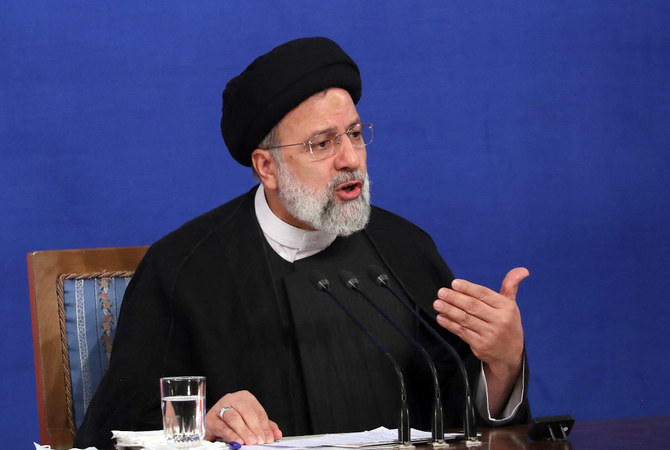
Iran's President Ebrahim Raisi said the Islamic republic will finalization of SCO membership documents and legal process during summit. (File/AFP)
Short Url
Updated 15 September 2022
Follow

Iran says will pursue membership of Russia, China-led bloc

  • The Shanghai Cooperation Organization was set up in 2001 as a political, economic and security organization to rival Western institutions
  • Iran's application for full membership in 2008 was slowed by sanctions imposed over nuclear program

TEHRAN: Iran intends to pursue membership of a Chinese and Russian-led bloc that is meeting in Uzbekistan this week, President Ebrahim Raisi said Wednesday as he prepared to head to the summit.
The Shanghai Cooperation Organization (SCO) — made up of China, Russia, India, Pakistan and four ex-Soviet Central Asian countries — was set up in 2001 as a political, economic and security organization to rival Western institutions.
The summit set for Thursday and Friday in the Uzbek city of Samarkand is the first entirely face-to-face leaders’ meeting since the start of the coronavirus pandemic.
“One of the important acts of this summit will be the finalization of SCO (membership) documents and the legal process they will need to take in order to be signed by the foreign ministers of the member countries,” Raisi said.
Iran, one of four SCO observer states, had applied for full membership in 2008 but its bid was slowed by UN and US sanctions imposed over its nuclear program.
Several SCO members did not want a country under international sanctions in their ranks.
At a conference in Dushanbe in September last year, members of the bloc endorsed Iran’s future membership.
Tehran wants to “make the most of the economic power and the capacities of the region and of Asian countries for the benefit of the Iranian nation,” Raisi said.
The Kremlin said Tuesday that this week’s summit in Samarkand will showcase an “alternative” to the West.
The move comes as Iran and major powers have been struggling to revive a 2015 nuclear deal.
The original agreement promised Iran relief from crippling sanctions in return for tight limits to its nuclear activities verified by UN monitors.
Since last year, Iran has been engaged in EU-brokered talks to revive the deal with the renewed involvement of the United States, which pulled out in 2018.


UN rights chief Shocked by 'unbearable' Darfur atrocities

Updated 6 sec ago
Follow

UN rights chief Shocked by 'unbearable' Darfur atrocities

  • Mediation efforts have failed to produce a ceasefire, even after international outrage intensified last year with reports of mass killings, rape, and abductions during the RSF’s takeover of El-Fasher in Darfur

PORT SUDAN: Nearly three years of war have put the Sudanese people through “hell,” the UN’s rights chief said on Sunday, blasting the vast sums spent on advanced weaponry at the expense of humanitarian aid and the recruitment of child soldiers.
Since April 2023, Sudan has been gripped by a conflict between the army and the paramilitary Rapid Support Forces that has left tens of thousands of people dead and around 11 million displaced.
Speaking in Port Sudan during his first wartime visit, UN Human Rights commissioner Volker Turk said the population had endured “horror and hell,” calling it “despicable” that funds that “should be used to alleviate the suffering of the population” are instead spent on advanced weapons, particularly drones.
More than 21 million people are facing acute food insecurity, and two-thirds of Sudan’s population is in urgent need of humanitarian aid, according to the UN.
In addition to the world’s largest hunger and displacement crisis, Sudan is also facing “the increasing militarization of society by all parties to the conflict, including through the arming of civilians and recruitment and use of children,” Turk added.
He said he had heard testimony of “unbearable” atrocities from survivors of attacks in Darfur, and warned of similar crimes unfolding in the Kordofan region — the current epicenter of the fighting.
Testimony of these atrocities must be heard by “the commanders of this conflict and those who are arming, funding and profiting from this war,” he said.
Mediation efforts have failed to produce a ceasefire, even after international outrage intensified last year with reports of mass killings, rape, and abductions during the RSF’s takeover of El-Fasher in Darfur.
“We must ensure that the perpetrators of these horrific violations face justice regardless of the affiliation,” Turk said on Sunday, adding that repeated attacks on civilian infrastructure could constitute “war crimes.”
He called on both sides to “cease intolerable attacks against civilian objects that are indispensable to the civilian population, including markets, health facilities, schools and shelters.”
Turk again warned on Sunday that crimes similar to those seen in El-Fasher could recur in volatile Kordofan, where the RSF has advanced, besieging and attacking several key cities.
Hundreds of thousands face starvation across the region, where more than 65,000 people have been displaced since October, according to the latest UN figures.