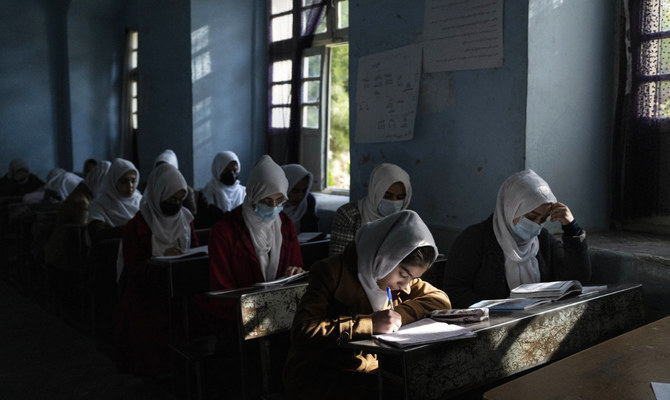

KABUL: Thousands of Afghans began an online campaign on Tuesday to protest the Taliban’s decision to shut secondary schools for girls, urging the government to reopen classrooms as millions are shut out of school for over a year.
Secondary school girls were set to return to classes in March after restrictions were brought in when the Taliban took control of Afghanistan last August, but the policy was reversed just hours into their first day.
Girls’ education was put on hold, though officials said a plan was being developed.
Earlier this month, four girls’ schools in Afghanistan’s Paktia province resumed classes after a recommendation by tribal elders and school principals, but without formal permission by the Taliban government. Authorities shut the schools days later, which led to a student-led protest over the weekend.
Afghans from across the country have taken to social media this week to protest the setback on girls’ education, appealing to the Taliban to allow girls to return to their studies.
“Through this campaign we want to tell them that Afghans want their daughters and sisters to attend school,” Rahmatullah Yousuf, an activist based in the eastern Nangarhar province and one of the organizers of the online campaign, told Arab News.
“They have been making different excuses during the last year. At first they said they are working on a plan for girls’ education, then they said the conditions are not right, and now they are saying girls’ education is against Afghans’ culture.”
Mawlawi Noorullah Munir, the education minister, was quoted by local media earlier this week as saying that some Afghans are against their teenage daughters attending school. The online campaign, Yousuf said, was a response to Munir’s statement.
“This indicates that the Taliban don’t actually have any intention to open girls’ schools. We are raising our voice, and I hope it reaches the officials and they reconsider their decision in this regard.”
On Facebook and Twitter, Afghans are hoping to make their voices heard by the new government. Thousands of posts are using hashtags in Pashto, which read: “We want our daughters to go to school” and “Schools for all” to promote their cause.
“I am a Muslim and an Afghan. I am a medical doctor, and I want my daughters and sisters to go to school,” activist Maliha Khan wrote on Twitter.
Shaiq Gahfoorzai, an Afghan expert in Islamic banking and finance, wrote on Facebook: “I am strongly against ignorance and darkness. I want my daughters to go to school.”
More than a year after the Taliban returned to power and US-led forces withdrew from Afghanistan, the country is facing a deepening humanitarian crisis and a collapsing economy.
Afghan girls face growing uncertainty over the future of their education, although secondary school girl students in some provinces, such as Balkh and Kunduz in the north, are still allowed to attend classes. An estimated 3 million secondary school girls in Afghanistan have been kept out of school for more than a year, UNICEF said.
Noor Ahmad, one of the online campaign organizers from Afghanistan’s second-largest city of Kandahar, said that education is an “Islamic and human right” of all Afghans.
“We have deprived a major part of the society from their guaranteed right and there is no justification for this. School gates should open for all girls at the earliest without any excuse,” Ahmad told Arab News.
“I have four girls in my family who are above grade six and they wish they go to school today. The situation is so depressing for them,” he said.
“All people in Kandahar city and districts want girls in their families to go to school.”