UNITED NATIONS: A former member of Afghanistan’s parliament urged the world on Monday to label the Taliban a “gender apartheid” regime because of its crackdown on human rights, saying the apartheid label was a catalyst for change in South Africa and can be a catalyst for change in Afghanistan.
Naheed Farid, a women’s rights activist who was the youngest-ever politician elected to parliament in 2010, told a UN news conference that as a result of severe restrictions on women’s movements, an end to secondary-school education for girls, and ban on jobs for women, “I’m hearing more and more stories from Afghan women choosing to take their life out of hopelessness and despair.”
“This is the ultimate indicator on how bad the situation is for Afghan women and girls — that they are choosing death, and that this is preferred for them than living under the Taliban regime,” she said.
Farid, now at Princeton University’s School of Public and International Affairs, said she isn’t the first person to call the Taliban a “gender apartheid” regime but she said “the inaction of the international community and decision-makers at large makes it important for all of us to repeat this” so that the voices of women in Afghanistan who can’t speak out aren’t forgotten.
She expressed hope that world leaders meeting next week for their annual gathering at the UN General Assembly would make time to meet and listen to Afghan women living in exile, and start grasping that “gender apartheid” is happening in Afghanistan because women are being “used and misused,” relegated to subordinate levels of society, and stripped of their human rights by the Taliban.
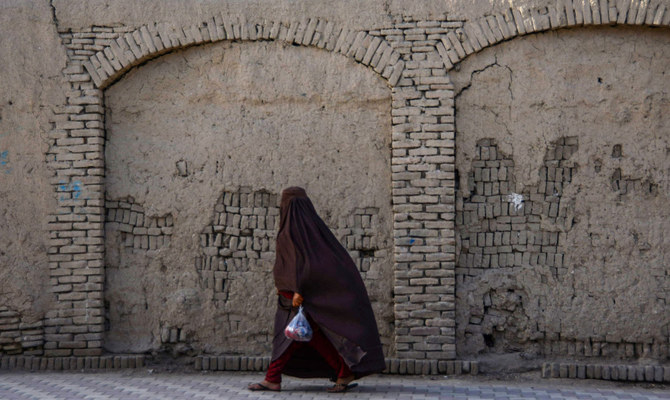
When the Taliban first ruled Afghanistan from 1996 to 2001, women and girls were subject to overwhelming restrictions — no education, no participation in public life, and women were required to wear the all-encompassing burqa.
Following the Taliban ouster by US forces in 2001 after the 9/11 attacks in the United States, and for the next 20 years, Afghan girls were not only enrolled in school but universities, and many women became doctors, lawyers, judges, members of parliament and owners of businesses, traveling without face coverings.
After the Taliban overran the capital on Aug. 15, 2021 as US and NATO forces were in the final stages of their chaotic withdrawal from Afghanistan after 20 years, they promised a more moderate form of Islamic rule including allowing women to continue their education and work outside the home. They initially announced no dress code though they also vowed to impose Sharia, or Islamic law.
But Taliban hard-liners have since turned back the clock to their previous harsh rule, confirming the worst fears of rights activists and further complicating Taliban dealings with an already distrustful international community.
Farid accused the Taliban of using women as a “bargaining chip” to demand legitimacy, funds, and aid from the international community. She called this “very dangerous” because the full rights of Afghan women and girls must be a non-negotiable starting point for all negotiations with the Taliban.
Farid called on the Organization of Islamic Cooperation, comprising 57 Muslim nations, and other countries to create a platform for Afghan women to directly negotiate with the Taliban on women’s rights and human rights issues. She also urged countries to maintain sanctions on the Taliban, for all 183 Taliban leaders to be kept on the UN sanctions blacklist, for a ban on Taliban representatives at the United Nations, and for all delegations meeting with the Taliban to include women.
Norway’s UN Ambassador Mona Juul, whose country oversees Afghanistan issues in the UN Security Council and organized the press conference, said that a year after the Taliban takeover “the situation or women and girls has deteriorated at a shocking scale and speed.” As one example, she said Afghanistan is now the only nation in the world that forbids girls from education beyond the sixth grade.
Najiba Sanjar, a human right activist and feminist said she was speaking to convey the voices of 17 million Afghan girls and women who have no voice now.
“We are all watching the sufferings of women, girls and minorities from the screens of our TVs as if an action movie is going on,” she told reporters. “A true form of injustice is taking place right in front of our eyes. And we are all watching silently and partaking in this sin by staying complacent and accepting it as a new normal.”
She pointed to a recent survey of women inside Afghanistan that found that only 4 percent of women reported always having enough food to eat, a quarter of women saying their income had dropped to zero, family violence and femicide increasing, and 57 percent of Afghan women married before the age of 19. She also cited families selling their daughters and their possessions to buy food.
Sanjar urged the international community to put all possible pressure on the Taliban to protect the rights of women and minorities to education and work while withholding diplomatic recognition.
“Because women’s rights are human rights, what is happening is already alarming for all women in the world,” she said.


![]()

Former Afghan MP: Taliban is a ‘gender apartheid’ regime
Short Url
https://arab.news/wzcv4
Former Afghan MP: Taliban is a ‘gender apartheid’ regime
- Farid called on the Organization of Islamic Cooperation, comprising 57 Muslim nations, and other countries to create a platform for Afghan women to directly negotiate with the Taliban on women’s rights and human rights issues


Latest updates


© 2026 SAUDI RESEARCH & PUBLISHING COMPANY, All Rights Reserved And subject to Terms of Use Agreement.