

Sindh chief minister appeals for provision of tents for 12.5 million people displaced by floods

Temporary housing is provided for flood victims by the UN Refugee Agency (UNHCR), in Sukkur, Pakistan, on September 10, 2022. (AP)
Short Url
Updated 12 September 2022
Follow

Sindh chief minister appeals for provision of tents for 12.5 million people displaced by floods

  • Murad Ali Shah says people who have lost their homes in recent monsoon rains are living in harsh conditions
  • The chief minister applauds UAE, Qatar for setting up mobile hospitals to provide medical facilities to people

SUKKUR: The chief executive of Pakistan’s southern Sindh province urged the world on Sunday to send tents for over 12.5 million people who were rendered homeless by recent floods in areas under his administration’s control while maintaining they were living in harsh conditions.

Massive floods triggered by unprecedented monsoon rains and glacier melt submerged a third of Pakistan while killing over 1,400 people and affecting the lives of 33 million since the month of June.

United Nations Secretary General Antonio Guterres visited the flood-affected regions over the weekend and described the situation as an unimaginable “climate carnage.”

“Due to the magnitude of the devastation and areas affected by floods, more than 12.5 million people have become homeless in Sindh,” Chief Minister Murad Ali Shah told Arab News in an exclusive interview in Sukkur.

“We still have thousands of families who do not have tents and are living under the sky,” he continued. “I would like to appeal to all countries to send us tents on priority so we can at least provide a temporary shelter to the affected families.”

Shah maintained that tents would be needed for a longer duration since a large number of houses had been destroyed in the province and needed to be rebuilt.
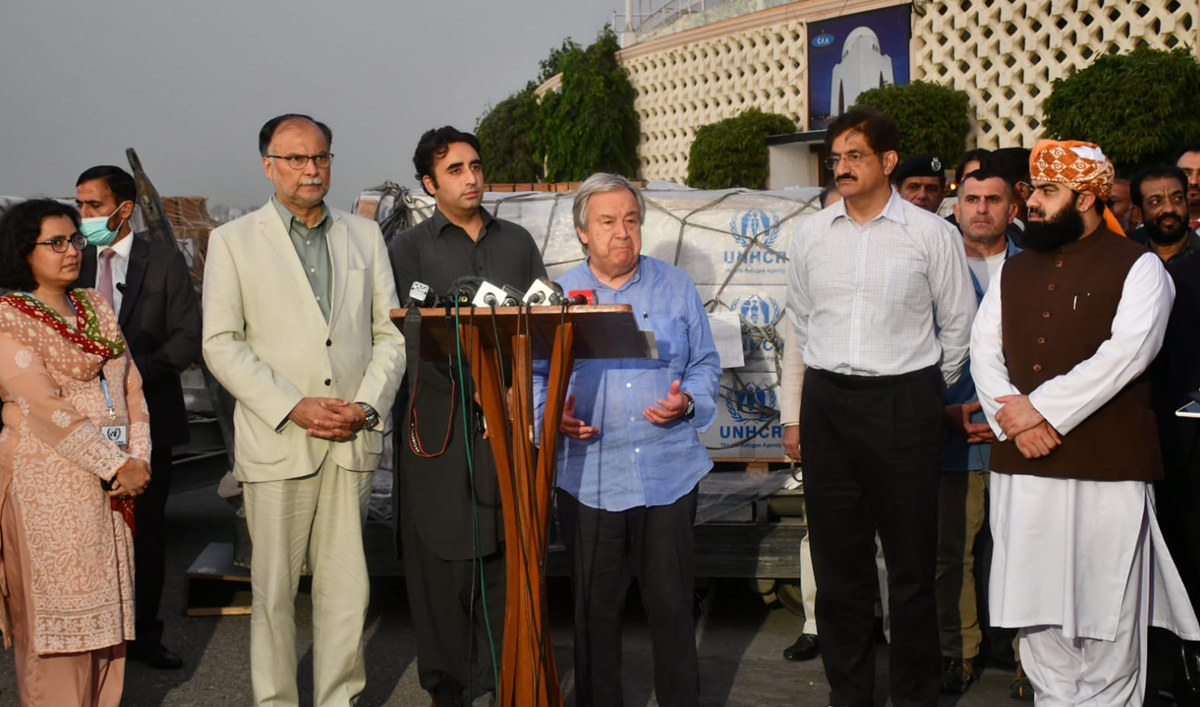


United Nations Secretary-General Antonio Guterres (C) speaks to the media during his visit to Pakistan’s flood-hit southern Sindh province on September 10, 2022 with officials from federal and provincial governments. (Twitter/Sindh government)

The chief minister said that people had lost their crops, livestock and businesses which would cost more than Rs350 billion. The estimate, he added, did not include damages to schools, hospitals and other public infrastructure in the province.

Shah said flood water was not receding and could take months to be drained out. He expressed satisfaction at his administration’s coordination with the federal government, though he added that the scale of devastation was so huge that it was beyond the country’s capacity to deal with it.

“The UN secretary general also committed he would do everything to help the people of Sindh and launch a special appeal to the world,” Shah continued. “He said it himself that developed nations were responsible for this climate-induced catastrophe.”

Asked about the rise of waterborne diseases in flood-affected regions, Shah said his administration was aware of the health care issues in the wake of the monsoon rains and was making arrangements to address the problem.

“We have dispersed our stocks of medicines in field hospitals and makeshift medical units,” he explained.

He added the provincial health department was also working with private sector to secure more medicines and provide free treatment to people.

Shah informed that Muslim countries, like the United Arab Emirates and Qatar, had come to his administration’s help by setting up mobile health hospitals in the province.

The Sindh chief minister also mentioned his “two-pronged strategy” to deal with the current disaster.

“First, we have to provide relief and rescue to people by ensuring collective national response with the help of the international community,” he said. “Second, we need to save our people from such calamities in the future by building climate-resilient infrastructure and facilities to deal with natural disasters.”


Pakistan, global crypto exchange discuss modernizing digital payments, creating job prospects 

Updated 8 sec ago
Follow

Pakistan, global crypto exchange discuss modernizing digital payments, creating job prospects 

  • Pakistani officials, Binance team discuss coordination between Islamabad, local banks and global exchanges
  • Pakistan has attempted to tap into growing crypto market to curb illicit transactions, improve oversight

ISLAMABAD: Pakistan’s finance officials and the team of a global cryptocurrency exchange on Friday held discussions aimed at modernizing the country’s digital payments system and building local talent pipelines to meet rising demand for blockchain and Web3 skills, the finance ministry said.

The development took place during a high-level meeting between Finance Minister Muhammad Aurangzeb, Pakistan Virtual Assets Regulatory Authority (PVARA) Chairman Bilal bin Saqib, domestic bank presidents and a Binance team led by Global CEO Richard Teng. The meeting was held to advance work on Pakistan’s National Digital Asset Framework, a regulatory setup to govern Pakistan’s digital assets.

Pakistan has been moving to regulate its fast-growing crypto and digital assets market by bringing virtual asset service providers (VASPs) under a formal licensing regime. Officials say the push is aimed at curbing illicit transactions, improving oversight, and encouraging innovation in blockchain-based financial services.

“Participants reviewed opportunities to modernize Pakistan’s digital payments landscape, noting that blockchain-based systems could significantly reduce costs from the country’s $38 billion annual remittance flows,” the finance ministry said in a statement. 

“Discussions also emphasized building local talent pipelines to meet rising global demand for blockchain and Web3 skills, creating high-value employment prospects for Pakistani youth.”

Blockchain is a type of digital database that is shared, transparent and tamper-resistant. Instead of being stored on one computer, the data is kept on a distributed network of computers, making it very hard to alter or hack.

Web3 refers to the next generation of the Internet built using blockchain, focusing on giving users more control over their data, identity and digital assets rather than big tech companies controlling it.

Participants of the meeting also discussed sovereign debt tokenization, which is the process of converting a country’s debt such as government bonds, into digital tokens on a blockchain, the ministry said. 

Aurangzeb called for close coordination between the government, domestic banks and global exchanges to modernize Pakistan’s payment landscape.

Participants of the meeting also discussed considering a “time-bound amnesty” to encourage users to move assets onto regulated platforms, stressing the need for stronger verifications and a risk-mitigation system.

Pakistan has attempted in recent months to tap into the country’s growing crypto market, crack down on money laundering and terror financing, and promote responsible innovation — a move analysts say could bring an estimated $25 billion in virtual assets into the tax net.

In September, Islamabad invited international crypto exchanges and other VASPs to apply for licenses to operate in the country, a step aimed at formalizing and regulating its fast-growing digital market.