
LONDON: The appointment of Liz Truss as the UK’s new prime minister represents as much an opportunity as a moment of suspense for Gulf relations, with her enthusiasm for the region matched by her being perceived as a “wild card,” according to analysts.
An early challenge arrived with the passing of the longest serving monarch in British history in Truss’ very first week in office. The death of Queen Elizabeth II at Balmoral Castle on Thursday thrust the country into a royal succession at a time of economic upheaval and political transition.
Paying homage to a figure who was viewed by Britons as a beacon of stability and a rare symbol of continuity and national unity, Truss described the late queen as “the rock on which modern Britain was built” while expressing hope that “in the difficult days ahead, we will come together with our friends ... to celebrate her extraordinary lifetime of service.”
Although her immediate focus will undoubtedly be on the domestic cost-of-living crisis and spiraling energy bills, there are growing calls for Truss to ensure continuity in strengthening relations with the Gulf states.
Chris Doyle, director of the Council for Arab-British Understanding, expects Truss will prioritize the finalization of the UK-GCC free trade agreement announced in June, which is potentially worth £33.5 billion ($38.5 billion) in new deals.
“Trade deals will speak to her primary objective upon taking office, and that’ll be getting the economy sorted,” said Doyle. “There are warm relations between the UK and the GCC and I do not see that changing dramatically. On this, it’ll likely be a ‘steady as you go’ relationship.”

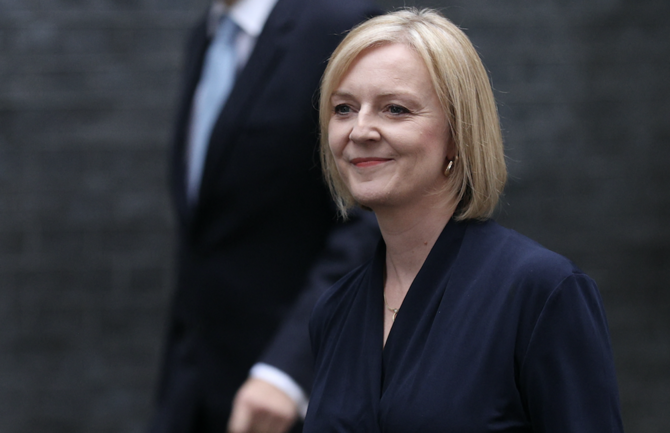
Prime Minister Liz Truss speaking outside 10 Downing Street. (AFP)
Concurring with this assessment, David Jones MP, a Conservative and Truss supporter who chairs the UK-UAE All-Party Parliamentary Group, said the new prime minister “recognizes the importance” of the GCC countries.
“As former international trade secretary and foreign secretary, Ms. Truss fully appreciates the crucial importance to the UK of maintaining strong relations with our steadfast regional ally, the UAE,” Jones told Arab News.
“I have no doubt that, under her leadership, those relations will be strengthened still further into a mainstay of regional and global security.”
Opinion
This section contains relevant reference points, placed in (Opinion field)
While hosting the GCC foreign ministers in December last year, Truss herself stressed that “closer economic and security ties with our Gulf partners will deliver jobs and opportunities for British people and help make us all safer.”
But for Doyle, these comments also exposed areas of concern, notably the new prime minister’s “transactional” approach to foreign policy, which tends to ignore the importance of building strong interpersonal relationships.
“Truss showed during her time in the foreign office a very transactional nature when dealing with other countries — one devoted to trade, the economy, and what Britain could get out (of) it. It was looking very much at the short-term benefits,” said Doyle.
“I don’t expect to see that change as she steps up into the new role and I think her focus when it comes to the Middle East will be very much about getting the free trade deal over the line.”

Such a short-term focus in strategy ties in with what Bronwen Maddox, director and chief executive of Chatham House, considers the core of Truss’ perceived political identity as a “disruptor” or even a “wild card.”
For Maddox, the new prime minister’s reputation and apparent desire to deliberately inject unpredictability into proceedings could be “both a strength and a potentially calamitous weakness.”
“A degree of improvisation in a leadership campaign is inevitable, but the priority of the next UK prime minister should be serious. If she indulges this (disruptor approach) without good judgment, she could do real damage to Britain’s prospects and world standing,” she added.
Such concerns appear well-founded and widely shared. According to Doyle, Truss demonstrated a distinct lack of interest or commitment to global affairs during her time at the foreign office.
“Foreign relations should be about building relations, long-term, but she does not seem to have a vision for foreign relations and quite what that means remains an unknown. But her time in the post lacked any real investment in these things. I’d expect her to be a pretty domestic-focused prime minister.”
Lina Khatib, director of the Middle East and North Africa program at Chatham House, says she would like to see this change, suggesting a priority for Truss and her new foreign secretary, James Cleverly, would be to restore a dedicated cabinet position for the region.

The UK's new Foreign Secretary James Cleverly. (AFP)
“The Middle East portfolio remains hefty and complex and requires diplomatic engagement to match,” Khatib told Arab News.
“This not only means restoring diplomatic cabinet distribution to give the region the attention it requires but also revising the UK’s approach, putting Iran’s regional interventions high on the agenda and in parallel to efforts on the Iran nuclear deal.”
Cleverly takes up the UK government’s foreign brief having previously served in a junior foreign office post managing the Middle East and North Africa portfolio, which included responsibility for dealing with Iran over the detention of Nazanin Zaghari-Ratcliffe.
He traveled extensively in the Middle East during this time, including trips to the UAE, Kuwait, Oman and Qatar. He was in Bahrain when the country appointed its first ambassador to Israel under the Abraham Accords, which he described as “genuinely a joyous occasion.”
Cleverly was an early supporter of Truss’ bid for the leadership, believing she would lay down a more robust challenge to Iran than her predecessors.
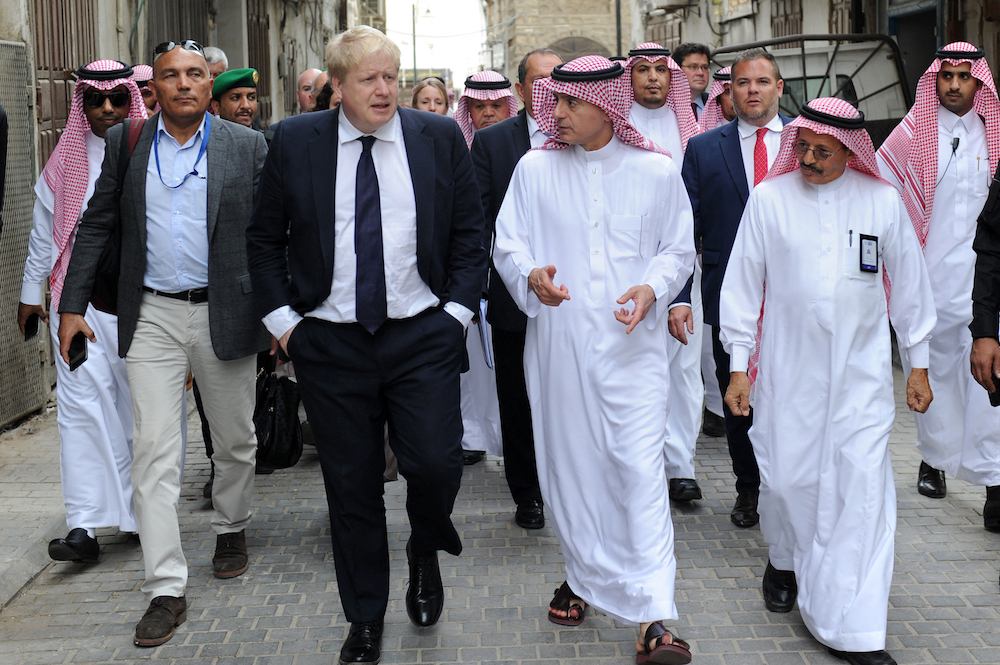
Truss took over from Boris Johnson, center-left, after a protracted Conservative Party leadership contest. (AFP/File Photo)
Truss won the grueling two-month battle to replace Boris Johnson on Sept. 5, beating her rival Rishi Sunak with 57 percent of the vote — the tightest margin of victory since Iain Duncan Smith was elected party leader in 2001 while the Conservatives were in opposition.
Doyle agrees that Truss will likely “take a more hawkish view than Johnson” when it comes to Iran. “Where I do expect that a Truss premiership will be even tougher and take a less helpful line is on Israel-Palestine,” he told Arab News.
“Under Johnson, government policy was dire and extremely partisan to one side: Israel. Truss will go even further, including reviewing moving the UK’s embassy to Jerusalem. It will be a deeply unfair and wrong approach to adopt.”
There are some Middle East watchers who are broadly optimistic about relations under Truss’ stewardship. Charlotte Leslie, director of the Conservative Middle East Council, believes Truss proved her bona fides during her time as foreign secretary.
“Personalities really matter in negotiations and Truss has demonstrated that she sees the GCC as close allies and friends, so I expect to see solid agreements reached that will quickly grow the almost £30 billion ($34.5 billion) already invested in each other’s economies,” Leslie told Arab News.
“The new prime minister will be looking to demonstrate the UK remains a strong, reliable, global friend and ally of choice. In a turbulent world, friends are more important than ever.”