

Queen Elizabeth II under medical care amid health fears

1 / 2
The doctors of Queen Elizabeth II, 96, are "concerned" about her health and "have recommended that she be placed under medical supervision" at her castle in Balmoral, Scotland, Buckingham Palace said. (AFP)
2 / 2
The 96-year-old monarch has been dogged by health problems since October last year that left her with difficulties walking and standing. (File/AFP)
Short Url
Updated 08 September 2022
Follow

Queen Elizabeth II under medical care amid health fears

  • Doctors say queen, 96, under medical supervision
  • Heir to the throne Prince Charles, other members of the family, with the monarch

BALMORAL, Scotland:Family members rushed to be with Queen Elizabeth after doctors said they were concerned about the health of Britain’s 96-year-old monarch on Thursday and said she should remain under medical supervision.
The queen, Britain’s longest-reigning sovereign and the world’s oldest monarch, has been suffering from what Buckingham Palace has called “episodic mobility problems” since the end of last year.
“Following further evaluation this morning, The Queen’s doctors are concerned for Her Majesty’s health and have recommended she remain under medical supervision,” the palace said in a statement.
“The queen remains comfortable and at Balmoral.”


The 96-year-old monarch has been dogged by health problems since October last year that left her with difficulties walking and standing. (File/AFP)

Her eldest son and heir Prince Charles and his wife Camilla have traveled to her Scottish home, Balmoral Castle, where she is staying, along with his eldest son Prince William, officials said. Her other children — Anne, Andrew and Edward — were also on their way to the castle.
A spokesperson said Prince Harry and his wife Meghan, in Britain for a number of events, would also travel to Scotland.
“My prayers, and the prayers of people across the @churchofengland and the nation, are with Her Majesty The Queen today,” Justin Welby, the Archbishop of Canterbury, said on Twitter.
Last October, Elizabeth spent a night in hospital and she has been forced to cut back on public engagements since then. On Wednesday she canceled a virtual meeting with senior ministers after being advised to rest by her doctors.
The previous day she had been pictured appointing Liz Truss as the country’s new prime minister at Balmoral.
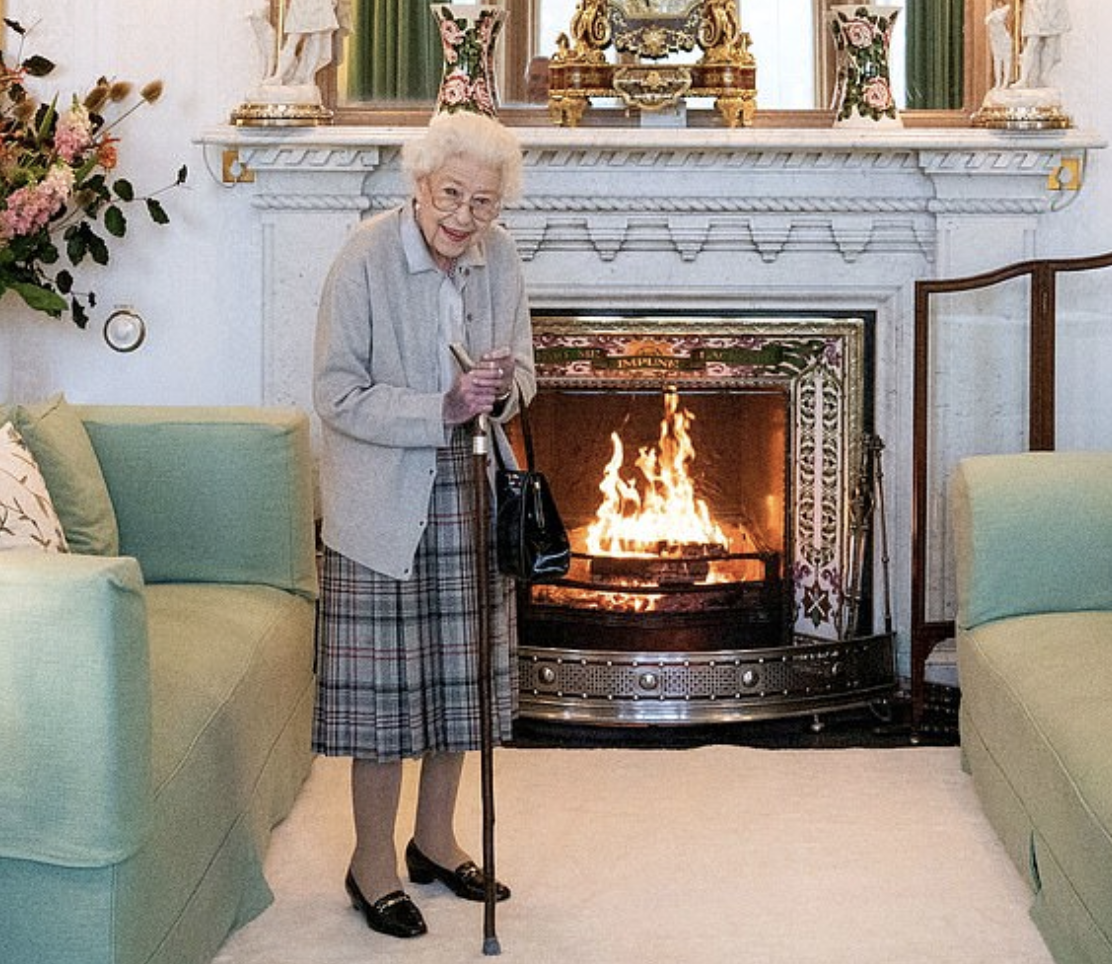


Britain's Queen Elizabeth waits in the Drawing Room before receiving Liz Truss for an audience, where she invited the newly elected leader of the Conservative party to become Prime Minister and form a new government, at Balmoral Castle, Scotland. (Reuters)

A palace source played down speculation that the monarch had suffered a fall.
Elizabeth has been queen of Britain and more than a dozen other countries since 1952, including Canada, Australia and New Zealand, and earlier this year marked her 70th year on the throne with four days of national celebrations in June.
“I have been inspired by the kindness, joy and kinship that has been so evident in recent days, and I hope this renewed sense of togetherness will be felt for many years to come,” she said at the time.
Elizabeth came to the throne after the death of her father King George VI on Feb. 6, 1952, when she was just 25.
She was crowned in June the following year. The first televised coronation was a foretaste of a new world in which the lives of the royals were to become increasingly scrutinized by the media.
She became monarch at a time when Britain retained much of its empire. It was emerging from the ravages of World War Two, with food rationing still in force and class and privilege still dominant in society.
Winston Churchill was the first prime minister who served during her reign, Joseph Stalin was leader of the Soviet Union, the Korean War was raging. Truss is the 15th premier of her record-breaking reign.
The prime minister said: “My thoughts — and the thoughts of people across our United Kingdom — are with Her Majesty The Queen and her family at this time.”

Lindsay Hoyle, speaker of the House of Commons, interrupted an energy debate in parliament to say he sent his best wishes to the monarch.
“Along with the rest of the country, I am deeply worried by the news from Buckingham Palace this afternoon,” opposition Labour leader Keir Starmer said.
Scotland’s First Minister Nicola Sturgeon said on Twitter: “All of us are feeling profoundly concerned at reports of Her Majesty’s health. My thoughts and wishes are with the Queen and all of the Royal Family at this time.”


India, Arab League target $500bn in trade by 2030

Updated 01 February 2026
Follow

India, Arab League target $500bn in trade by 2030

  • It was the first such gathering of India–Arab FMs since the forum’s inauguration in 2016
  • India and Arab states agree to link their startup ecosystems, cooperate in the space sector

NEW DELHI: India and the Arab League have committed to doubling bilateral trade to $500 billion by 2030, as their top diplomats met in New Delhi for the India–Arab Foreign Ministers’ Meeting. 

The foreign ministers’ forum is the highest mechanism guiding India’s partnership with the Arab world. It was established in March 2002, with an agreement to institutionalize dialogue between India and the League of Arab States, a regional bloc of 22 Arab countries from the Middle East and North Africa.

The New Delhi meeting on Saturday was the first gathering in a decade, following the inaugural forum in Bahrain in 2016.

India’s Foreign Minister S. Jaishankar said in his opening remarks that the forum was taking place amid a transformation in the global order.

“Nowhere is this more apparent than in West Asia or the Middle East, where the landscape itself has undergone a dramatic change in the last year,” he said. “This obviously impacts all of us, and India as a proximate region. To a considerable degree, its implications are relevant for India’s relationship with Arab nations as well.”

Jaishankar and his UAE counterpart co-chaired the talks, which aimed at producing a cooperation agenda for 2026-28.

“It currently covers energy, environment, agriculture, tourism, human resource development, culture and education, amongst others,” Jaishankar said.

“India looks forward to more contemporary dimensions of cooperation being included, such as digital, space, start-ups, innovation, etc.”

According to the “executive program” released by India’s Ministry of External Affairs, the roadmap agreed by India and the League outlined their planned collaboration, which included the target “to double trade between India and LAS to US$500 billion by 2030, from the current trade of US$240 billion.”

Under the roadmap, they also agreed to link their startup ecosystems by facilitating market access, joint projects, and investment opportunities — especially health tech, fintech, agritech, and green technologies — and strengthen cooperation in space with the establishment of an India–Arab Space Cooperation Working Group, of which the first meeting is scheduled for next year.

Over the past few years, there has been a growing momentum in Indo-Arab relations focused on economic, business, trade and investment ties between the regions that have some of the world’s youngest demographics, resulting in a “commonality of circumstances, visions and goals,” according to Muddassir Quamar, associate professor at the School of International Studies, Jawaharlal Nehru University.

“The focus of the summit meeting was on capitalizing on the economic opportunities … including in the field of energy security, sustainability, renewables, food and water security, environmental security, trade, investments, entrepreneurship, start-ups, technological innovations, educational cooperation, cultural cooperation, youth engagement, etc.,” Quamar told Arab News.

“A number of critical decisions have been taken for furthering future cooperation in this regard. In terms of opportunities, there is immense potential.”