

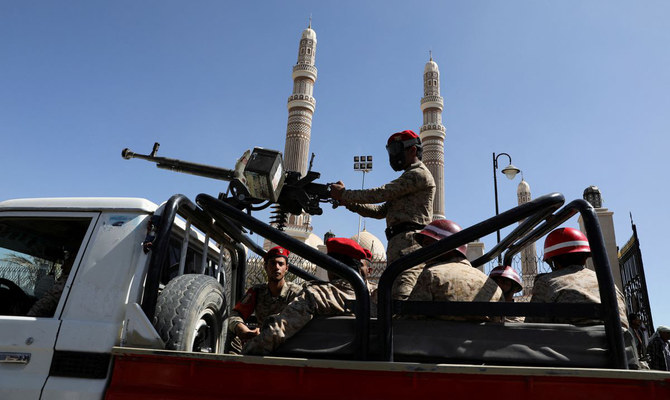
Yemeni army: 42 killed in Houthi attacks in Taiz during truce

The army reiterated calls for more aggressive pressure on the Houthis to abide by a truce between them and the Yemeni government. (Reuters/File)
Short Url
Updated 07 September 2022
Follow

Yemeni army: 42 killed in Houthi attacks in Taiz during truce

  • The Houthis have recently concentrated their attacks on a narrow and unpaved road in the Al-Dhabab area to the west of Taiz that connects the city with several Yemeni cities

AL-MUKALLA: Yemen’s army said on Wednesday that 42 people have been killed and 185 injured in attacks by the Iran-backed Houthis in various locations in the southern city of Taiz over the last five months.

The army reiterated calls for more aggressive pressure on the Houthis to abide by a truce between them and the Yemeni government.

Abdul Basit Al-Baher, a Yemeni military officer in Taiz, told Arab News that the Houthis have committed 4,450 violations since April 2, killing 30 soldiers and 12 civilians, including women and children, and injuring 131 soldiers and 54 civilians.

“We had no sense of a ceasefire at all,” Al-Baher said. “The bloodbath did not end, and neither did the siege nor … On the contrary, hostilities have risen to unprecedented levels.”

Under the truce, which has been renewed twice, the Houthis and the Yemeni government have agreed to cease fighting, allow commercial flights to leave Sanaa, and provide fuel ships with easy access to the port of Hodeidah.

A joint committee was formed to discuss the opening of roads in besieged Taiz and other provinces.

Yemeni officials argue that Taiz, the country’s third-largest city, is the only city that has not benefited from the truce because the Houthis have not stopped their arbitrary and lethal attacks on civilian and military gatherings. They claim that the Houthis have not lifted their seven-year blockade of the city.

The Houthis have recently concentrated their attacks on a narrow and unpaved road in the Al-Dhabab area to the west of Taiz that connects the city with several Yemeni cities.

The Houthis seized full control of Taiz’s gateways and the major thoroughfares that link the city to Sanaa, Hodeidah and Aden, obstructing goods and humanitarian aid for hundreds of thousands of people.

“Imagine that they are currently attacking the lone route that connects Taiz to the outside world. Those people are not serious about peace,” Al-Baher stated, adding that army troops have successfully repelled Houthi advances on Al-Dhabab over the past 48 hours.

On Wednesday, hundreds of people in Aden attended a funeral procession for a military commander killed by the Houthis in the province of Lahj.

Officials said a Houthi sniper shot dead Haddar Al-Shawhati, commander of the 4th Support and Reinforcements Brigade, on Tuesday while he was touring the frontlines in the Yafae area.


A ceasefire holds in Syria but civilians live with fear and resentment

Updated 27 January 2026
Follow

A ceasefire holds in Syria but civilians live with fear and resentment

  • The Arab-majority population in the areas that changed hands, Raqqa and Deir Ezzor, have celebrated the SDF’s withdrawal after largely resenting its rule
  • But thousands of Kurdish residents of those areas fled, and non-Kurdish residents remain in Kurdish-majority enclaves still controlled by the SDF

QAMISHLI: Fighting this month between Syria’s government and Kurdish-led forces left civilians on either side of the frontline fearing for their future or harboring resentment as the country’s new leaders push forward with transition after years of civil war.
The fighting ended with government forces capturing most of the territory previously held by the Kurdish-led Syrian Democratic Forces in the country’s northeast, and a fragile ceasefire is holding. SDF fighters will be absorbed into Syria’s army and police, ending months of disputes.
The Arab-majority population in the areas that changed hands, Raqqa and Deir Ezzor, have celebrated the SDF’s withdrawal after largely resenting its rule.
But thousands of Kurdish residents of those areas fled, and non-Kurdish residents remain in Kurdish-majority enclaves still controlled by the SDF. The International Organization for Migration has registered more than 173,000 people displaced.
Fleeing again and again
Subhi Hannan is among them, sleeping in a chilly schoolroom in the SDF-controlled city of Qamishli with his wife, three children and his mother after fleeing Raqqa.
The family is familiar with displacement after the years of civil war under former President Bashar Assad. They were first displaced from their hometown of Afrin in 2018, in an offensive by Turkish-backed rebels. Five years later, Hannan stepped on a land mine and lost his legs.
During the insurgent offensive that ousted Assad in December 2024, the family fled again, landing in Raqqa.
In the family’s latest flight this month, Hannan said their convoy was stopped by government fighters, who arrested most of their escort of SDF fighters and killed one. Hannan said fighters also took his money and cell phone and confiscated the car the family was riding in.
“I’m 42 years old and I’ve never seen something like this,” Hannan said. “I have two amputated legs, and they were hitting me.”
Now, he said, “I just want security and stability, whether it’s here or somewhere else.”
The father of another family in the convoy, Khalil Ebo, confirmed the confrontation and thefts by government forces, and said two of his sons were wounded in the crossfire.
Syria’s defense ministry in a statement acknowledged “a number of violations of established laws and disciplinary regulations” by its forces during this month’s offensive and said it is taking legal action against perpetrators.
A change from previous violence
The level of reported violence against civilians in the clashes between government and SDF fighters has been far lower than in fighting last year on Syria’s coast and in the southern province of Sweida. Hundreds of civilians from the Alawite and Druze religious minorities were killed in revenge attacks, many of them carried out by government-affiliated fighters.
This time, government forces opened “humanitarian corridors” in several areas for Kurdish and other civilians to flee. Areas captured by government forces, meanwhile, were largely Arab-majority with populations that welcomed their advance.
One term of the ceasefire says government forces should not enter Kurdish-majority cities and towns. But residents of Kurdish enclaves remain fearful.
The city of Kobani, surrounded by government-controlled territory, has been effectively besieged, with residents reporting cuts to electricity and water and shortages of essential supplies. A UN aid convoy entered the enclave for the first time Sunday.
On the streets of SDF-controlled Qamishli, armed civilians volunteered for overnight patrols to watch for any attack.
“We left and closed our businesses to defend our people and city,” said one volunteer, Suheil Ali. “Because we saw what happened in the coast and in Sweida and we don’t want that to be repeated here.”
Resentment remains
On the other side of the frontline in Raqqa, dozens of Arab families waited outside Al-Aqtan prison and the local courthouse over the weekend to see if loved ones would be released after SDF fighters evacuated the facilities.
Many residents of the region believe Arabs were unfairly targeted by the SDF and often imprisoned on trumped-up charges.
At least 126 boys under the age of 18 were released from the prison Saturday after government forces took it over.
Issa Mayouf from the village of Al-Hamrat, was waiting with his wife outside the courthouse Sunday for word about their 18-year-old son, who was arrested four months ago. Mayouf said he was accused of supporting a terrorist organization after SDF forces found Islamic chants as well as images on his phone mocking SDF commander Mazloum Abdi.
“SDF was a failure as a government,” Mayouf said “And there were no services. Look at the streets, the infrastructure, the education. It was all zero.”
Northeast Syria has oil and gas reserves and some of the country’s most fertile agricultural land. The SDF “had all the wealth of the country and they did nothing with it for the country,” Mayouf said.
Mona Yacoubian, director of the Middle East Program at the Center for Strategic and International Studies, said Kurdish civilians in besieged areas are terrified of “an onslaught and even atrocities” by government forces or allied groups.
But Arabs living in formerly SDF-controlled areas “also harbor deep fears and resentment toward the Kurds based on accusations of discrimination, intimidation, forced recruitment and even torture while imprisoned,” she said.
“The experience of both sides underscores the deep distrust and resentment across Syria’s diverse society that threatens to derail the country’s transition,” Yacoubian said.
She added it’s now on the government of interim Syrian President Ahmad Al-Sharaa to strike a balance between demonstrating its power and creating space for the country’s anxious minorities to have a say in their destiny.