

Jordan facing water crisis amid wet season delays: Minister

1 / 4
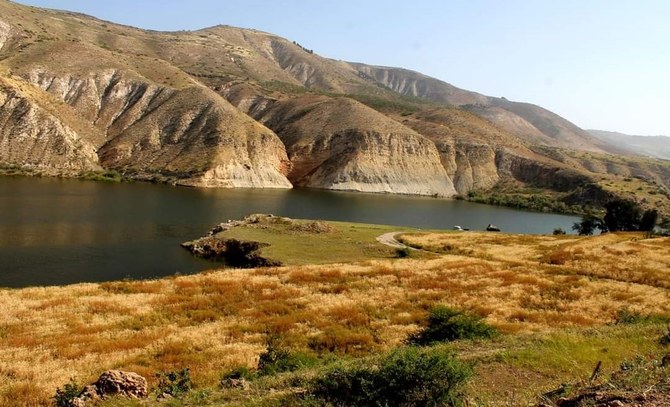
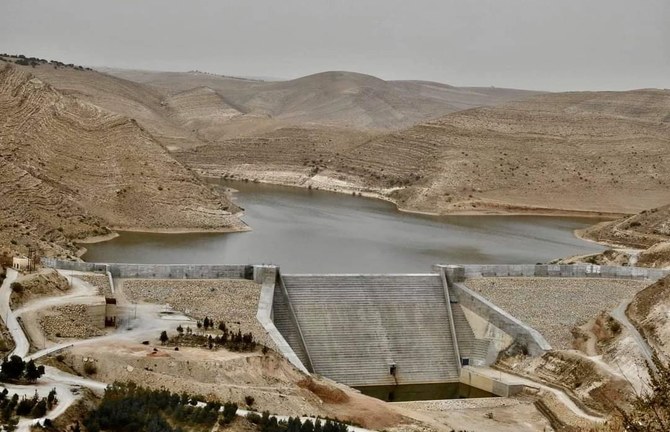
Jordan’s water reserves have hit record lows, with major dams being less than 15% full. (Supplied)
2 / 4
Jordan’s water reserves have hit record lows, with major dams being less than 15% full. (Supplied)
3 / 4
Jordan’s water reserves have hit record lows, with major dams being less than 15% full. (Supplied)
4 / 4
Jordan’s water reserves have hit record lows, with major dams being less than 15% full. (Supplied)
Short Url
Updated 07 September 2022
Follow

Jordan facing water crisis amid wet season delays: Minister

  • Jordanian Water Ministry spokesperson Omar Salameh: Water reserves at all Jordan’s dams have dropped to critical levels of less than 15%
  • Omar Salameh: This is unprecedented; never in the history of Jordan has such a percentage been recorded

AMMAN: After a long and hot summer, Jordan’s water reserves have hit record lows, with major dams being less than 15 percent full, officials said, warning of a looming water crisis amid a delayed onset of the wet season.

Omar Salameh, spokesperson for the Water Ministry, told Arab News that “water reserves at all Jordan’s dams have dropped to critical levels of less than 15 percent.”

Acknowledging that a drop in water storage is normal at the end of summer, Salameh added: “But this is unprecedented. Never in the history of Jordan has such a percentage been recorded.”

The official attributed the cause of the limited water supply to this year’s “long dry season, the rising temperature and the accompanying high water consumption for household usage and irrigation.”

He added that the volume of water currently stored at the kingdom’s 14 major dams is “only 43 million cubic meters of their total capacity of 336.4 million cubic meters.”

Salameh warned that “we will definitely face a water crisis in case of a delay in the onset of the rainy season (which begins in November to May).”

Water from Syria

Jordan recently confirmed that its request for 30 million cubic meters of water from Syria was rejected as Amman looks to secure water for agriculture in the fertile northern region.

Water Minister Mohammad Najjar said in late July that Syria had rejected Jordan’s request under the deal signed between the two countries, attributing the reason to the northern neighbor also facing a water crisis and to the political situation in Syria’s southern regions bordering the kingdom.

Najjar said at the time that the ministry’s available solution to the growing demand on irrigation water was to rehabilitate the underground water reservoirs in northern Jordan.

Jordan and Syria signed the Yarmouk Water Agreement in 1987 to institutionalize water cooperation. Under the deal, signed in Damascus, the two sides agreed to build the Al-Wehda Dam on the borders between the two countries to also generate electricity.

Under the deal, Syria receives 75 percent of the electricity generated from the dam while Jordan has “all the sovereignty over its water storage.”

Jordan has always accused the Syrians of building water reservoirs and large agricultural projects on the sides of the Yarmouk River, thus allowing only small quantities of water to flow to the Wehda Dam.

“The Syrians are honoring the agreement but they also face a water crisis like all the region,” Salameh said.

National conveyor project

Classified as the world’s second most water-scarce country, Jordan announced the launch of the Aqaba-Amman Water Desalination and Conveyance National Project (AAWDC) in February 2020.

An unnamed government source has been quoted in Jordan’s news agency, Petra, as saying that the kingdom will host an international donor conference in Amman at the end of the year to secure funds for the project, described as “the largest water generation scheme to be implemented in the history of the kingdom.”

Jordan’s Water Authority has recently said that the mega-project will “ensure the country’s water stability until 2040.”

The Water Ministry announced that the AAWDC will generate 130 million cubic meters of water each year and will be implemented on a build-operate-transfer basis.

In October last year, Jordan announced it had purchased an additional 50 million cubic meters of water from Israel outside the framework of the 1994 peace agreement and what it stipulates in regard to water quantities.


Lebanese man flees hometown, months after repairing home damaged in last war

Updated 3 sec ago
Follow

Lebanese man flees hometown, months after repairing home damaged in last war

  • Lebanese man rebuilt home four times but fled new war
  • Many in Lebanon ‌were still recovering from 2024 conflict
HAZMIEH: Just days ago, Hussain Khrais was proudly showing off his newly restored home in south Lebanon, fixed up after ​being badly damaged in 2024 clashes between Israel and Hezbollah. But a new war has since erupted and his home is in the line of fire again.
Khrais fled his hometown of Khiyam, about five km (three miles) from the border with Israel, as Israel pounded Lebanon with heavy airstrikes last week in retaliation for Iran-backed group Hezbollah’s rocket and drone fire into Israel.
“Is the house I worked so hard to build, or the business I started, still there? Or is it all gone?” Khrais told Reuters from a relative’s home near the capital Beirut where he and his family are now staying.
“The feeling is ‌very, very upsetting, ‌because we still don’t know if we’ll go back or not.”
’WHAT ​KIND ‌OF ⁠LIFE IS ​THAT?’
It ⁠wasn’t Khrais’ first time — or even his second. The 66-year-old has been displaced at least four times in the last four decades by Israeli incursions and airstrikes, each time returning to a town in ruins and rebuilding patiently.
Last year, he spent months and around $25,000 repairing the damage from the last war between Hezbollah and Israel, which ended 15 months ago. Hezbollah started firing at Israel after the United States and Israel launched airstrikes against Iran on February 28.
“It really bothers me to think this is the life I’ve lived,” Khrais told Reuters. “Once ⁠again, displacement, return, rebuilding, restoration — then again displacement, return, rebuilding. What kind of life ‌is that?“
With no support from the Lebanese state and ‌little coming from Hezbollah’s social welfare program, most Lebanese whose homes were ​damaged or destroyed in the 2024 war have ‌used their own private funds to rebuild.
Reconstruction has placed a huge burden on affected Lebanese families, still ‌struggling to access their savings in commercial banks after a financial collapse in 2019.
Two weeks ago, Khrais had told Reuters he was scared that a new war would start. “I’m at an age where I can’t start all over again. That’s it,” he said.
’WORTH THE WORLD’S TREASURES’
The new war has dealt Lebanese another blow. About 300,000 people have ‌been displaced over the last week by Israel’s strikes and by the Israeli military’s evacuation orders, which encompass around 8 percent of Lebanese territory.
Khrais is staying ⁠with around 20 other ⁠displaced relatives, some displaced from Khiyam and others from Beirut’s southern suburbs, which have been hit hard by Israeli strikes.
He is glued to the television, where news bulletins have reported on Israeli troops and tanks pushing deeper into his hometown.
“I’ve been in Beirut for four days now, and these four days feel like 400 years,” Khrais said.
He misses his house dearly.
“Maybe the thing I’m most attached to, is when I open the door to my children’s bedrooms and see the pictures of their children hanging on the walls,” he said.
“That sight is worth the world’s treasures — to see my grandchildren’s pictures in Khiyam.”
Khrais has no news on the state of his home. He said he remains hopeful but that if it has been destroyed, he’ll still do what he’s always done.
“The big shock would be if I ​came back and didn’t find it. But my ​feeling says no, God willing, it will remain. And like I said, even if we don’t find the house, we’ll go back and rebuild,” he said.