

Typhoon leaves 20,000 homes without power in South Korea

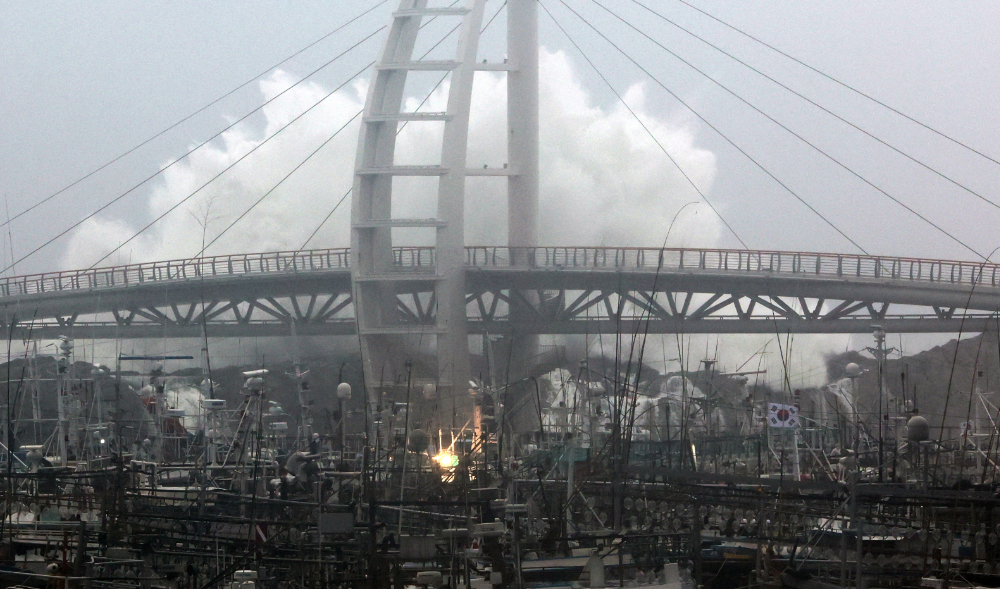
A wave caused by Typhoon Hinnamnor hits the waterfront in Busan, South Korea, September 6, 2022. (REUTERS)
Short Url
Updated 06 September 2022
Follow

Typhoon leaves 20,000 homes without power in South Korea

  • More than 250 flights and 70 ferry services were grounded while more than 66,000 fishing boats evacuated to ports

SEOUL, South Korea: Thousands of people were forced to evacuate in South Korea as Typhoon Hinnamnor made landfall in the country’s southern regions on Tuesday, unleashing fierce rains and winds that destroyed trees and roads, and left more than 20,000 homes without power.
A 25-year-old man went missing after falling into a rain swollen stream in the southern city of Ulsan, according to the Ministry of the Interior and Safety, which didn’t immediately report more casualties. Fires were reported at a major steel plant operated by POSCO in the southern city of Pohang, but it wasn’t immediately clear whether they were caused by the storm.


A high wave caused by Typhoon Hinnamnor hits a port on Jeju island, South Korea, September 5, 2022. (REUTERS)

Government officials have put the nation on alert about potential damages from flooding, landslides and tidal waves unleashed by Hinnamnor, which they said would be the most powerful storm to hit the country in years. The storm came just weeks after capital Seoul and nearby regions were battered by heavy rainfall that unleashed flashfloods and killed at least 14 people.
Prime Minister Han Duk-soo had called for proactive efforts to evacuate residents in areas vulnerable to flooding, saying that Hinnamnor could end up being a “historically strong typhoon that we never experienced before.”
South Korea’s weather agency said Hinnamnor–packing heavy rains and winds of up to 144 kilometers (89 miles) per hour – was moving northeast toward open sea after grazing the southern resort island of Jeju and making landfall near the mainland port of Busan earlier on Tuesday.
The storm dumped more than 94 centimeters (37 inches) of rain in the central part of Jeju since Sunday, where winds once reached a maximum speed of 155 kph (96 mph).
The Safety Ministry said more than 3,400 people in the southern regions were forced to evacuate from their homes because of safety concerns and that officials were advising or ordering 14,000 more people to evacuate. At least five homes and buildings were flooded or destroyed, and scores of roads were damaged.
More than 600 schools nationwide were closed or converted to online classes. More than 250 flights and 70 ferry services were grounded while more than 66,000 fishing boats evacuated to ports. Workers as of 6 a.m. managed to restore electricity to 2,795 of the 20,334 households that were knocked out of power.


South Korea will boost medical school admissions to tackle physician shortage

Updated 9 sec ago
Follow

South Korea will boost medical school admissions to tackle physician shortage

  • Jeong said all of the additional students will be trained through regional physician programs

SEOUL: South Korea plans to increase medical school admissions by more than 3,340 students from 2027 to 2031 to address concerns about physician shortages in one of the fastest-aging countries in the world, the government said Tuesday.

The decision was announced months after officials defused a prolonged doctors’ strike by backing away from a more ambitious increase pursued by Seoul’s former conservative government. Even the scaled-down plan drew criticism from the country’s doctors’ lobby, which said the move was “devoid of rational judgment.”

Kwak Soon-hun, a senior Health Ministry official, said that the president of the Korean Medical Association attended the healthcare policy meeting but left early to boycott the vote confirming the size of the admission increases.

The KMA president, Kim Taek-woo, later said the increases would overwhelm medical schools when combined with students returning from strikes or mandatory military service, and warned that the government would be “fully responsible for all confusion that emerges in the medical sector going forward.” The group didn’t immediately signal plans for further walkouts.

Health Minister Jeong Eun Kyeong said the annual medical school admissions cap will increase from the current 3,058 to 3,548 in 2027, with further hikes planned in subsequent years to reach 3,871 by 2031. This represents an average increase of 668 students per year over the five-year period, far smaller than the 2,000-per-year hike initially proposed by the government of former President Yoon Suk Yeol, which sparked the months long strike by thousands of doctors.

Jeong said all of the additional students will be trained through regional physician programs, which aim to increase the number of doctors in small towns and rural areas that have been hit hardest by demographic pressures. The specific admissions quota for each medical school will be finalized in April.