

Asfan Al-Khalediah claims King Faisal Cup in marquee event of Taif horseracing season

1 / 3
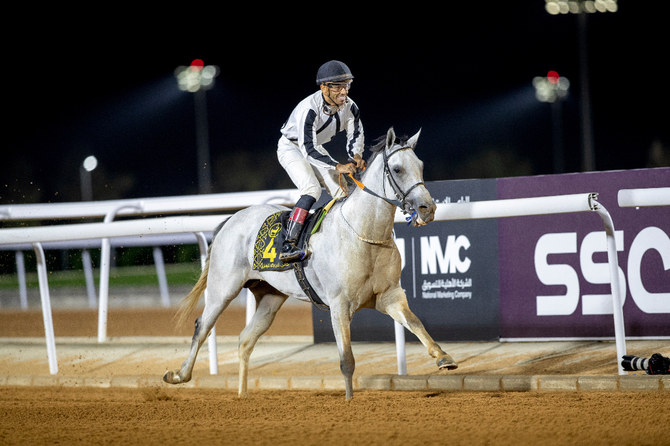
Asfan Al-Khalediah, under jockey Abdullah Alawfi, romps to a 15-length victory in the SAR1m Listed King Faisal Cup for Purebred Arabians. (Ali Abdullah/JCSA)
2 / 3
Abdullah Alawfi steers Qaswarat Al Khalediah to victory in the SAR1m Prince Abdullah Alfaisal Cup. (Ali Abdullah/JCSA)
3 / 3
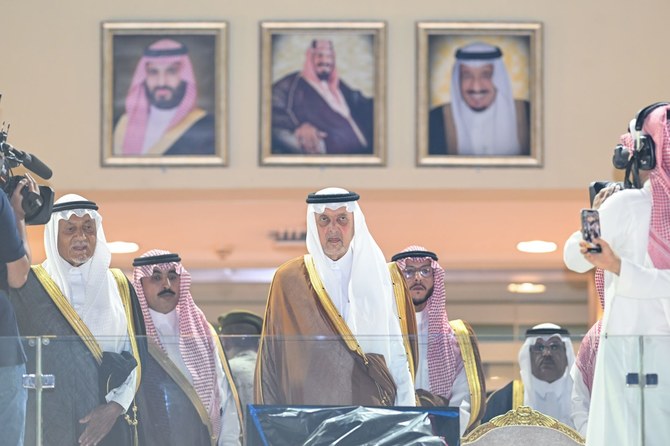
Prince Khalid Al-Faisal, Governor of Makkah Region and Patron of the 33rd JCSA race, arrives with his companions in the VIP box of the King Khalid Racecourse to award the winners. (Khalid Alfehaid/JCSA)
Short Url
Updated 06 September 2022
Follow

Asfan Al-Khalediah claims King Faisal Cup in marquee event of Taif horseracing season

  • The 2022 Taif summer racing fixtures have been doubled to 48 from the previous year’s 24

To the roar of Taif’s King Khaled Racetrack crowd, the 2022 King Faisal Arabian Horses Cup was claimed on Saturday evening by Asfan Al-Khalediah for Prince Khaled bin Sultan bin Abdulaziz’s Al-Khalediah Stables, finishing well ahead of contenders Modhishah and Malzaman.

Sired by Laith Al-Khalediah and ridden by Abdullah Al-Awfi, gray colt Afsan Al-Khalediah completed the 1,600-meter race in a final time of 1:55.38, besting Modhishah by 15.75 lengths, with Malzaman another 0.75 lengths back in third.

Having won the King Faisal Cup in 2021 with Tilal Al-Khalediah, Al-Khalediah Stables hold a perfect record in this $266,000 race. And it was a glorious day for Al-Awfi, who earlier steered Qaswarat Al-Khalediah to victory in the Prince Abdullah Al-Faisal Cup, also with a $266,000 bounty.

“I was wary of the filly Katebat Al-Khalediah, but as it turned out I knew I had won from 800 meters out,” Al-Awfi said. “I’ve won three out of three on Asfan now; he’s an excellent horse. I feel that Asfan could emulate Tilal Al-Khalediah, who was the winner of this race in 2021 and went on to also win the King Abdulaziz Cup for purebred Arabians.”

The purebred Arabian race followed a number of other competitions throughout the day in addition to the Prince Abdullah Al-Faisal Cup, including the Fillies Open, won by Rooqa; the Taif Cup (fillies and colts) with Al-Kuweit in the lead; the Taif Cup (fillies), claimed by Aewaaly Najd; and the Okaz Cup, with Yahtarez taking the prize — a day of racing worth more than $1.2 million across the card.

“I extend my congratulations to Al-Awfi, trainer Saad Mutlaq and the Al-Khalediah Stables on their victory in the second renewal of the King Faisal Cup,” Jockey Club of Saudi Arabia Chairman Prince Bandar bin Khaled Al-Faisal told Arab News. “This is a race that will continue to grow in stature, and the names on this trophy will become part of Saudi racing history.

“As an internationally listed contest, the King Faisal Cup has global importance for purebred Arabian racing. Arabian racing horses represent not only a key area of Saudi Arabian heritage but as foundation sires, Arabians have also played a considerable role in the international evolution of thoroughbred racing.”

Arabian horses are distinguished from thoroughbreds by their smaller size, lighter bodies and thicker skin, protecting them from the scorching conditions of the region.

The King Faisal Cup is a marquee occasion of the Jockey Club of Saudi Arabia’s expanded summer season program at Taif’s King Khaled Racetrack, running from June 16 to Oct. 8.

The 2022 Taif summer racing fixtures have been doubled to 48 from the previous year’s 24, with a total of 384 races (up from 190). And the new National Day Cup meeting on Saturday, Sept. 22 will feature the Taif Derby, Taif Sprint Cup and Taif Arabian Horses Derby, all worth over $100,000.

Taif is situated at an altitude of almost 2,000 meters, with a cool and balmy climate perfect for racing during the summer months — unique in the Gulf and therefore a draw for horseracing professionals across the Kingdom as well as from neighboring countries such as the UAE and Bahrain.

As soon as the Taif racing season draws to a close, the Riyadh season will kick off with a succession of local and international races worth an average of $30,000 each and culminating with the $20 million Saudi Cup — the world’s most valuable. Launched in 2020, the upcoming February 2023 event will be the fourth edition of the Saudi Cup.

“We have been racing in Taif for two decades but, like all racing in Saudi Arabia, the Taif season received a boost thanks to the international profile of the Saudi Cup,” Salem Binmafhooz, JCSA’s director of racing, told Arab News.

“Racing in Taif is unique in the region in being able to stage temperate summertime racing thanks to its location and altitude.

“We are in the process of finalizing infrastructure developments at King Khaled Racetrack that in coming seasons will allow us to accommodate horses from across the region, making Taif a hub for the other racing jurisdictions in the Gulf Cooperation Council.”

JCSA CEO Marwan Al-Olayan added: “As an industry, Saudi Arabian racing is evolving at a fast pace and while we are making great progress on the international stage, as borne out by the success of the Saudi Cup, we are also keen to showcase the sport and its opportunities to our communities.

“Racing is one of the most popular forms of sporting entertainment around the world, and we hope to continue to attract greater numbers of fans to this industry during the coming seasons.”


Australia depth shows up England’s Ashes ‘failures’

Updated 12 December 2025
Follow

Australia depth shows up England’s Ashes ‘failures’

SYDNEY: A well-drilled Australia are on the cusp of retaining the Ashes after just six days of cricket — not bad for a team lambasted by England great Stuart Broad before the series began as its weakest since 2010.
The hosts take a 2-0 lead into the third Test at Adelaide on December 17 needing only a draw to keep the famous urn and pile more humiliation on Ben Stokes’s tourists.
Australia have put themselves on the brink despite missing injured pace spearheads Pat Cummins and Josh Hazlewood, with the performances of stand-ins Michael Neser and Brendan Doggett a reflection of their depth.
“The great and the healthiest thing for Australian cricket right now is that they’ve got almost a second XI or an Australia ‘A’ side that could come in and play some outstanding cricket too,” said former Australia Test quick Brett Lee.
“The guys who have had their opportunity, the Doggetts and the Nesers, have stood up. They’ve taken their opportunity and taken it with both hands, which is brilliant.”
The strength of the country’s talent pool was driven home by Australia ‘A’ crushing England’s second-tier side by an innings and 127 runs at Allan Border Field while Stokes’s men were being thrashed down the road in the second Test at the Gabba.
Young prospects Fergus O’Neill, Cooper Connolly and Campbell Kellaway stood out, while discarded Test batsman Nathan McSweeney fired a double-century reminder to selectors.
It is a far cry from the pre-Ashes war-of-words where England were hyped as having their best chance in a generation to win a series in Australia, with seamer Broad’s comments coming back to haunt him.
“It’s probably the worst Australian team since 2010 when England last won and it’s the best English team since 2010,” said Broad, who retired in 2023 and is now working as a pundit.
“It’s actually not an opinion, it’s fact.”
At the time, he pointed to questions over the make-up of Australia’s batting line-up and a perceived lack of bowling depth.
Both have been blown out of the water.

On the go

Australia went into the first Test in Perth dogged by uncertainty, with the uncapped Jake Weatherald as Usman Khawaja’s sixth opening partner since David Warner retired nearly two years ago.
In a quirk of fate, Khawaja was unable to bat in the first innings because of back spasms with Marnus Labuschagne replacing him.
But it was when he pulled out again in the second innings and Travis Head stepped up that the tide turned on England with his stunning 69-ball match-winning century.
“Ever since Travis Head stuck his hand up to open when Khawaja got hurt in Perth, Australia have looked like a different team,” said Australian legend Glenn McGrath.
Labuschagne said Head and Weatherald’s confidence trickled down to the lower order in Brisbane, where himself, Steve Smith and Alex Carey all blasted quick-fire half centuries.
It leaves selectors with a dilemma for the third Test: recall now-fit 85-Test veteran Khawaja or persist with Weatherald and Head, whose home ground is Adelaide.
Smith, who stood in for Cummins as skipper in the first two Tests, attributed Australia’s success so far to being able to adapt “in real time.”
“We play ‘live’. We adapt on the go, instead of getting back in the sheds and going, ‘We should have done this’,” he said.
“Sometimes it’s just playing the long game. I think we’ve just adapted so well the last couple of years, and played in real time, I suppose.”
For former Australia captain Greg Chappell, Australia’s success has been as much about England’s failures.
While their aggressive “Bazball” approach might be suited to flat English pitches and small grounds, it has been brutally exposed by the bigger boundaries and demanding conditions in Australia.
“The failure that has ensued across the first two Tests is a whole-of-system one, a catastrophic breakdown of both the game plan and its execution,” he wrote in a column.
“While the players have been the immediate culprits, the off-field leaders —  Brendon McCullum and Ben Stokes — are equally responsible for not recognizing the different challenges presented by Test cricket in Australia.”