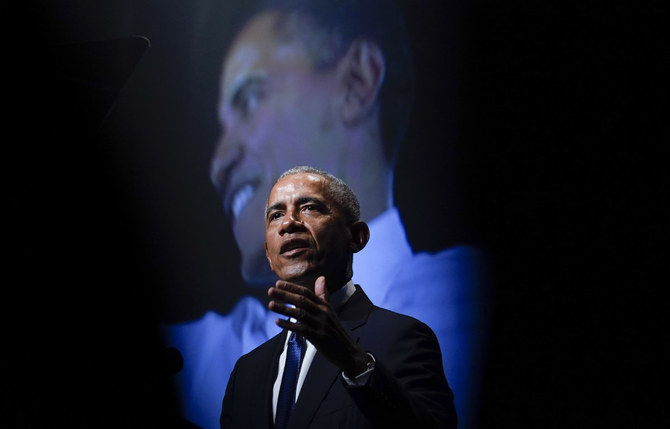
Barack Obama wins Emmy for narrating national parks series

Former President Barack Obama won an Emmy Award on Sept. 3, 2022 for his work on the Netflix documentary series, "Our Great National Parks." (AP File)
Short Url
Updated 04 September 2022
Follow

Barack Obama wins Emmy for narrating national parks series

  • Barack Obama is the second president to have an Emmy. Dwight D. Eisenhower was given a special Emmy Award in 1956

LOS ANGELES: Barack Obama is halfway to an EGOT.
The former president won an Emmy Award on Saturday to go with his two Grammys.
Obama won the best narrator Emmy for his work on the Netflix documentary series, “Our Great National Parks.”
The five-part show, which features national parks from around the globe, is produced by Barack and Michelle Obama’s production company, “Higher Ground.”
He was the biggest name in a category full of famous nominees for the award handed out at Saturday night’s Creative Arts Emmys, including Kareem Abdul-Jabbar, David Attenborough and Lupita Nyong’o.
Barack Obama is the second president to have an Emmy. Dwight D. Eisenhower was given a special Emmy Award in 1956.
Barack Obama previously won Grammy Awards for his audiobook reading of two of his memoirs, “The Audacity of Hope” and “A Promised Land.” Michelle Obama won her own Grammy for reading her audiobook in 2020.
EGOT refers to a special category of entertainers who have won an Emmy, a Grammy, an Oscar and a Tony. To date, 17 people have done it.
The late Chadwick Boseman also won an Emmy for his voice work on Saturday. The “Black Panther” actor won for outstanding character voiceover for the Disney+ and Marvel Studios animated show “What If...?“
On the show, Boseman voiced his “Black Panther” character T’Challa in an alternate universe where he becomes Star-Lord from “Guardians of the Galaxy.”
It was one of the last projects for Boseman, who died in 2020 of colon cancer at age 43. 


Art Cairo spotlights pioneering artist Inji Efflatoun

Updated 23 January 2026
Follow

Art Cairo spotlights pioneering artist Inji Efflatoun

CAIRO: Art Cairo 2026 returned to Egypt’s bustling capital from Jan. 23-26, with visitors treated to gallery offerings from across the Middle East as well as a solo museum exhibition dedicated to pioneering Egyptian artist Inji Efflatoun.

While gallery booths hailed from across the Arab world, guests also had the chance to explore the oeuvre of the politically charged artist, who died in 1989.

Many of the pieces in the 14-work exhibition were drawn from the collection of the Egyptian Museum of Modern Art and cover four main periods of the artist’s work, including her Harvest, Motherhood, Prison and Knoll series.

While gallery booths hailed from across the Arab world, guests also had the chance to explore the oeuvre of the politically charged artist, who died in 1989. (Supplied)

Efflatoun was a pivotal figure in modern Egyptian art and is as well known for her work as her Marxist and feminist activism.

“This is the third year there is this collaboration between Art Cairo and the Ministry of Culture,” Noor Al-Askar, director of Art Cairo, told Arab News.

“This year we said Inji because (she) has a lot of work.”

Born in 1924 to an affluent, Ottoman-descended family in Cairo, Efflatoun rebelled against her background and took part heavily in communist organizations, with her artwork reflecting her abhorrence of social inequalities and her anti-colonial sentiments.

Many of the pieces in the 14-work exhibition were drawn from the collection of the Egyptian Museum of Modern Art and cover four main periods of the artist’s work, including her Harvest, Motherhood, Prison and Knoll series. (Supplied)

One untitled work on show is a barbed statement on social inequalities and motherhood, featuring a shrouded mother crouched low on the ground, working as she hugs and seemingly protects two infants between her legs.

The artist was a member of the influential Art et Liberte movement, a group of staunchly anti-imperialist artists and thinkers.

In 1959, Efflatoun was imprisoned under Gamal Abdel Nasser, the second president of Egypt. The artist served her sentence for four years across a number of women’s prisons in the deserts near Cairo — it was a period that heavily impacted her art, leading to her post-release “White Light” period, marked dynamic compositions and vibrant tones.

Grouped together, four of the exhibited works take inspiration from her time in prison, with powerful images of women stacked above each other in cell bunkbeds, with feminine bare legs at sharp odds with their surroundings.

Art Cairo 2026 returned to Egypt’s bustling capital from Jan. 23-26. (Supplied)

The bars of the prison cells obstruct the onlooker’s view, with harsh vertical bars juxtaposed against the monochrome stripes of the prison garb in some of her works on show.

“Modern art, Egyptian modern art, most people, they really don’t know it very well,” Al-Askar said, adding that there has been a recent uptick in interest across the Middle East, in the wake of a book on the artist by UAE art patron Sultan Sooud Al-Qassemi.

“So, without any reason, all the lights are now on Inji,” Al-Askar added.

Although it was not all-encompassing, Art Cairo’s spotlight on Efflatoun served as a powerful starting point for guests wishing to explore her artistic journey.