

UK charity group raises $15m for Pakistan flood relief efforts

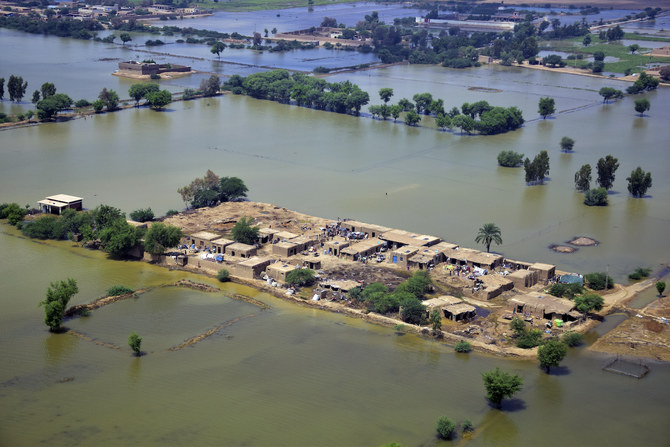
Homes are surrounded by floodwaters in Jaffarabad, a district of Pakistan's southwestern Baluchistan province, Saturday, Sep. 3, 2022. (AP)
Short Url
Updated 03 September 2022
Follow

UK charity group raises $15m for Pakistan flood relief efforts

  • British Muslims dig deep to help devastated country

LONDON: A major British charity group has raised £13.5 million ($15.5 million) to support relief efforts for Pakistan amid the devastating floods.

The Disaster Emergency Committee — a collection of 15 leading charities in Britain — gathered most of the funding from British Muslims across the UK, who dug deep into their pay packets and savings to support the Pakistani people after the committee issued an emergency appeal.

DEC chief executive Saleh Saeed told Sky News that the funds were raised in just over two days, thanking the “hard efforts” from his teams.

The DEC has 11 charitable organizations working in Pakistan — including Cafod, Oxfam, and the Red Cross — in tandem with the government and the UN.

British Muslims have led from the front when supporting the DEC’s relief efforts. Islamic Relief, one of the main charities supported by the DEC, has deployed fundraisers to every other mosque in the country.

In Finsbury Park Mosque in north London, around £6,000 was raised in less than an hour. The rapid fundraising has been all the more extraordinary as Britain braces for its worst cost of living crisis in a generation.

The mosque’s imam, Jamal Abdinasir, told Sky News that empathy and charity should motivate every Muslim.

He said: “Allah tests different people in different ways. Tomorrow it could be us going through a flood, famine, drought, hunger… any difficulty.

“We don’t want that to be us. And should that be us, we are going to find rest in the fact that there are our brothers and sisters across the globe who are going to help.”

Azizur Rahman, one of the Islamic Relief fundraisers, told Sky News: “Our collection is going to help provide emergency aid to those that are vulnerable now. From food packs to emergency hygiene kits, and putting people in shelter.

“A lot of people have lost their homes, so we are setting up temporary accommodation for people, to give them a safe space to stay.”

Even young children dipped into their pocket money to support charity efforts, with Selina Khaider telling Sky News about the importance of compassion.

“Some of them don’t have food. They are suffering. We should help them. It would be very kind to.”


2025 among world’s three hottest years on record, WMO says

Updated 4 sec ago
Follow

2025 among world’s three hottest years on record, WMO says

  • All eight datasets confirmed that the last three years were the planet’s three hottest since records began, the WMO said
  • The slight differences in the datasets’ rankings reflect their different methodologies and types of measurements

BRUSSELS: Last year was among the planet’s three warmest on record, the World Meteorological Organization said on Wednesday, as EU scientists also confirmed average temperatures have now exceeded 1.5 degrees Celsius of global warming for the longest since records began.
The WMO, which consolidates eight climate datasets from around the world, said six of them — including the European Union’s European Center for Medium-Range Weather Forecasts (ECMWF) and the British national weather service — had ranked 2025 as the third warmest, while two placed it as the second warmest in the 176-year record.
All eight datasets confirmed that the last three years were the planet’s three hottest since records began, the WMO said. The warmest year on record was 2024.

THREE-YEAR PERIOD ABOVE 1.5 C AVERAGE ⁠WARMING LEVEL
The slight differences in the datasets’ rankings reflect their different methodologies and types of measurements — which include satellite data and readings from weather stations.
ECMWF said 2025 also rounded out the first three-year period in which the average global temperature was 1.5 C above the pre-industrial era — the limit beyond which scientists expect global warming will unleash severe impacts, some of them irreversible.
“1.5 C is not a cliff edge. However, we know that every fraction of a degree matters, particularly for worsening extreme weather events,” said Samantha Burgess, strategic ⁠lead for climate at ECMWF.
Burgess said she expected 2026 to be among the planet’s five warmest years.

CHOICE OF HOW TO MANAGE TEMPERATURE OVERSHOOT
Governments pledged under the 2015 Paris Agreement to try to avoid exceeding 1.5 C of global warming, measured as a decades-long average temperature compared with pre-industrial temperatures.
But their failure to reduce greenhouse gas emissions means that target could now be breached before 2030 — a decade earlier than had been predicted when the Paris accord was signed in 2015, ECMWF said. “We are bound to pass it,” said Carlo Buontempo, director of the EU’s Copernicus Climate Change Service. “The choice we now have is how to best manage the inevitable overshoot and its consequences on societies and natural systems.”
Currently, the world’s long-term warming level is about 1.4 C above the pre-industrial era, ECMWF said. Measured on a short-term ⁠basis, average annual temperatures breached 1.5 C for the first time in 2024.

EXTREME WEATHER
Exceeding the long-term 1.5 C limit would lead to more extreme and widespread impacts, including hotter and longer heatwaves, and more powerful storms and floods. Already in 2025, wildfires in Europe produced the highest total emissions on record, while scientific studies confirmed specific weather events were made worse by climate change, including Hurricane Melissa in the Caribbean and monsoon rains in Pakistan which killed more than 1,000 people in floods.
Despite these worsening impacts, climate science is facing political pushback. US President Donald Trump, who has called climate change “the greatest con job,” last week withdrew from dozens of UN entities including the scientific Intergovernmental Panel on Climate Change.
The long-established consensus among the world’s scientists is that climate change is real, mostly caused by humans, and getting worse. Its main cause is greenhouse gas emissions from burning fossil fuels like coal, oil and gas, which trap heat in the atmosphere.