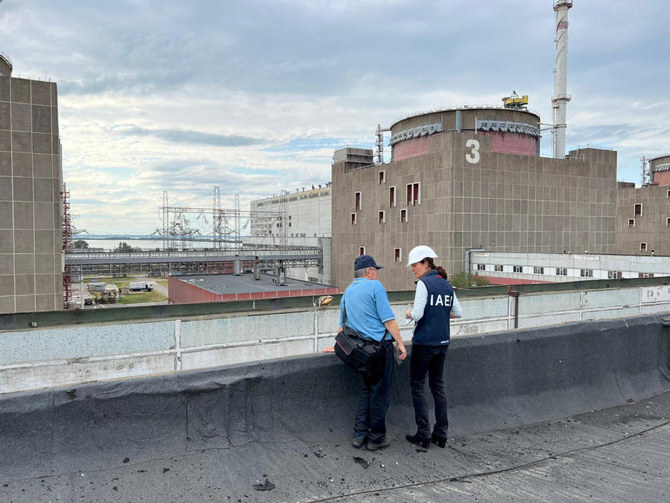
CERNOBBIO, Italy: The International Atomic Energy Agency’s (IAEA) mission to the Zaporizhzhia nuclear plant could still be important despite the difficulties met due to Russian presence at the site, Ukraine’s President Volodymyr Zelensky said on Friday.
“We did everything to ensure that IAEA would get access to the Zaporizhzhia plant and I believe that this mission may still have a role to play,” Zelensky said in a video streamed at The European House, Ambrosetti Forum meeting in northern Italy.
Ukraine’s state nuclear company earlier on Friday said that the IAEA mission had not been allowed to enter the plant’s crisis center, where Ukraine says Russian troops are stationed, and would struggle to make an impartial assessment of the situation.
“Unfortunately we haven’t heard the main thing from the IAEA which is the call from Russia to demilitarize the station,” Zelensky said.
“I hope the mission will comply with what we’ve agreed and that it will serve the interests of the entire international community.”
Zelensky said ensuring the Zaporizhzhia plant returns to operate safely and remains connected to the country’s power grid would help Ukraine to act to counter Europe’s energy crisis.
“Ukraine is ready to increase electricity exports to EU countries,” he said.


Ukrainian leader says IAEA mission could still play a role
https://arab.news/p734z
Ukrainian leader says IAEA mission could still play a role

- The IAEA mission had not been allowed to enter the Zaporizhzhia nuclear plant’s crisis center


EU parliament approves 90-bn-euro loan for Ukraine amid US cuts
- awmakers voted by 458 to 140 in favor of the loan, intended to cover two-thirds of Ukraine’s financial needs for 2026 and 2027
The EU parliament on Wednesday approved a 90-billion-euro loan for Ukraine, providing a financial lifeline to cash-strapped Kyiv four years into Russia’s invasion.
Lawmakers voted by 458 to 140 in favor of the loan, intended to cover two-thirds of Ukraine’s financial needs for 2026 and 2027 and backed by the EU’s common budget — after plans to tap frozen Russian central bank assets fell by the wayside.
Military aid to Ukraine hit its lowest level in 2025 as the US pulled funding, leaving Europe almost alone in footing the bill and averting a complete collapse, the Kiel Institute said Wednesday.
Kyiv's allies allocated 36 billion euros ($42.9 billion) in military aid in 2025, down 14 percent from 41.1 billion euros the previous year, according to Kiel, which tracks military, financial and humanitarian assistance pledged and delivered to Ukraine since Russia's full-scale invasion.
Military aid in 2025 was even lower than in 2022, despite the invasion not taking place until February 24 that year.
US aid came to a complete halt with President Donald Trump's return to the White House in early 2025.
Washington provided roughly half of all military assistance between 2022 and 2024.
European countries have thus made a significant effort to plug the gap, increasing their collective allocation by 67 percent in 2025 compared with the 2022-2024 average.
Without that effort, the US cuts could have been even more damaging, the institute argued.
However, the think tank points to "growing disparities" among European contributors, with Northern and Western European countries accounting for around 95 percent of military aid.
The institute calculated that Northern European countries (Denmark, Estonia, Finland, Iceland, Latvia, Lithuania, Norway, and Sweden) provided 33 percent of European military aid in 2025, despite accounting for only eight percent of the combined GDP of European donor countries.
Southern Europe, which accounts for 19 percent of the combined GDP of European donors, contributed just three percent.
To help fill the gap left by the United States, NATO launched the PURL programme, under which European donors purchased US weapons for Ukraine, worth 3.7 billion euros in 2025.
Kiel called the initiative a "notable development", which had enabled the acquisition of Patriot air-defense batteries and HIMARS multiple-launch rocket systems.
European allies are also increasingly placing orders with Ukraine's own defence industry, following a trend started by Denmark in 2024.
War-torn Ukraine's defence production capacity has "grown by a factor of 35" since 2022, according to Kiel, but Kyiv lacks the funds to procure enough weapons to keep its factories working at full capacity.
Orders from 11 European donor countries helped bridge that gap last year.
In the second half of 2025, 22 percent of weapons purchases for Ukraine were procured domestically, a record high.


