

Senior US official holds ‘fruitful consultations’ on reopening embassy in Libya

1 / 2
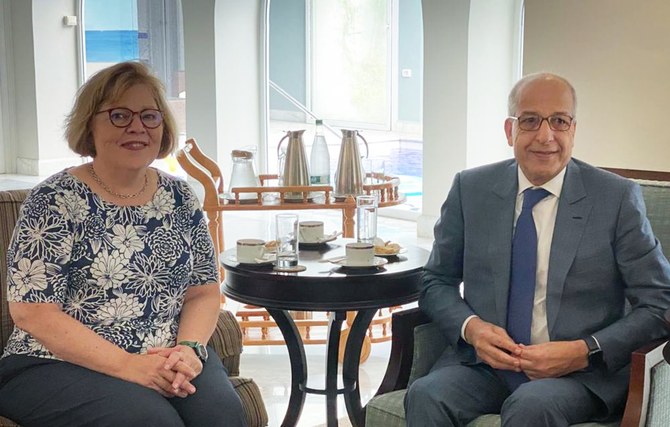
US Assistant Secretary for Near Eastern Affairs Barbara Leaf meets Governor of the Central Bank of Libya Saddek Elkaber. (Twitter/@ StateDept_NEA)
2 / 2
US Assistant Secretary for Near Eastern Affairs Barbara Leaf meets US envoy and ambassador to Libya Richard Norland. (Twitter/@ StateDept_NEA)
Short Url
Updated 01 September 2022
Follow

Senior US official holds ‘fruitful consultations’ on reopening embassy in Libya

  • US Assistant Secretary of State for Near Eastern Affairs said: ‘The sooner the situation stabilizes, the sooner we will be able to resume embassy operations’
  • Barbara Leaf is on an official trip to Tunisia, Israel, the West Bank and Jordan

LONDON: Libya’s full integration into the global economy is being hampered by actors pursuing destabilizing agendas that undermine peace and national unity, the US said on Wednesday.

The comments came after the US Assistant Secretary of State for Near Eastern Affairs Barbara Leaf held separate meetings with Mohammed Al-Menfi, the head of the Libyan Presidential Council, and Richard Norland, the US special envoy and ambassador to Libya.

“(There were) fruitful consultations with (Norland) and the US embassy in Libya team on the prospects for boosting the US diplomatic presence in Libya to promote stability, security cooperation, economic growth and sustainable development,” Leaf said during her visit to Tunisia.

“We eagerly hope that the US embassy can permanently return to Tripoli as soon as possible to provide consular, trade promotion, educational advising, and other services.”


The embassy closed and operations moved to neighboring Tunisia in 2014 because fighting near the capital posed too much of a danger.

“The outbreak of violence in Tripoli this past weekend demonstrates that political figures from both East and West must reconcile, commit to a constitutional basis for elections, and put the interests of the Libyan people ahead of their own,” Leaf said.

Heavy gunfire and shelling last week in several neighborhoods of Tripoli left 32 people dead.

Libya descended into chaos after a NATO-backed uprising in 2011 toppled and claimed the life of longtime dictator Muammar Qaddafi. Since then, the oil-rich county has been split between rival administrations.

“It is tragic that warring factions with their own agendas have been unable to meet the aspirations of millions of Libyans, including students, entrepreneurs, educators and community leaders, who desperately seek to choose the leadership of their country peacefully,” Leaf said.


During a phone call with Al-Menfi, Leaf discussed the recent violence in Tripoli and they agreed that peaceful dialogue to agree a constitutional basis for democratic elections is vital to prevent further instability and conflict.

The State Department said that Leaf noted that the most recent violence has disrupted US efforts to reestablish a diplomatic presence in Libya. She added: “The sooner the situation stabilizes, the sooner we will be able to resume embassy operations.”

Leaf also met Saddek Elkaber, governor of the Central Bank of Libya, in Tunis. During their discussions she underscored the US support for the bank’s “efforts to strengthen transparency in the financial sector to ensure equitable use of public funds for the benefit of all Libyans.”

Meanwhile, the State Department said on Wednesday that Leaf is on an official trip to Tunisia, Israel, the West Bank and Jordan that began on Monday and will continue until Sunday.

In Tunis, in addition to her meetings with Norland and Elkaber, she was set to meet senior government officials and leading local experts, including economic analysts, to hear their views on a path forward to improve prosperity for all Tunisians.

“Her visit underscores US support for an inclusive and transparent political and economic reform process that represents diverse Tunisian voices and protects fundamental human rights, including freedom of expression,” the State Department said.

She will also reiterate the support of the US for a political resolution to the Libyan conflict in talks with senior Libyan and Tunisian officials, as “the recent outbreak of violence in Tripoli demonstrates the urgency for warring factions to reach consensus on a constitutional basis for elections to prevent further instability.”

Leaf will visit Israel and the West Bank from Sept. 1-3, where she will meet Israeli and Palestinian officials to discuss a range of priority issues, including Washington’s commitment to Israel’s security, the strengthening of US cooperation with Israel and the Palestinian Authority, America’s interest in improving the quality of life for the Palestinian people, and the Biden administration’s continued support for a two-state solution.

In Amman, she will meet Jordanian Foreign Minister Ayman Safadi to discuss the strategic relationship between their countries, joint efforts to promote regional stability, and the new seven-year, $10.15 billion bilateral memorandum of understanding on a strategic partnership that was announced by President Joe Biden following his meeting with King Abdullah II in July.


US senator urges military action if Hamas, Hezbollah remained armed

Updated 4 sec ago
Follow

US senator urges military action if Hamas, Hezbollah remained armed

  • Graham’s remarks came a day after mediators urged Hamas and Israel to uphold Gaza ceasefire
  • The 2nd phase of the Gaza truce envisages the demilitarization of the territory, including the disarmament of Hamas

JERUSALEM: US Senator Lindsey Graham called on Sunday for renewed military action against Hamas and Hezbollah if they fail to disarm and accused the Palestinian Islamist group of consolidating its power in Gaza.
The Republican politician, on a visit to Israel, is a staunch ally of US President Donald Trump.
Beginning in October, a fragile ceasefire has so far halted two years of war between Israel and Hamas in the Gaza Strip despite both sides trading accusations of truce violations.
A separate ceasefire between Israel and Lebanon’s Hezbollah also came into effect in November 2024 after more than a year of hostilities, though Israel continues to carry out strikes on Lebanese territory.
Israel has made dismantling the arsenals of both groups, allies of its arch-foe Iran, a key condition for any lasting peace.
“It’s imperative we come up with a plan quickly, put Hamas on a time clock, give them a period of time to achieve the goal of disarmament,” Graham said at a press conference during his visit.
“And if you don’t, I would encourage President Trump to unleash Israel to go finish off Hamas.”
“It’s a long, brutal war, but you cannot be successful anywhere in the region until you deliver in dealing Hamas out of the future of Gaza and disarming them,” Graham added, insisting that the second stage of the truce would fail if Hamas remains armed.
“Ninety days after the ceasefire, they are consolidating power in Gaza,” Graham said.
He also called for military engagement against Hezbollah if it too does not surrender its weapons.
“If Hezbollah refuses to give up their heavy weapons, down the road we should engage in military operations working with Lebanon, Israel and the United States, where we fly with Israel... to take Hezbollah out,” Graham said.

-- Opposition to Turkiye --

The Lebanese government has begun to disarm Hezbollah, starting in the country’s south, and insists it will complete the plan.
Israel, however, has questioned the effectiveness of the Lebanese military, and Hezbollah itself has repeatedly refused to lay down its weapons.
Graham’s remarks came a day after mediators the United States, Qatar, Egypt and Turkiye urged both sides in the Gaza war to uphold the ceasefire.
The mediators are pressing for the implementation of the second phase of the truce, which would involve an Israeli withdrawal from Gaza, the deployment of an international stabilization force and the establishment of an interim authority to govern the territory in place of Hamas.
The second phase of the Gaza truce also envisages the demilitarization of the territory, including the disarmament of Hamas.
Graham backed Israel’s opposition to Turkiye being included in the stabilization force, saying it would “rock Israel to its core.”
“There is no political support anywhere in Israel for having Turkiye being involved in the stabilising force,” he said.
Hamas, meanwhile, has called on the mediators and Washington to stop Israeli “violations” of the ceasefire in Gaza.
On Sunday, Israeli artillery shelling was reported in several parts of Gaza’s southern area of Khan Yunis, according to the civil defense agency, which operates under the authority of Hamas.
On Friday, six people, including two children, were killed in an Israeli bombing of a school serving as a shelter for displaced people, according to the agency.
