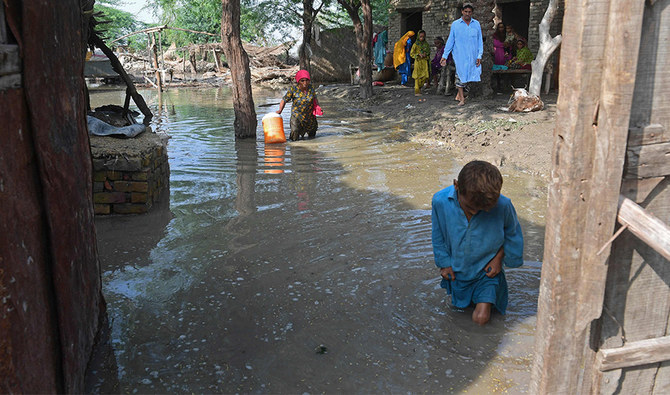

ISLAMABAD: The United Nations (UN) on Tuesday issued a flash appeal for $160 million to help Pakistan cope with catastrophic floods that have killed more than 1,100 people, affected 33 million and destroyed homes, crops and critical infrastructure across the South Asian country.
Early estimates have put the damage from the floods at more than $10 billion, the Pakistani government has said, adding the world was under an obligation to help the South Asian country cope with the effects of climate change.
The appeal was issued by UN Secretary-General Antonio Guterres in his video message during the joint launch of 2022 Pakistan floods response plan by the Pakistani government and the UN simultaneously in Islamabad and Geneva.
“The United Nations is issuing the flash appeal of $160 million to support response led by the government of Pakistan,” Guterres said, adding that this fund would provide 5.2 million people with food, water, sanitation, emergency education, protection and other support.
Pakistan was awash in suffering, he said, the climate catastrophe had killed more than 1,000 people.
“Millions are homeless, schools and health facilities have been destroyed, livelihoods are shattered, critical infrastructure have been wiped out and people’s hopes and dreams are washed away,” the UN secretary-general said.
The Pakistani people were facing a monsoon on steroids and every province of the country had been affected, he said.
“In response of devastation, the government of Pakistan has released funds including immediate cash relief but the scale of needs is rising like the flood waters and it required the world’s collective and prioritized attention,” Gutteres said.
“Let us all step up in solidarity and support to the people of Pakistan in their hour of need.”
Addressing the ceremony, Pakistan’s foreign minister Bilawal Bhutto-Zardari urged the international community to extend their support to Pakistan in these challenging times.
“I would like to urge the international community to give its full backing to the flash appeal to help our people most in need which prioritizes focused interventions in areas of education, food security and agriculture, health, nutrition, protection, shelter and non-food items, and water, sanitation and hygiene,” he said.
“Pakistan has become the ground zero of this century’s biggest existential threat, global warming.”
Seventy-two districts of the country have been declared calamity-hit, with hundreds of thousands of women, children and men displaced and forced to spend days and nights in camps and in open areas under a merciless sky, according to Bhutto-Zardari.
“Lack of access to food, clean water, shelter and basic health care is making life harder for them with each passing day,” he said, adding the country also needs assistance with livelihoods and livestock support as well as relief machinery and equipment.
He said the Pakistani government was cognizant of its responsibilities and had been leading the humanitarian response with invaluable support from the UN and humanitarian partners.
“As part of our national effort, we have earmarked Rs35 billion ($173 million) to help flood-affected people through direct cash transfers,” the foreign minister said.
This money will be disbursed through the Benazir Income Support Programme (BISP) to 1.5 million families, with each receiving Rs25,000 ($115) in immediate cash relief, according to the foreign minister. Another Rs5 billion ($23 million) have been allocated for the National Disaster Management Authority (NDMA) for relief works.
“The Government is also providing Rs1 million ($4,615) in ex-gratia compensation to the next of kin of each deceased, Rs250,000 ($1,154) for injuries and for partially damaged houses and Rs500,000 ($2,308) for destroyed houses,” he said.
Planning Minister Ahsan Iqbal said Pakistan was currently facing the horrors of climate change with unprecedented, devastating flash floods and hill torrents that had washed away roads, homes, crops and communities.
“Almost half of the country’s cotton crop has been washed away, while vegetable, fruit and rice fields have sustained significant damage, posing serious challenges to food security,” he said at the ceremony.
Preliminary estimates of rehabilitation were higher than $10 billion, Iqbal said, adding the Pakistani government was looking forward for assistance from aid agencies, friendly countries and international donors.
Julien Harneis, the UN resident and humanitarian coordinator, said the scale of the catastrophe was beyond comprehension as hundreds of thousands of people had been rendered homeless.
“I spent the last week in the districts of Balochistan and Sindh, there was hundreds of thousands of people on the move and trying to find a secure place,” he said, adding that their hands were stretched out, asking for help.
“This is the time that the international community step up for the people of Pakistan as climate change-driven catastrophe demands international solidarity.”