

Albanian police to help UK Border Force identify, deport migrants 

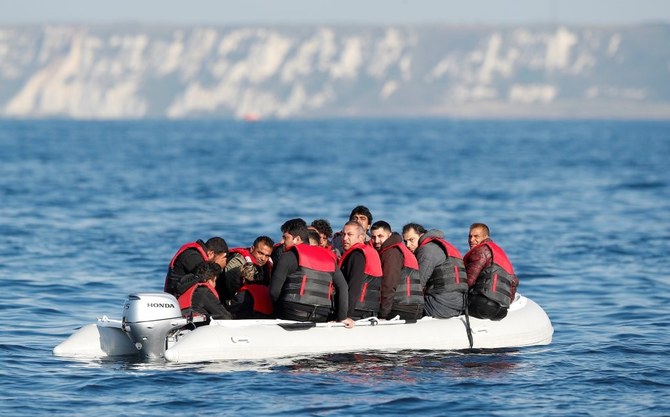
Migrants attempt to cross the English Channel from France to the UK, Aug. 4, 2021. (Reuters)
Short Url
Updated 30 August 2022
Follow

Albanian police to help UK Border Force identify, deport migrants 

  • Home Office figures suggest majority of 25,000 people crossing English Channel come from Balkan country
  • Biometric data to be used to identify Albanians with criminal records in their home country

LONDON: Police from Albania will be drafted to the UK to help identify migrants from the Balkan country arriving in Britain via small boats.

The UK Border Force will be assisted by Albanian officers in fast-tracking deportations of criminals and those with no right to be in the UK through cross-referencing Tirana’s criminal databases via fingerprints and biometric data.

The UK Home Office says up to 60 percent of the more than 25,000 migrants who have entered Britain this year via the English Channel could be from Albania.

Many of their claims for asylum are believed to be “unfounded” as they face “no serious risk of persecution.”

The UK government can refuse entry on suspicion of individuals posing a risk of “serious harm,” whose removal may be “conducive to the public good,” or those with a criminal record.

The proposal to deploy Albanian officers in the UK is thought to have been made by Gledis Nano, general director of the Albanian state police, during a visit to Britain to assess the situation last month, mirroring a similar agreement between Albania and France.

It comes as part of a broader Home Office cooperation agreement with Tirana to remove illegal migrants from the UK, which has included the British government spending £1 million ($1.17 million) on a new police station at Rinas International Airport in the Albanian capital.

Four Albanian police forensic experts are set to meet UK counterparts on Tuesday to discuss funding for DNA processing. 

A source told the Daily Telegraph: “Biometric data will enable (UK) officers to detect any Albanian wanted by Albanian police or who has a criminal background. They (the Albanian officers stationed in the UK) will have two laptops with all the systems and data that Albanian police have.”

A UK Border Force source told the newspaper: “This access would help us immensely, assuming there are no data protection or legal issues that would prevent the Albanian police from receiving biographic and biometric data captured by UK Border Force under UK law to check against their own records.

“It will not only enable us to identify who they are, but also if there are known criminals among them.

“However, there may be a risk in sharing information about asylum seekers with the government of the country they are claiming to fear persecution from — at least before the claim is assessed.”

A Home Office spokesperson said: “Those coming from Albania — a safe and prosperous country — are traveling through multiple countries to make the journey to the UK. Many then make spurious asylum claims when they arrive.

“Asylum claims may be inadmissible if someone travels through a safe third country before reaching the UK.”


WHO appeals for $1 bn for world’s worst health crises in 2026

Updated 58 min 6 sec ago
Follow

WHO appeals for $1 bn for world’s worst health crises in 2026

  • The UN health agency estimated 239 million people would need urgent humanitarian assistance this year and the money would keep essential health services going

GENEVA: The World Health Organization on Tuesday appealed for $1 billion to tackle health crises this year across the world’s 36 most severe emergencies, including in Gaza, Sudan, Haiti and the Democratic Republic of Congo.
The UN health agency estimated 239 million people would need urgent humanitarian assistance this year and the money would keep essential health services going.
WHO health emergencies chief Chikwe Ihekweazu told reporters in Geneva: “A quarter of a billion people are living through humanitarian crises that strip away the most basic protections: safety, shelter and access to health care.
“In these settings, health needs are surging, whether due to injuries, disease outbreaks, malnutrition or untreated chronic diseases,” he warned.
“Yet access to care is shrinking.”
The agency’s emergency request was significantly lower than in recent years, given the global funding crunch for aid operations.
Washington, traditionally the UN health agency’s biggest donor, has slashed foreign aid spending under President Donald Trump, who on his first day back in office in January 2025 handed the WHO his country’s one-year withdrawal notice.
Last year, WHO had appealed for $1.5 billion but Ihekweazu said that only $900 million was ultimately made available.
Unfortunately, he said, the agency had been “recognizing ... that the appetite for resource mobilization is much smaller than it was in previous years.”
“That’s one of the reasons that we’ve calibrated our ask a little bit more toward what is available realistically, understanding the situation around the world, the constraints that many countries have,” he said.
The WHO said in 2026 it was “hyper-prioritising the highest-impact services and scaling back lower?impact activities to maximize lives saved.”
Last year, global funding cuts forced 6,700 health facilities across 22 humanitarian settings to either close or reduce services, “cutting 53 million people off from health care.” Ihekweazu said.
“Families living on the edge face impossible decisions, such as whether to buy food or medicine,” he added, stressing that “people should never have to make these choices.”
“This is why today we are appealing to the better sense of countries, and of people, and asking them to invest in a healthier, safer world.”