

Saudi calligraphers develop unique styles after learning rules of the art

1 / 2
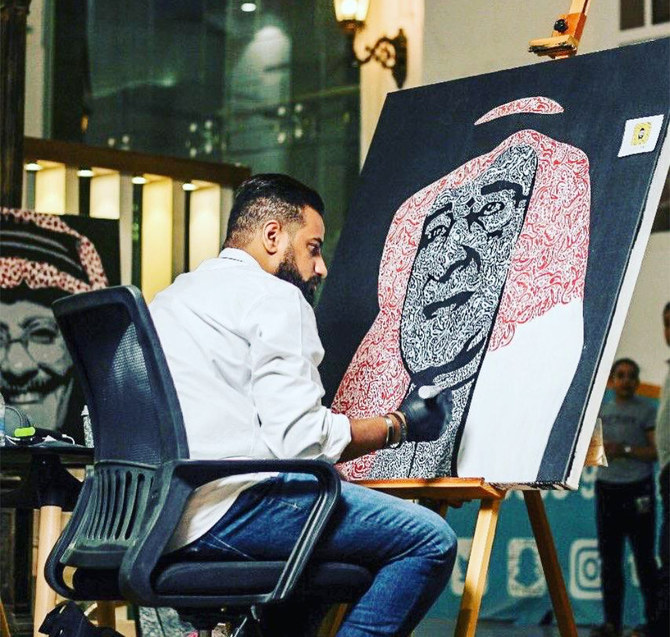
From a distance, Mohammed Bajubair’s artwork looks like accurate portraiture — most famously of members of Saudi Arabia’s royals — but upon closer inspection, the words become clearer. (Supplied)
2 / 2
Mazen Basaqer practicing his art form on different objects. (Supplied)
Short Url
Updated 29 August 2022
Follow

Saudi calligraphers develop unique styles after learning rules of the art

  • Calligraphers Mohammed Bajubair, Mazen Basaqer express creativity in different ways to distinguish artworks

JEDDAH: Calligraphy is an ancient art form practiced for thousands of years, and even today, people continue to employ the medium, which has evolved from merely an aesthetically-pleasing way to transmit the Arabic language, to express their own creativity.

Every artist who practices calligraphy adds something original. One of them is Saudi national Mohammed Bajubair, a 34-year-old calligrapher who has been taking Arabic poems and transcribing them in a way that creates portraits of people.

Typographic art, where words are written to create images, is well suited to the twisting, beautifying and bending of Arabic letters in a way that flows together.

Bajubair’s work is mind-bending, and breathtakingly beautiful. From a distance, it looks like accurate portraiture — most famously of members of the Kingdom’s royals — but upon closer inspection, the words become clearer.

FASTFACT

Mazen Basaqer has used all kinds of mediums for his calligraphy, from painting murals on big walls to tote bags to carving perfume bottles.

“The phrases, words, and poems I use are related to the person I am drawing. There is always a connection between the text I use and the person I have decided to portray,” said Bajubair, explaining how his work brings art and literature together.

He said he discovered this style of drawing “after learning calligraphy properly. I decided to apply the rules of typography to calligraphy and started arranging the calligraphy in a way that looked like realistic portraits. I developed it in my way so I can be distinguished among artists.”

Bajubair said standing out from a crowd of very creative people was his wish, to reach enough people with his artwork and leave a positive imprint for future generations.

The phrases, words, and poems I use are related to the person I am drawing. There is always a connection between the text I use and the person I have decided to portray.

Mohammed Bajubair

There are three great calligraphers who usually define the golden age of Arabic calligraphy: Ibn Muqla (886-940 AD), who is known as the inventor of the Thuluth style of calligraphy; Ibn Al-Buwwab (961-1022) who worked with the round script of the Arabic language, and Yakut Al-Musta’simi of Amasya (who died in 1298) who refined the six styles of Arabic calligraphy.

The six major Arabic calligraphy styles are Thuluth, Nesish, Muhakkak, Reyhami, Teuki, and Rika.

Mazen Basaqer, a calligrapher, defines the form as “like my sanctuary.”

He said that being such a big part of history makes calligraphy a sacred art. Still, to make it his own, he said he practiced the original rules first. “Once I had command over the calligraphy, and I was sure I understood the rules, I started to develop into my style.”

Basaqer has used all kinds of mediums for his calligraphy, from painting murals on big walls to tote bags to carving perfume bottles; he has managed to beautify everything, taking an object and making it a priceless piece of art.

He said that calligraphy has also gone from the physical world to social media, and this way, Arabs can reconnect with their ancient art, and people unacquainted with it can discover it.

“The art of Arabic calligraphy is not (just) an ancient art (but is) present in our current lives at all times. The period we live in can also be considered a golden time because I can reach my audience with just one touch,” said Basaqer.


Surviving the sands: The battle to save Arabian wolves

Updated 13 December 2025
Follow

Surviving the sands: The battle to save Arabian wolves

  • Exploring the wolf’s role in Arabia’s heritage and ecosystem

RIYADH: Wolves are often portrayed in Western stories and films as dangerous, unpredictable predators. In contrast, Arabic perspectives offer a more nuanced view. 

In Saudi Arabia, wolves are admired for their resilience, intelligence, and role in the natural environment. The Arabian wolf, or Canis lupus arabs, is one of the Peninsula’s iconic native predators. 

For centuries, it shaped both ecological and cultural landscapes across Saudi Arabia. However, its population declined in recent decades. Today, conservation efforts led by the National Center for Wildlife aim to protect and restore this species.

Saudi regulations now make it illegal to display, sell, or transport wolves without authorization. NCW’s initiatives include studying wolf genetics, developing breeding programs to restore wild populations, raising public awareness, and imposing fines of up to SR80,000 ($22,000) for unlicensed hunters.

The Arabian wolf, or Canis lupus arabs, is one of the Arabian Peninsula’s iconic native predators. (SPA)

The Arabian wolf is a symbol of the desert and an important component of the Kingdom’s biodiversity. Historically, it inhabited deserts, mountains, and valleys across Saudi Arabia, Yemen, and Oman. Unlike wolves from colder regions, it evolved to survive extreme heat, scarce water, and fluctuating prey populations.

“Saudi Arabia’s vast and diverse ecosystems have enabled many wildlife species to thrive, including the Arabian wolf,” NCW notes. The wolf historically helped control populations of rodents, small mammals, and weak or diseased animals, maintaining a balanced ecosystem.

However, the shift from nomadic life to urban settlements and agriculture, alongside expanding human activity, put increasing pressure on the species. 

Habitat loss, conflicts with herders, and hunting practices significantly reduced their natural range. NCW records show numerous cases of injured wolves rescued and rehabilitated, highlighting the challenges they face today.

DID YOU KNOW?

• In Saudi Arabia, hunting wolves without a proper license can result in fines of up to SR80,000.

• Mexican wolves, locally known as ‘El Lobo,’ are critically endangered, despite ongoing reintroduction efforts.

• While recent figures for Saudi Arabia’s wolf population are not available, a 2004 report estimated their numbers at 500-600.

Culturally, the Arabian wolf is admired and feared in equal measure. In Bedouin tradition, it symbolizes independence and intelligence, appearing in poetry and oral stories.

“Two cultures in the world share a similar view of the wolf: Native American and Arab cultures,” said Obaid Alouni, a Saudi environmentalist. “They admired wolves and respected wolves. For example, when they see a wolf and someone has a gun, they don’t kill it even though they could,” he added.

Alouni explained that despite being predators, wolves coexisted with humans in the Arabian Peninsula: “There was a kind of coexistence in the Arabian Peninsula.” Yet livestock owners often feared wolves for preying on sheep and goats, creating a tense relationship between humans and wolves.

This dual perception shaped the wolf’s role in cultural metaphors: it was seen as a mirror of the desert itself — tough, resilient, and adaptable. “Arabs have always sought positive qualities in wolves. For example, one of their characteristics is that wolves understand their pack and sacrifice themselves for them. They do not betray their pack and fight for it, in addition to their loyalty to it,” Alouni explained.

Protecting wolves is crucial for maintaining healthy ecosystems. Their presence influences herbivore behavior, supporting a balanced environment. (SPA)

Physically, the Arabian wolf is one of the smallest gray wolf subspecies, adapted to desert life. It weighs 18-25 kilograms and measures 100-110 cm in length. Its large ears reduce heat, a light sandy-gray coat reflects sunlight and camouflages it in the desert, and its diet includes small mammals, birds, and occasionally livestock.

Sadly, the Arabian wolf is classified as endangered due to habitat loss, human conflict, and historical hunting. Alouni noted that hybridization has further reduced the population of purebred Arabian wolves: “Unfortunately, a species is now being circulated that is not the true size of the Arabian wolf. The National Center for Wildlife is currently conducting extensive research to learn more about the Arabian wolf and its true size. The species currently prevalent is shorter in stature.”

Other wolf subspecies include the Gray Wolf, found in North America, Europe, and Asia. It weighs 30–80 kilograms, measures up to 180 cm in length, and is known for its complex social packs. 

Opinion

This section contains relevant reference points, placed in (Opinion field)

The Arctic Wolf, native to Arctic Canada and Greenland, has a thick white coat, short snout and ears, and survives extreme cold, preying on musk oxen, Arctic hares, and caribou. 

The Indian Wolf, scientifically known as Canis lupus pallipes, inhabits South and West Asia, weighs 20-30 kilograms, and forms small, stealthy packs. 

Finally, the Ethiopian wolf is fox-like, inhabits highlands above 3,000 meters, weighs 13–18 kilograms, and has a reddish coat with white markings. It is one of the world’s rarest wolves, with fewer than 500 individuals in the wild.

Protecting wolves is crucial for maintaining healthy ecosystems. As apex predators, they regulate prey populations, prevent overgrazing, maintain plant diversity, and reduce disease spread by feeding on sick or weak animals. Their presence influences herbivore behavior, supporting a balanced environment.

The Arabian wolf is more than a desert predator. It is a cultural symbol, a survivor of harsh landscapes, and a vital component of Saudi Arabia’s ecological identity. The work of the NCW is essential: protecting the Arabian wolf means conserving biodiversity, preserving heritage, and sustaining ecological systems across the Arabian Peninsula.