


RAMALLAH: Pictures and a video message posted by Palestinian hunger striker Khalil Al-Awawdeh have shocked Palestinian public opinion and the EU, which criticized Israel’s continued detention of him without trial.
Al-Awawdeh’s message came three days before 4,600 Palestinian inmates in Israeli prisons began an open hunger strike to protest their poor conditions in detention.
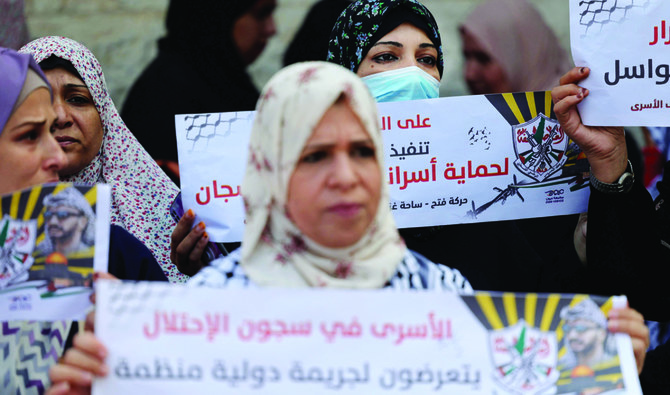
West Bank cities are showing support for Palestinian prisoners in Israeli prisons this week, with Palestinians holding a sit-in in front of the headquarters of the International Committee of the Red Cross there.
Dalal Al-Awawdeh, the wife of the prisoner, appealed to international organizations and Palestinian Authority President Mahmoud Abbas to intervene and urgently release her husband.
Al-Awawdeh, held for more than 170 days, said in his video message: “No to administrative detention, no to administrative detention.”
“We are a people whose cause is just, and it will remain just, and we will remain against administrative detention, even if the flesh and skin melt and the bones vanish, even if the lives are gone,” he said.
“Be confident that we are the rightful owners and that our cause is just, no matter how high the price paid.”
Dalal Al-Awawdeh spoke to Arab News from inside the Israeli Assaf Harofeh Hospital where her husband is in intensive care.
She said that Al-Awawdeh “screams with his thin body to expose this criminal occupation and to tell the world that this prisoner was arrested without charge or trial and only wants freedom.”
Al-Awawdeh was arrested on Dec. 27, 2021 on charges of incitement via Facebook.
The Israeli military court released him on Jan. 5, 2022 because the charges against him had not been proven. However, the Israeli military prosecutor intervened, demanding that Al-Awawdeh be transferred to administrative detention.
It is expected that the Israeli military authorities will release Al-Awawdeh on Oct. 2. However, there is no guarantee that his administrative detention will not be extended so he has decided to continue the hunger strike until his release is confirmed.
The recent Israeli military operation against the Gaza Strip was halted with Egyptian efforts in exchange for the urgent release of Al-Awawdeh.
But the Israeli authorities stalled in implementing the agreement and only temporarily suspended Al-Awawdeh’s detention to allow him to receive medical care.
Palestinian politician Mustafa Barghouti told Arab News that anyone who saw photographs of Al-Awawda would be stunned by his poor condition.
He said that the detainee’s health was in danger and warned of a risky situation in the Palestinian territories if Al-Awawda died in an Israeli prison.
“Israel wants to break the will of the prisoners by breaking the will of return. But I say that this is the battle of the Palestinian people and not the battle of Al-Awawdeh alone,” Barghouti said.
There are 4,600 Palestinian security prisoners in Israeli prisons, detained in 23 Israeli prisons and detention centers.
The figure includes 730 administrative detainees held without trial, based on a secret file submitted by the Shin Bet to the Public Prosecution and the Israeli military judge. It also includes 175 children, 32 women, 600 patients and elderly detainees, the oldest of whom is Fuad Al-Shobaki, aged 82.
There are 250 prisoners who have spent more than 20 years in Israeli detention.
There are 25 prisoners who were detained before the signing of the Oslo agreement between the Palestine Liberation Organization and Israel. The most important of them are Karim and Maher Younis, who have spent 42 years in detention.
While 1,385,000 Palestinian students went to their classrooms on Monday, 175 children did not because they were held in Israeli prisons.


