TASI ends flat on economic uncertainty: Closing bell

The Tadawul All Share Index ended at 12,530, while the parallel Nomu fell 1.16 percent at 21,510.
Short Url
Updated 29 August 2022
Follow

TASI ends flat on economic uncertainty: Closing bell

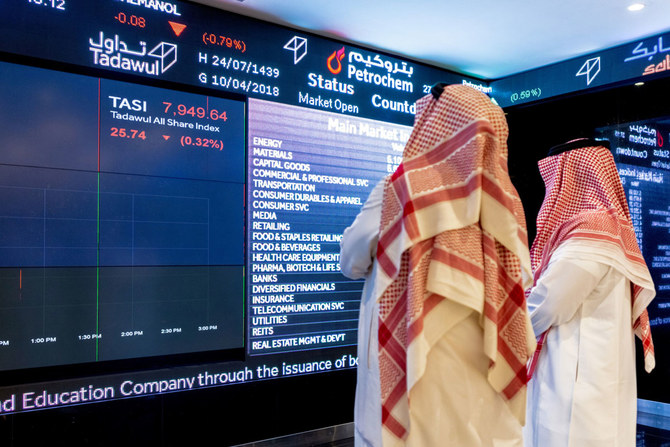
RIYADH: The Saudi stock market mimicked global counterparts with stocks ending almost flat on Monday, as investors worry about inflation-related economic slowdowns.

The Tadawul All Share Index ended at 12,530, while the parallel Nomu fell 1.16 percent at 21,510.

Oil giant Saudi Aramco ended the session with a 0.65 percent decline, while Methanol Chemicals Co. declined 0.13 percent.

In the financial sector, Al Rajhi, the Kingdom’s largest valued bank, advanced 0.44 percent, while the Saudi National Bank, the country’s biggest lender, ended the day flat at SR70.5.

The share price of Alinma Bank added 1.45 percent, while the Saudi British Bank was down 1.33 percent.

In the pharmaceutical sector, Nahdi Medical Co. increased 0.42 percent, while Aldawaa Medical Services Co. gained 1.32 percent.

Saudi Pharmaceutical Industries and Medical Appliances Corp. rose 0.7 percent, after securing SR1.26 billion ($335 million) worth of Shariah-compliant financing to grow the business.

Among the Kingdom’s information technology firms, Elm Co. gained 1.46 percent, while Al Moammar Information Systems Co. improved 0.58 percent.

Saudi healthcare provider Tibbiyah plunged 10.23 percent, after it suffered losses of SR21 million during the first half of the year from profits of SR5.1 million in the prior-year period.


Islamic finance in Oman poised for 25% growth: Fitch 

Updated 01 February 2026
Follow

Islamic finance in Oman poised for 25% growth: Fitch 

RIYADH: Oman’s Islamic finance sector is on track to reach $45 billion this year, rising from $36 billion at the end of 2025, supported by a favorable macroeconomic environment, according to a report by Fitch Ratings. 

The rating agency said the anticipated 25 percent year-on-year growth will be underpinned by increasing demand for sukuk as both a funding mechanism and a public policy tool, alongside government-led initiatives and growing grassroots demand for Shariah-compliant financial products. 

Sukuk accounted for around 60 percent of US dollar-denominated debt issuance in 2025, a sharp decline from 94.3 percent previously, with the remaining share comprising conventional bonds. Despite this progress, Fitch highlighted ongoing structural challenges, including the absence of Islamic treasury bills and derivatives, an underdeveloped Omani rial sukuk and bond market, and the limited role of Islamic non-bank financial institutions. 

The performance of Oman’s banking sector continues to reflect steady advancement toward Vision 2040, the country’s long-term development strategy focused on economic diversification, private sector expansion, and enhanced financial resilience. 

Operating conditions remain supportive for both Islamic and conventional banks in Oman, buoyed by elevated, though gradually moderating, oil prices, the report noted. 

Expanding credit flows — particularly to non-financial corporates and households — are helping drive the growth of small and medium-sized enterprises and boost domestic investment. These trends are reinforcing Oman’s efforts to reduce dependence on hydrocarbons and build a more diversified economic base. 

Fitch projects loan growth of 6 to 7 percent in 2026, fueled by rising demand across both retail and corporate segments. In addition, the proposed 5 percent personal income tax, scheduled for implementation from 2028, is expected to have only a limited overall impact on banks, according to the agency. 

Islamic banking in Oman was introduced following the Central Bank of Oman’s preliminary licensing guidelines issued in May 2011, which allowed the establishment of full-fledged Islamic banks and Islamic banking windows operating alongside conventional institutions. 

This regulatory framework was formally entrenched in December 2012 through a royal decree amending the Banking Law, requiring the creation of Shariah supervisory boards and granting the central bank authority to establish a High Shariah Supervisory Authority.