

Turkey plays down US sanctions threat over Russia ties

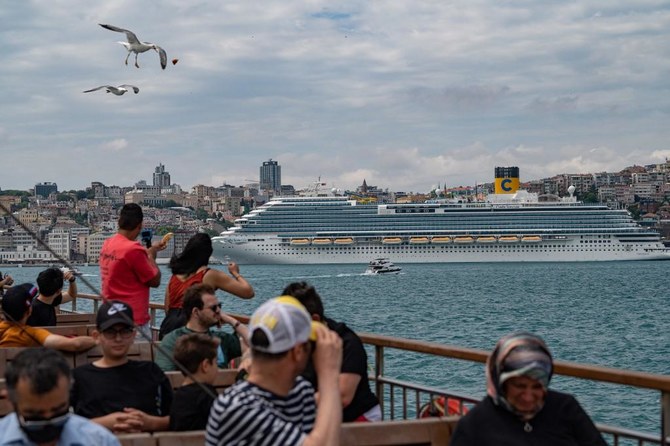
Turkey said it was determined to develop commercial relations with other countries, especially tourism, which is not subject to sanctions. (AFP)
Short Url
Updated 26 August 2022
Follow

Turkey plays down US sanctions threat over Russia ties

  • US warned Turkish banks and companies they would face secondary sanctions if they cooperated with Russians sanctioned in response to the Kremlin’s invasion of Ukraine

ISTANBUL: Turkey’s finance minister told businesses on Friday they should not be concerned by the threat of sanctions that Washington warns will follow if they do business with sanctioned Russians.

Nureddin Nebati’s Twitter comments represent Ankara’s first official response to a letter the US Treasury sent to Turkish businesses on Monday.

US Deputy Secretary of the Treasury Wally Adeyemo warned Turkish banks and companies they would face secondary sanctions if they cooperated with Russians sanctioned in response to the Kremlin’s invasion of Ukraine.

The value of Turkey’s trade with Russia shot up by nearly 50 percent between May and July.

Nebati said the letter should not “cause concern in our business circles. Turkey is one of the most important political and economic power centers in the world.”

NATO member Turkey — on good terms with both Moscow and Kyiv — has tried to stay neutral in the conflict and refused to join the international sanctions.

Turkish President Recep Tayyip Erdogan and Russian counterpart Vladimir Putin agreed to step up economic cooperation at a summit in the Black Sea resort of Sochi earlier this month.

US officials worry that sanctioned Russians are setting up Turkish entities to trade with the outside world.

They are also concerned that European companies are doing the same to circumnavigate EU sanctions imposed on Russian trade.

Nebati said Turkey was “determined to develop our commercial relations with our neighbors in various sectors — especially tourism — within a framework that is not subject to sanctions.”

A part of the US concern stems from Turkey’s decision to transition to paying rubles for the natural gas it imports from the Kremlin-tied giant Gazprom.

Washington is also worried that Russia may be using Turkey to acquire technology whose export has been banned by Washington and the EU.

Data reviewed by The Wall Street Journal showed Russians opening more than 500 companies in Turkey since the start of the year — more than double the number started last year.

Erdogan has argued that Turkey must remain “neutral” in the conflict because its industries rely heavily on Russian energy imports.


Slain son of former Libya ruler Qaddafi to be buried near capital

Updated 9 sec ago
Follow

Slain son of former Libya ruler Qaddafi to be buried near capital

TRIPOLI: The slain son of former Libyan ruler Muammar Qaddafi will be buried in a town south of the capital that remains loyal to the family, relatives said Thursday.
Seif Al-Islam Qaddafi, once seen by some as Libya’s heir apparent, was shot dead on Tuesday in the northwestern city of Zintan.
The burial will be held on Friday in the town of Bani Walid some 175 kilometers south of Tripoli, two of his brothers said.
“The date and location of his burial have been decided by mutual agreement among the family,” half-brother Mohamed Qaddafi said in a Facebook post.
Mohamed said the plan reflected “our respect” for the town, which has remained loyal to the elder Qaddafi years after he was toppled and killed in the 2011 Arab Spring uprisings.
Each year, the town of about 100,000 celebrates the anniversary of a 1969 coup that brought Muammar to power, parading through the streets holding the ex-leader’s portrait.
Saadi Qaddafi, a younger brother, said his dead sibling will be “buried among the Werfalla,” an influential local tribe, in a grave next to his brother Khamis Qaddafi, who died during the 2011 unrest.
Marcel Ceccaldi, a French lawyer who had been representing Seif Al-Islam, told AFP he was killed by an unidentified “four-man commando” who stormed his house on Tuesday.
Seif Al-Islam had long been widely seen as his father’s heir. Under the elder Qaddafi’s iron-fisted 40-year rule, he was described as the de facto prime minister, cultivating an image of moderation and reform despite holding no official position.
But that reputation soon collapsed when he promised “rivers of blood” in retaliation for the 2011 uprising.
He was arrested that year on a warrant issued by the International Criminal Court for alleged crimes against humanity, and a Tripoli court later sentenced him to death, although he was later granted amnesty.
In 2021 he announced he would run for president but the elections were indefinitely postponed.
He is survived by four out of six siblings: Mohamed, Saadi, Aicha and Hannibal, who was recently released from a Lebanese prison on bail.
Libya has struggled to recover from chaos that erupted after the 2011 uprising. It remains split between a UN-backed government based in Tripoli and an eastern administration backed by Khalifa Haftar.