US warns of sanctions against Turkey over Russia ties

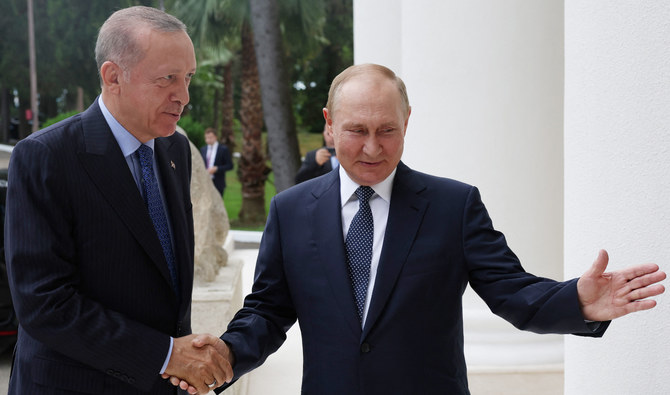
Russia's President Vladimir Putin (R) shaking hands with Turkish President Recep Tayyip Erdogan on August 5, 2022. (AFP/File)
Short Url
Updated 25 August 2022
Follow

US warns of sanctions against Turkey over Russia ties

ISTANBUL: Turkey’s top business association has confirmed receiving a letter from the US Treasury warning of possible sanctions if it continues doing business with Russia.

Washington is growing increasingly alarmed that the Russian government and businesses are using Turkey to evade Western financial and trading restrictions imposed in response to the Kremlin’s invasion of Ukraine six months ago.

Turkish President Recep Tayyip Erdogan and Russian counterpart Vladimir Putin agreed to step up economic cooperation at a summit in the Black Sea resort of Sochi earlier this month.

Official data show the value of Turkish exports to Russia between May and July growing by nearly 50 percent from last year’s figure.

Turkey’s imports of Russian oil are ballooning and the two sides have agreed to transition to ruble payments for the natural gas exported by the Kremlin-tied giant Gazprom.

US Deputy Secretary of the Treasury Wally Adeyemo paid a rare visit to Ankara and Istanbul in June to express Washington’s worries that Russian oligarchs and big businesses were using Turkish entities to avoid Western sanctions.

NATO member Turkey — on good terms with both Moscow and Kyiv — has tried to stay neutral in the conflict and refused to join the international sanctions regime.

Adeyemo followed that up with a letter to Turkey’s TUSIAD business association and the American Chamber of Commerce in Turkey warning that companies and banks were in danger of being sanctioned themselves.

TUSIAD said in a statement on Tuesday that is has passed on the letter to Turkey’s foreign and finance ministries.

The letter’s contents were first reported by The Wall Street Journal this week.

“Any individuals or entities providing material support to US-designated persons are themselves at risk of US sanctions,” Adeyemo wrote.

“Turkish banks cannot expect to establish corresponding relationships with sanctioned Russian banks and retain their corresponding relationships with major global banks as well as access to the US dollar and other major currencies.”

The economic cooperation agreement sealed by Erdogan and Putin includes a deal for more Turkish banks to start processing Russia’s Mir payments system.

Turkish officials have not formally responded to Adeyemo’s letter.

Broader cooperation with Russia could help support Turkey’s ailing economy in the runup to next-year’s general election.

Erdogan has previously argued that Ankara cannot join Western sanctions on Moscow because of Turkey’s heavy dependence on Russian oil and natural gas imports.

“Our economy is such that imposing sanctions on Russia would harm Turkey the most,” Erdogan’s foreign policy adviser Ibrahim Kalin said in June.

“We have taken a clear approach. Right now, the Westerners have accepted this.”

Tourism on hold as Middle East war casts uncertainty

Updated 58 min 39 sec ago
Follow

Tourism on hold as Middle East war casts uncertainty

  • Cancelled flights, postponed trips and a great deal of uncertainty: the war in the Middle East is casting a long shadow over the tourism outlook for the region

PARIS: Cancelled flights, postponed trips and a great deal of uncertainty: the war in the Middle East is casting a long shadow over the tourism outlook for a region that has become a prized destination for travelers worldwide.
“My last group of tourists left three days ago, and all the other groups planned for March have been canceled,” said Nazih Rawashdeh, a tour guide near Irbid, in northern Jordan.
“This is the start of the high season here. It’s catastrophic,” he told AFP.
“And yet there’s no problem in Jordan. It’s perfectly safe.”
Across the world, tour operators are scrambling to find solutions for clients stranded in the region or who had trips planned there.
“The priority is getting those already there back home,” said Alain Capestan, president of the French tour operator Comptoir des Voyages.
He said however that the war was also affecting customers who have traveled to other parts of the world, as the Gulf region is home to several major aviation hubs — Dubai, Abu Dhabi and Doha.
Like other companies, the German tour operators surveyed by AFP — Alltours, Dertour, Schauinsland-Reisen — announced they would cover the cost of extra nights for clients stranded in the Middle East. They also canceled trips to the UAE and Oman until at least March 7.
Swiss operator MSC Cruises, which has a ship stranded in Dubai, told AFP on Thursday it was sending five charter flights to airlift nearly 1,000 passengers.
The firm said it expected the passengers to be out of the region by Saturday, without specifying the destinations of the flights or the nationalities of the holidaymakers.
The British travel industry association ABTA said agencies “would not be sending customers to the region for as long as the British Foreign Office advises against all non-essential travel.”
Customers whose holidays were canceled in recent days will be able to rebook or receive a refund, it said.
- Economic impact -
The war is disrupting a sector that had been booming in the region.
According to UN Tourism, in 2025 around 100 million tourists visited the Middle East — nearly seven percent of all international tourists recorded worldwide. That figure had grown three percent year-on-year and 39 percent compared to the pre-pandemic period.
Depending on the destination, Europeans make up a large share of visitors, followed by tourists from South Asia, the Americas, and other Middle Eastern countries.
For example, nearby markets accounted for 26 percent of total visitors to Dubai in 2025, according to its Ministry of Tourism and Economy.
Against this backdrop analysts Oxford Economics warns that “a decline in tourist flows to the region will deal a more severe economic blow than in the past, as tourism’s share of GDP has grown, as has employment in the sector.”
“We estimate inbound arrivals to the Middle East could decline 11-27 percent year-on-year in 2026 due to the conflict, compared to our December forecast that projected 13 percent growth,” said Director of Global Forecasting Helen McDermott.
That would translate, according to the firm, to between 23 and 38 million fewer international visitors compared to the prior scenario, and a loss of $34 to $56 billion in tourist spending.
After Covid and then the conflict in Gaza, tourists had been coming back, said Rawashdeh, the Jordanian tour guide.
“For the past six months, people working in tourism here had hope. And now there’s a war. This is going to be terrible for the economy,” he said.
“We’ve definitely noticed an understandable slowdown in new bookings from our partners right now, but we fully expect that to bounce back as soon as things settle down and travelers feel more confident,” said Ibrahim Mohamed, marketing director of Middle East Travel Alliance, which offers direct tours to American and British operators.
He remains optimistic: “The Middle East has always been an incredibly resilient market, and demand always bounces back fast once stability returns.”