

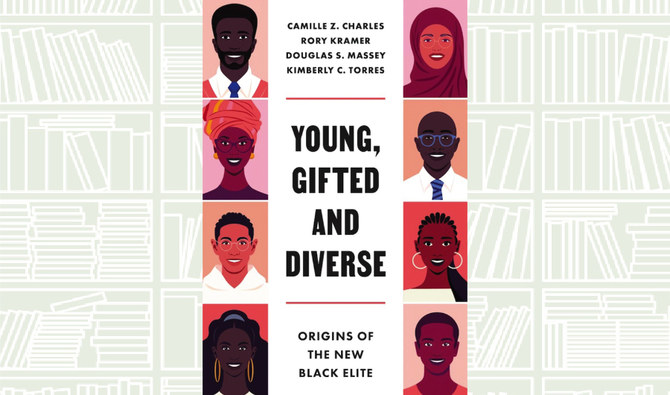
What We Are Reading Today: Young, Gifted and Diverse

Short Url
Updated 26 August 2022
Follow

What We Are Reading Today: Young, Gifted and Diverse

Authors: Camille Z. Charles, Douglas S. Massey, Kimberly C. Torres, and Rory Kramer

Despite their diversity, Black Americans have long been studied as a uniformly disadvantaged group.

Drawing from a representative sample of over a thousand Black students and in-depth interviews and focus groups with over 100 more, Young, Gifted and Diverse highlights diversity among the new educated Black elite—those graduating from America’s selective colleges and universities in the early 21st century.

Differences in childhood experiences shape this generation, including their racial and other social identities and attitudes, and beliefs about and interactions with one another.

While those in the new Black elite come from myriad backgrounds and have varied views on American racism, as they progress through college and toward the Black professional class they develop a shared worldview and group consciousness. They graduate with optimism about their own futures, but remain guarded about racial equality more broadly.

This internal diversity alongside political consensus among the elite complicates assumptions about both a monolithic Black experience and the future of Black political solidarity.


What We Are Reading Today: The Political Economy of Security by Stephen G. Brooks

Updated 04 March 2026
Follow

What We Are Reading Today: The Political Economy of Security by Stephen G. Brooks

In this book, Stephen Brooks provides a systematic empirical and theoretical examination of how economic factors influence security affairs. Empirically, he analyzes how economic variables of all kinds affect interstate war, terrorism, and civil war; in total, 16 pathways are examined.

Brooks shows that the relationship between economic factors and conflict is complex and multifaceted; discrete economic factors—such as international trade, economic development, and globalized manufacturing, to name a few—are sometimes helpful for promoting peace and stability, but at other times are detrimental.

Brooks also develops a stronger theoretical foundation for guiding future research on the economics-security interaction. 

Drawing on Adam Smith, he provides a more complete range of answers to the three key conceptual questions analysts must consider: how economic goals relate to security goals; what economic factors to focus on; and how economic actors influence security policies.

Combining an innovative theoretical understanding with empirical rigor, Brooks’s account will reshape our understanding of the political economy of security.