


KUALA LUMPUR: Jailed Malaysian ex-Prime Minister Najib Razak returned to court Thursday for a second corruption trial over the pilfering of the 1MDB state fund, two days after he began a 12-year prison term for graft.
Najib, 69, became Malaysia’s first leader to be imprisoned Tuesday after the country’s top court rejected his final appeal in his first graft case linked to the looting of the 1Malaysia Development Berhad fund. His incarceration comes four years after his election ouster over the scandal and was celebrated by many citizens as justice served.
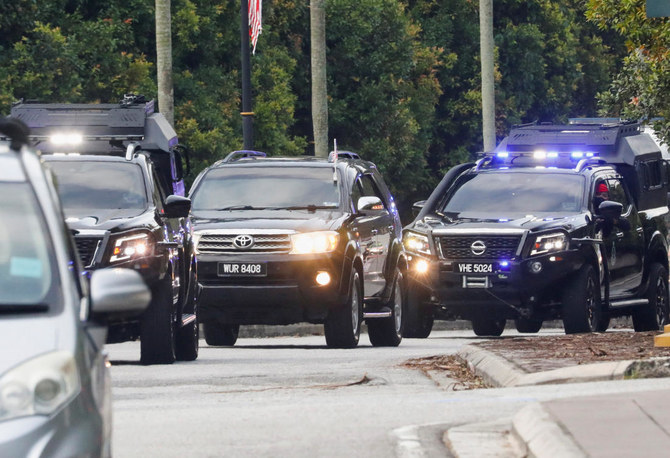
Wearing a dark blue suit, red tie and face mask, Najib sat impassively in the dock without handcuffs as the hearing began. He was earlier brought into the court complex in a tinted police vehicle under heavy security to avoid a crowd of media waiting to catch a glimpse of him.
The current trial began in August 2019 and is the most significant as it ties Najib directly to the 1MDB scandal that has prompted investigations in the US and several other countries. Prosecutors allege Najib pilfered billions of dollars from 1MDB through an “elaborate charade” and then sought to cover his tracks. Najib says he was misled into believing it was a donation from the Saudi Arabia royal family.
Najib faces four charges of abusing his power to obtain 2.3 billion ringgit (more than $700 million in the exchange rate at the time) from 1MDB between 2011 and 2014, and 21 counts of money laundering involving the same amount.
He faces up to 20 years in prison for each count of abuse of power and up to five years for each of the money laundering charges.
1MDB was a development fund that Najib set up shortly after taking power in 2009. Investigators allege more than $4.5 billion was stolen from the fund and laundered by Najib’s associates through layers of bank accounts in the US and other countries to finance Hollywood films and extravagant purchases that included hotels, a luxury yacht, art works and jewelry.
The scandal led to the ouster in 2018 general elections of Najib’s United Malays National Organization, which had been in power since the country’s independence from the British in 1957.
The new government opened investigations into 1MDB that were stifled under Najib’s rule, and blocked Najib and his wife from leaving the country.
Najib faces dozens of charges of criminal breach of trust, graft, abuse of power and money laundering in a total of five criminal cases linked to 1MDB. His wife and other senior government officials have also been hauled to court for corruption.
Najib was found guilty in 2020 of seven charges of corruption for illegally receiving $9.4 million from SRC International, a former unit of 1MDB. The country’s top court affirmed the decision on Tuesday, sending Najib straight to prison to begin his sentence.
Najib has insisted he was misled by fugitive Malaysian financier Low Taek Jho and other bankers into believing the funds entering his personal accounts were an Arab donation. Low, who was identified by US investigators as the mastermind in the pilfering of the fund, is wanted in both the US and Malaysia but has been in hiding.


